Roof Rebecca A, Roman David L, Clements Samuel T, Sobczyk-Kojiro Katarzyna, Blazer Levi L, Ota Shodai, Mosberg Henry I, Neubig Richard R
Department of Pharmacology, University of Michigan,1301 MSRB III SPC 5632, 1150 W, Medical Center Dr, Ann Arbor, MI 48109, USA.
BMC Pharmacol. 2009 May 22;9:9. doi: 10.1186/1471-2210-9-9.
Regulators of G protein signaling (RGSs) accelerate GTP hydrolysis by Galpha subunits and profoundly inhibit signaling by G protein-coupled receptors (GPCRs). The distinct expression patterns and pathophysiologic regulation of RGS proteins suggest that inhibitors may have therapeutic potential. We recently described a focused one-bead, one-compound (OBOC) library screen to identify peptide inhibitors of RGS4. Here we extend our observations to include another peptide with a different mechanism of action.
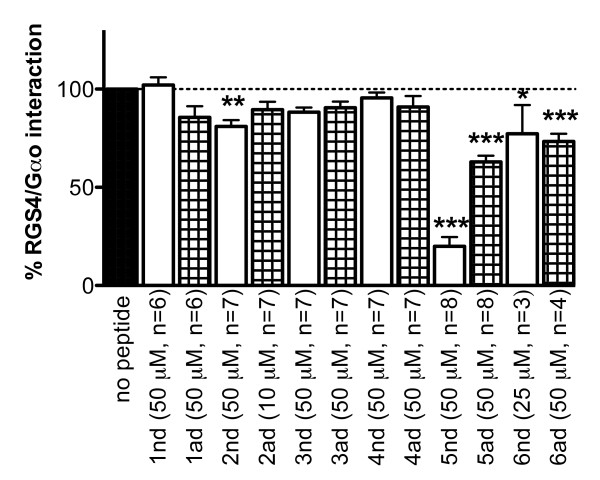
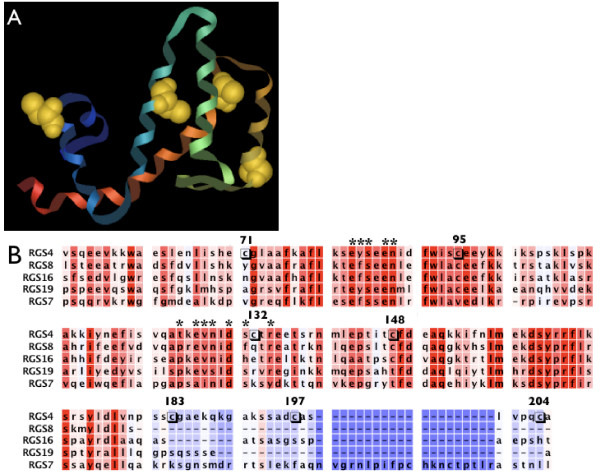
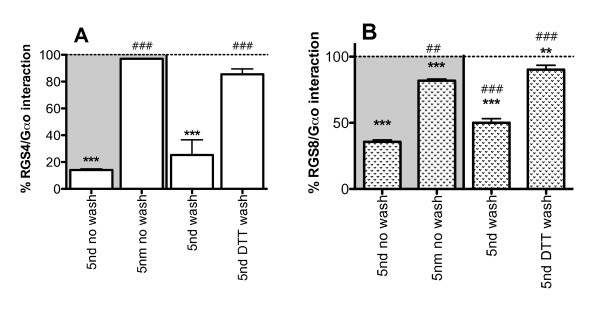
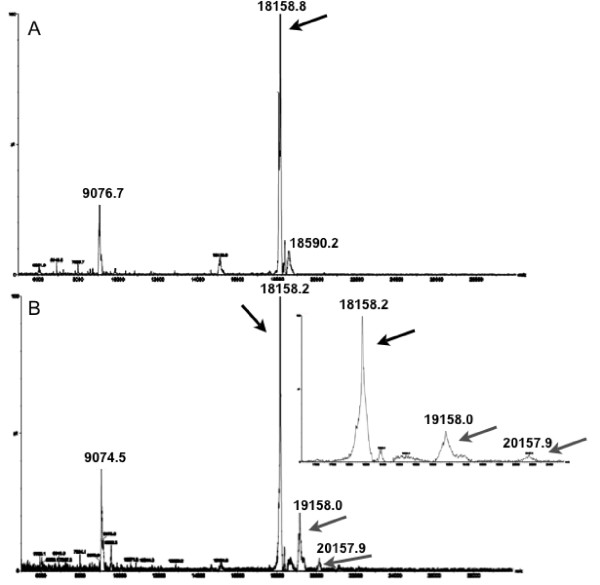
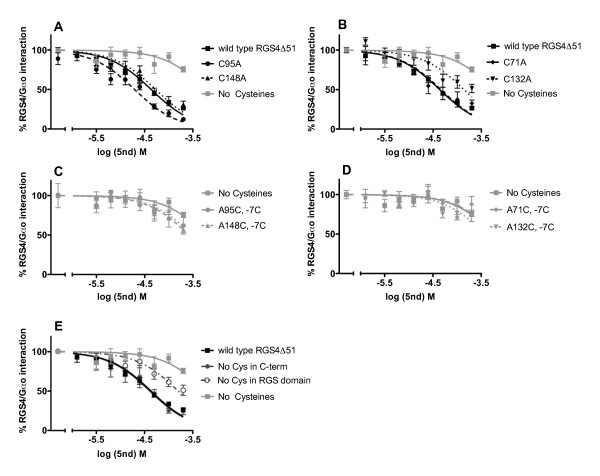
Peptide 5nd (Tyr-Trp-c [Cys-Lys-Gly-Leu-Cys]-Lys-NH2, S-S) blocks the RGS4-Galphao interaction with an IC50 of 28 microM. It forms a covalent, dithiothreitol (DTT) sensitive adduct with a mass consistent with the incorporation of one peptide per RGS. Peptide 5nd activity is abolished by either changing its disulfide bridge to a methylene dithioether bridge, which cannot form disulfide bridges to the RGS, or by removing all cysteines from the RGS protein. However, no single cysteine in RGS4 is completely necessary or sufficient for 5nd activity.
Though it has some RGS selectivity, 5nd appears to be a partially random cysteine modifier. These data suggest that it inhibits RGS4 by forming disulfide bridges with the protein.
G蛋白信号调节因子(RGSs)可加速Gα亚基的GTP水解,并显著抑制G蛋白偶联受体(GPCRs)的信号传导。RGS蛋白独特的表达模式和病理生理调节表明,其抑制剂可能具有治疗潜力。我们最近描述了一种聚焦的单珠单化合物(OBOC)文库筛选,以鉴定RGS4的肽类抑制剂。在此,我们将观察范围扩展至另一种具有不同作用机制的肽。
肽5nd(酪氨酸-色氨酸-c[半胱氨酸-赖氨酸-甘氨酸-亮氨酸-半胱氨酸]-赖氨酸-NH2,S-S)以28微摩尔的半数抑制浓度(IC50)阻断RGS4与Gαo的相互作用。它形成一种共价的、对二硫苏糖醇(DTT)敏感的加合物,其质量与每个RGS掺入一个肽相符。通过将其二硫键改为亚甲基二硫醚键(不能与RGS形成二硫键)或从RGS蛋白中去除所有半胱氨酸,肽5nd的活性均被消除。然而,RGS4中没有单个半胱氨酸对于5nd的活性是完全必要或充分的。
尽管肽5nd具有一定的RGS选择性,但它似乎是一种部分随机的半胱氨酸修饰剂。这些数据表明,它通过与该蛋白形成二硫键来抑制RGS4。