Agabiti-Rosei Enrico, Porteri Enzo, Rizzoni Damiano
Department of Medical and Surgical Sciences, Clinica Medica, University of Brescia, Brescia, Italy.
Vasc Health Risk Manag. 2009;5(1):353-60. doi: 10.2147/vhrm.s3056.
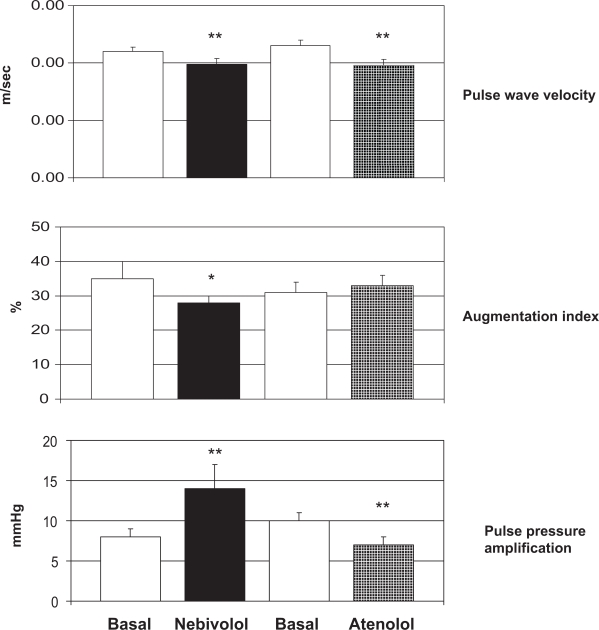
Arterial stiffness plays a key role in the pathophysiology of the cardiovascular system. Some indices of arterial stiffness (pulse wave velocity, augmentation index, characteristics of central blood pressure waveform) may be presently calculated and evaluated in the clinical setting. Age and blood pressure are the two major clinical determinants of increased arterial stiffness, while molecular determinants of arterial stiffness are related to fibrotic components of the extracellular matrix, mainly elastin, collagen and fibronectin. Increased arterial stiffness has been consistently observed in conditions such as hypertension, dyslipidemia and diabetes. Arterial stiffness evaluated by means of carotid-femoral pulse wave velocity yielded prognostic significance beyond and above traditional risk factors. A more favorable effect of calcium channel blockers, diuretics and ACE inhibitors compared with beta-blockers on indices of arterial stiffness was observed in several studies. It is conceivable that newer beta-blockers with additional vasodilating properties, such as nebivolol, which has favorable effects on carbohydrate and lipid metabolism, as well as on endothelial function and on oxidative stress, may have favorable effects on arterial stiffness, compared with atenolol. In fact, in recent studies, nebivolol was demonstrated to improve artery stiffness to a greater extent than older beta-blockers. Because endothelial dysfunction and increased arterial stiffness play an important role in the early atherosclerotic processes and are associated with poor outcomes and increased mortality, independently of blood pressure, the ability of nebivolol to enhance release of endothelium-derived nitric oxide, and consequently improve endothelial function and arterial stiffness, may have significant clinical implications for the use of this agent in the treatment of hypertension and cardiovascular diseases.
动脉僵硬度在心血管系统的病理生理学中起着关键作用。目前,一些动脉僵硬度指标(脉搏波速度、增强指数、中心血压波形特征)可在临床环境中进行计算和评估。年龄和血压是动脉僵硬度增加的两个主要临床决定因素,而动脉僵硬度的分子决定因素与细胞外基质的纤维化成分有关,主要是弹性蛋白、胶原蛋白和纤连蛋白。在高血压、血脂异常和糖尿病等病症中,一直观察到动脉僵硬度增加。通过颈股脉搏波速度评估的动脉僵硬度具有超越传统危险因素的预后意义。在多项研究中观察到,与β受体阻滞剂相比,钙通道阻滞剂、利尿剂和血管紧张素转换酶抑制剂对动脉僵硬度指标具有更有利的影响。可以想象,具有额外血管舒张特性的新型β受体阻滞剂,如奈必洛尔,对碳水化合物和脂质代谢、内皮功能和氧化应激均有有利影响,与阿替洛尔相比,可能对动脉僵硬度有有利影响。事实上,在最近的研究中,奈必洛尔被证明比旧的β受体阻滞剂能更大程度地改善动脉僵硬度。由于内皮功能障碍和动脉僵硬度增加在早期动脉粥样硬化过程中起重要作用,且与不良结局和死亡率增加相关,与血压无关,奈必洛尔增强内皮源性一氧化氮释放的能力,从而改善内皮功能和动脉僵硬度,可能对该药物用于治疗高血压和心血管疾病具有重要的临床意义。