Vider-Shalit Tal, Sarid Ronit, Maman Kobi, Tsaban Lea, Levi Ran, Louzoun Yoram
Department of Mathematics and Gonda Brain Research Center, Bar Ilan University, Ramat Gan, Israel.
Bioinformatics. 2009 Jun 15;25(12):i39-44. doi: 10.1093/bioinformatics/btp221.
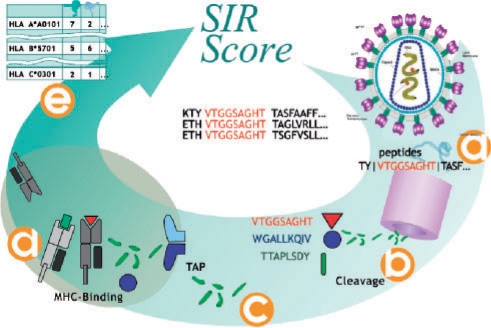
Viruses employ various means to evade immune detection. One common evasion strategy is the removal of CD8+cytotoxic T-lymphocyte epitopes. We here use a combination of multiple bioinformatic tools and large amount of genomic data to compute the epitope repertoire presented by over 1300 viruses in many HLA alleles. We define the 'Size of Immune Repertoire score', which represents the ratio between the epitope density within a protein and the expected density. This score is used to study viral immune evasion.
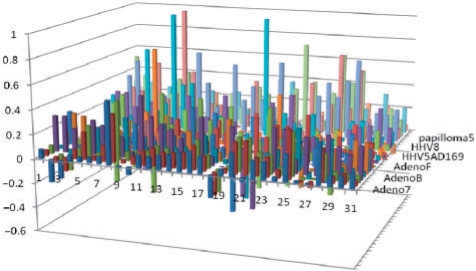
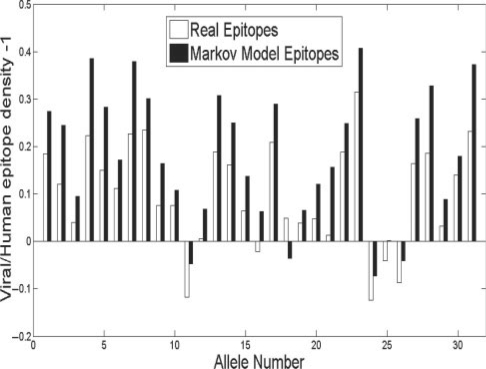
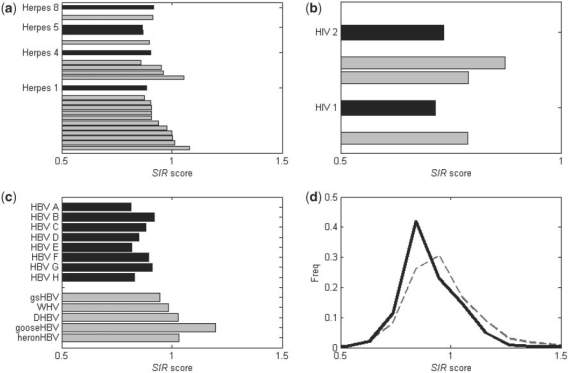
We show that viral proteins in general have a higher epitope density than human proteins. This difference is due to a good fit of the human MHC molecules to the typical amino-acid usage of viruses. Among different viruses, viruses infecting humans present less epitopes than non-human viruses. This selection is not at the amino-acid usage level, but through the removal of specific epitopes. Within a single virus, not all proteins express the same epitopes density. Proteins expressed early in the viral life cycle have a lower epitope density than late proteins. Such a difference is not observed in non-human viruses. The removal of early epitopes and the targeting of the cellular immune response to late viral proteins, allow the virus a time interval to propagate before its host cells are destroyed by T cells.
病毒采用多种手段逃避免疫检测。一种常见的逃避策略是去除CD8 +细胞毒性T淋巴细胞表位。我们在此结合多种生物信息学工具和大量基因组数据,来计算1300多种病毒在多种人类白细胞抗原(HLA)等位基因中呈现的表位库。我们定义了“免疫库大小分数”,它代表蛋白质内表位密度与预期密度之间的比率。该分数用于研究病毒的免疫逃避。
我们发现,病毒蛋白的表位密度总体上高于人类蛋白。这种差异是由于人类主要组织相容性复合体(MHC)分子与病毒典型氨基酸使用情况的良好契合。在不同病毒中,感染人类的病毒呈现的表位比非人类病毒少。这种选择不是在氨基酸使用水平上,而是通过去除特定表位。在单一病毒内,并非所有蛋白质都表达相同的表位密度。在病毒生命周期早期表达的蛋白质的表位密度低于晚期蛋白质。在非人类病毒中未观察到这种差异。早期表位的去除以及细胞免疫反应对病毒晚期蛋白质的靶向作用,使病毒在其宿主细胞被T细胞破坏之前有一个传播的时间间隔。