Ricarte-Filho Julio C, Ryder Mabel, Chitale Dhananjay A, Rivera Michael, Heguy Adriana, Ladanyi Marc, Janakiraman Manickam, Solit David, Knauf Jeffrey A, Tuttle R Michael, Ghossein Ronald A, Fagin James A
Human Oncology and Pathogenesis Program and Departments of Medicine and Pathology, Memorial Sloan-Kettering Cancer Center, New York, New York 10065, USA.
Cancer Res. 2009 Jun 1;69(11):4885-93. doi: 10.1158/0008-5472.CAN-09-0727.
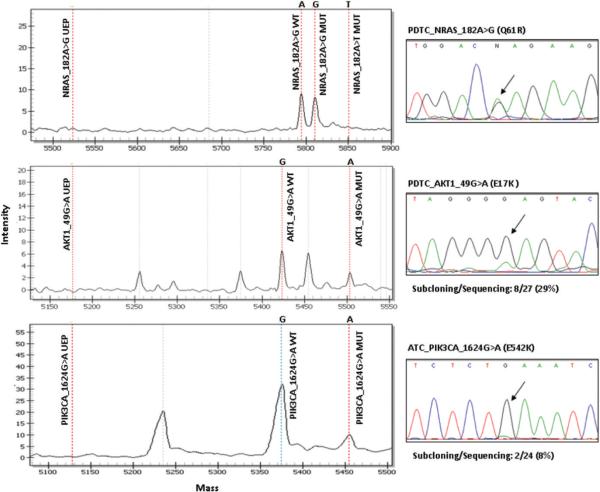
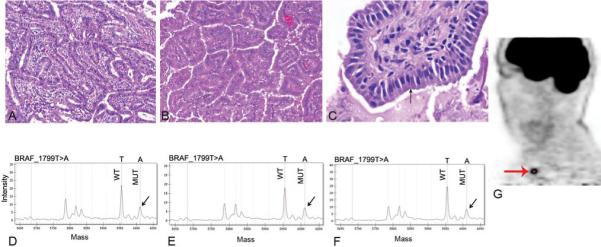
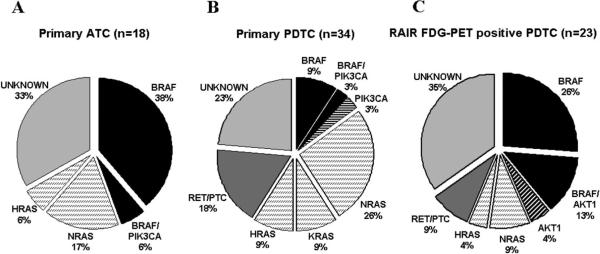
Patients with poorly differentiated thyroid cancers (PDTC), anaplastic thyroid cancers (ATC), and radioactive iodine-refractory (RAIR) differentiated thyroid cancers have a high mortality, particularly if positive on [(18)F]fluorodeoxyglucose (FDG)-positron emission tomography (PET). To obtain comprehensive genetic information on advanced thyroid cancers, we designed an assay panel for mass spectrometry genotyping encompassing the most significant oncogenes in this disease: 111 mutations in RET, BRAF, NRAS, HRAS, KRAS, PIK3CA, AKT1, and other related genes were surveyed in 31 cell lines, 52 primary tumors (34 PDTC and 18 ATC), and 55 RAIR, FDG-PET-positive recurrences and metastases (nodal and distant) from 42 patients. RAS mutations were more prevalent than BRAF (44 versus 12%; P = 0.002) in primary PDTC, whereas BRAF was more common than RAS (39 versus 13%; P = 0.04) in PET-positive metastatic PDTC. BRAF mutations were highly prevalent in ATC (44%) and in metastatic tumors from RAIR PTC patients (95%). Among patients with multiple metastases, 9 of 10 showed between-sample concordance for BRAF or RAS mutations. By contrast, 5 of 6 patients were discordant for mutations of PIK3CA or AKT1. AKT1_G49A was found in 9 specimens, exclusively in metastases. This is the first documentation of AKT1 mutation in thyroid cancer. Thus, RAIR, FDG-PET-positive metastases are enriched for BRAF mutations. If BRAF is mutated in the primary, it is likely that the metastases will harbor the defect. By contrast, absence of PIK3CA/AKT1 mutations in one specimen may not reflect the status at other sites because these mutations arise during progression, an important consideration for therapies directed at phosphoinositide 3-kinase effectors.
低分化甲状腺癌(PDTC)、间变性甲状腺癌(ATC)和放射性碘难治性(RAIR)分化型甲状腺癌患者的死亡率很高,尤其是在[(18)F]氟脱氧葡萄糖(FDG)-正电子发射断层扫描(PET)检查呈阳性时。为了获取晚期甲状腺癌的全面遗传信息,我们设计了一个用于质谱基因分型的检测面板,涵盖了该疾病中最重要的致癌基因:在31个细胞系、52个原发性肿瘤(34个PDTC和18个ATC)以及来自42例患者的55个RAIR、FDG-PET阳性复发和转移灶(淋巴结和远处)中检测了RET、BRAF、NRAS、HRAS、KRAS、PIK3CA、AKT1及其他相关基因的111个突变。在原发性PDTC中,RAS突变比BRAF更常见(44%对12%;P = 0.002),而在PET阳性的转移性PDTC中,BRAF比RAS更常见(39%对13%;P = 0.04)。BRAF突变在ATC(44%)和RAIR PTC患者的转移性肿瘤(95%)中高度常见。在有多个转移灶的患者中,10例中有9例BRAF或RAS突变在样本间具有一致性。相比之下,6例患者中有5例PIK3CA或AKT1突变不一致。在9个标本中发现了AKT1_G49A,仅在转移灶中出现。这是甲状腺癌中AKT1突变的首次记录。因此,RAIR、FDG-PET阳性转移灶中BRAF突变富集。如果原发性肿瘤中BRAF发生突变,转移灶很可能也存在该缺陷。相比之下,一个标本中PIK3CA/AKT1无突变可能并不反映其他部位的情况,因为这些突变是在疾病进展过程中出现的,这对于针对磷酸肌醇3激酶效应器的治疗来说是一个重要的考虑因素。