Genome Center and Bioinformatics Program, University of California, Davis, California, USA.
Mol Brain. 2009 Jun 2;2:14. doi: 10.1186/1756-6606-2-14.
In vitro reactions are useful to identify putative enzyme substrates, but in vivo validation is required to identify actual enzyme substrates that have biological meaning. To investigate in vivo effects of prolyl endopeptidase (PREP), a serine protease, on alpha melanocyte stimulating hormone (alpha-MSH), we developed a new mass spectrometry based technique to quantitate, in multiplex, the various forms of alpha-MSH.
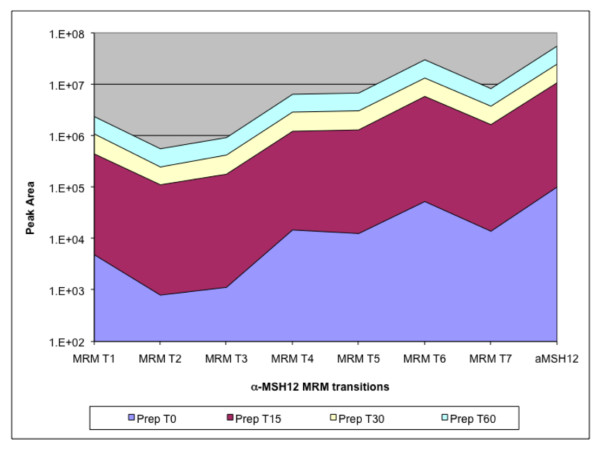
Using Multiple Reaction Monitoring (MRM), we analyzed peptide transitions to quantify three different forms of alpha-MSH. Transitions were first confirmed using standard peptides. Samples were then analyzed by mass spectrometry using a triple quadrupole mass spectrometer, after elution from a reverse phase C18 column by a gradient of acetonitrile.
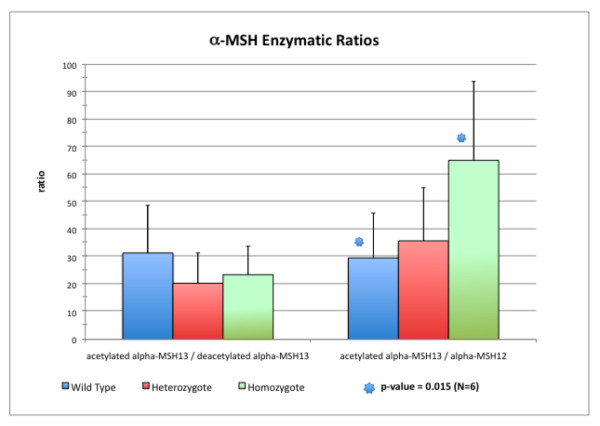
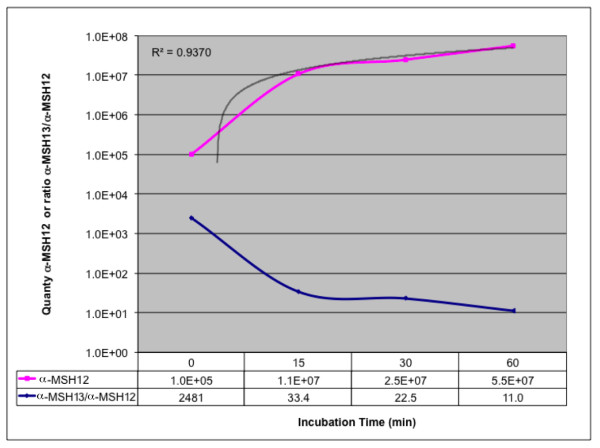
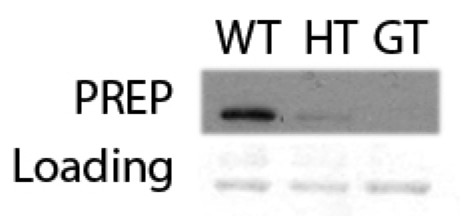
We first demonstrate in vitro that PREP digests biological active alpha melanocyte stimulating hormone (alpha-MSH(1-13)), by cleaving the terminal amidated valine and releasing a truncated alpha melanocyte stimulating hormone (alpha-MSH(1-12)) product--the 12 residues alpha-MSH form. We then use the technique in vivo to analyze the MRM transitions of the three different forms of alpha-MSH: the deacetylated alpha-MSH(1-13), the acetylated alpha-MSH(1-13) and the truncated form alpha-MSH(1-12). For this experiment, we used a mouse model (PREP-GT) in which the serine protease, prolyl endopeptidase, is deficient due to a genetrap insertion. Here we report that the ratio between acetylated alpha-MSH(1-13) and alpha-MSH(1-12) is significantly increased (P-value = 0.015, N = 6) in the pituitaries of PREP-GT mice when compared to wild type littermates. In addition no significant changes were revealed in the relative level of alpha-MSH(1-13) versus the deacetylated alpha-MSH(1-13). These results combined with the demonstration that PREP digests alpha-MSH(1-13) in vitro, strongly suggest that alpha-MSH(1-13) is an in vivo substrate of PREP.
The multiplex targeted quantitative peptidomics technique we present in this study will be decidedly useful to monitor several neuropeptide enzymatic reactions in vivo under varying conditions.
体外反应有助于鉴定潜在的酶底物,但需要进行体内验证才能确定具有生物学意义的实际酶底物。为了研究脯氨酰内肽酶 (PREP) 这种丝氨酸蛋白酶对α-促黑素细胞激素 (α-MSH) 的体内影响,我们开发了一种新的基于质谱的技术,以多重检测的方式定量分析 α-MSH 的各种形式。
使用多重反应监测 (MRM),我们分析了肽转移以定量三种不同形式的 α-MSH。首先使用标准肽确认转移。然后,在通过反相 C18 柱洗脱后,使用三重四极杆质谱仪通过乙腈梯度对样品进行质谱分析。
我们首先在体外证明 PREP 通过切割末端酰胺化的缬氨酸并释放截断的α-促黑素细胞激素 (α-MSH(1-12)) 产物来消化生物活性的α-促黑素细胞激素 (α-MSH(1-13))——这是 12 个残基的α-MSH 形式。然后,我们在体内使用该技术分析三种不同形式的 α-MSH 的 MRM 转移:去乙酰化的α-MSH(1-13)、乙酰化的α-MSH(1-13)和截断形式的α-MSH(1-12)。为此实验,我们使用了一种小鼠模型 (PREP-GT),其中丝氨酸蛋白酶脯氨酰内肽酶由于基因陷阱插入而缺失。在这里,我们报告说,与野生型同窝仔相比,PREP-GT 小鼠垂体中乙酰化的α-MSH(1-13)与α-MSH(1-12)的比值显着增加(P 值=0.015,N=6)。此外,α-MSH(1-13)与去乙酰化的α-MSH(1-13)的相对水平没有明显变化。这些结果结合 PREP 在体外消化α-MSH(1-13)的证明,强烈表明α-MSH(1-13)是 PREP 的体内底物。
我们在这项研究中提出的多重靶向定量肽组学技术将非常有助于在不同条件下监测体内几种神经肽酶反应。