Yasui Yumiko, Tanaka Takuji
Department of Oncologic Pathology, Kanazawa Medical University, 1-1 Daigaku, Uchinada, Ishikawa 920-0293, Japan.
J Carcinog. 2009;8:10. doi: 10.4103/1477-3163.51851.
Chronic inflammation is a risk factor for colorectal cancer (CRC) development. The aim of this study was to determine the differences in protein expression between CRC and the surrounding nontumorous colonic tissues in the mice that received azoxymethane (AOM) and dextran sodium sulfate (DSS) using a proteomic analysis.
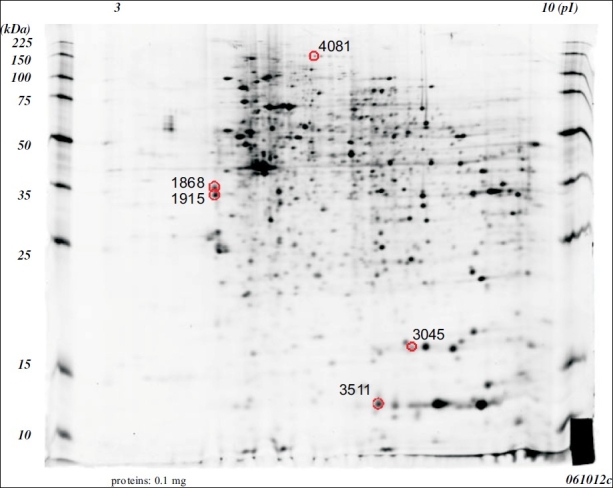
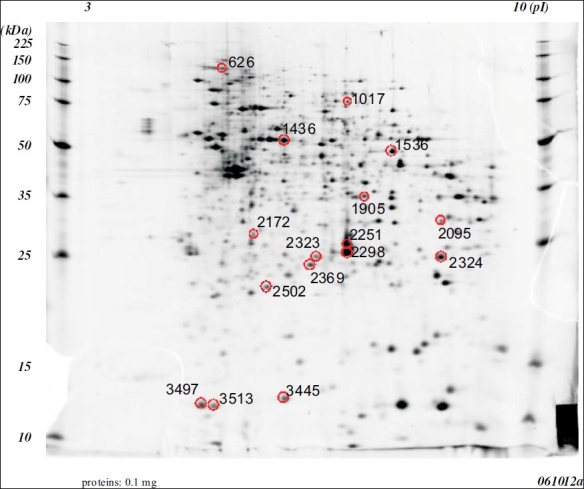
Male ICR mice were given a single intraperitoneal injection of AOM (10 mg/kg body weight), followed by 2% (w/v) DSS in their drinking water for seven days, starting one week after the AOM injection. Colonic adenocarcinoma developed after 20 weeks and a proteomics analysis based on two-dimensional gel electrophoresis and ultraflex TOF/TOF mass spectrometry was conducted in the cancerous and nontumorous tissue specimens.
The proteomic analysis revealed 21 differentially expressed proteins in the cancerous tissues in comparison to the nontumorous tissues. There were five markedly increased proteins (beta-tropomyosin, tropomyosin 1 alpha isoform b, S100 calcium binding protein A9, and an unknown protein) and 16 markedly decreased proteins (Car1 proteins, selenium-binding protein 1, HMG-CoA synthase, thioredoxin 1, 1 Cys peroxiredoxin protein 2, Fcgbp protein, Cytochrome c oxidase, subunit Va, ETHE1 protein, and 7 unknown proteins).
There were 21 differentially expressed proteins in the cancerous tissues of the mice that received AOM and DSS. Their functions include metabolism, the antioxidant system, oxidative stress, mucin production, and inflammation. These findings may provide new insights into the mechanisms of inflammation-related colon carcinogenesis and the establishment of novel therapies and preventative strategies to treat carcinogenesis in the inflamed colon.
慢性炎症是结直肠癌(CRC)发生的一个危险因素。本研究的目的是通过蛋白质组学分析确定接受偶氮甲烷(AOM)和葡聚糖硫酸钠(DSS)处理的小鼠的CRC组织与周围非肿瘤性结肠组织之间蛋白质表达的差异。
雄性ICR小鼠腹腔注射一次AOM(10mg/kg体重),然后在AOM注射一周后,饮用含2%(w/v)DSS的水7天。20周后发生结肠腺癌,并对癌组织和非癌组织标本进行基于二维凝胶电泳和ultraflex TOF/TOF质谱的蛋白质组学分析。
蛋白质组学分析显示,与非肿瘤组织相比,癌组织中有21种差异表达蛋白。有5种蛋白显著增加(β-原肌球蛋白、原肌球蛋白1α异构体b、S100钙结合蛋白A9和一种未知蛋白),16种蛋白显著减少(Car1蛋白、硒结合蛋白1、HMG-CoA合酶、硫氧还蛋白1、1-Cys过氧化物酶蛋白2、Fcgbp蛋白、细胞色素c氧化酶亚基Va、ETHE1蛋白和7种未知蛋白)。
接受AOM和DSS处理的小鼠癌组织中有21种差异表达蛋白。它们的功能包括代谢、抗氧化系统、氧化应激、粘蛋白产生和炎症。这些发现可能为炎症相关结肠癌发生的机制以及建立治疗炎症性结肠癌变的新疗法和预防策略提供新的见解。