Carey Jason P W, Asirvatham Ananthi J, Galm Oliver, Ghogomu Tandeih A, Chaudhary Jaideep
Department of Biology, Center for Cancer Research and Therapeutics Development, Clark Atlanta University, Atlanta, GA 30314, USA.
BMC Cancer. 2009 Jun 7;9:173. doi: 10.1186/1471-2407-9-173.
Inhibitor of differentiation 4 (Id4), a member of the Id gene family is also a dominant negative regulator of basic helix loop helix (bHLH) transcription factors. Some of the functions of Id4 appear to be unique as compared to its other family members Id1, Id2 and Id3. Loss of Id4 gene expression in many cancers in association with promoter hypermethylation has led to the proposal that Id4 may act as a tumor suppressor. In this study we provide functional evidence that Id4 indeed acts as a tumor suppressor and is part of a cancer associated epigenetic re-programming.
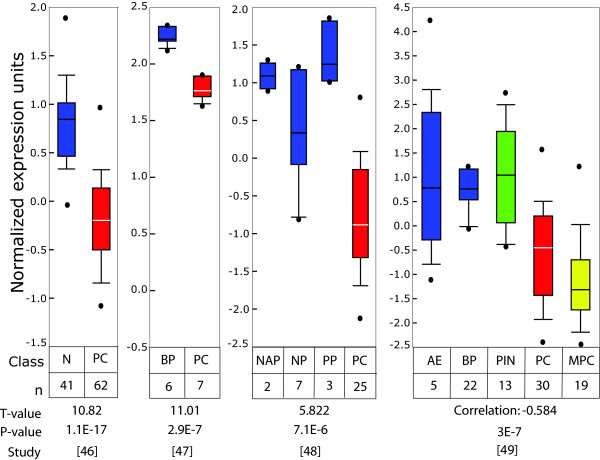
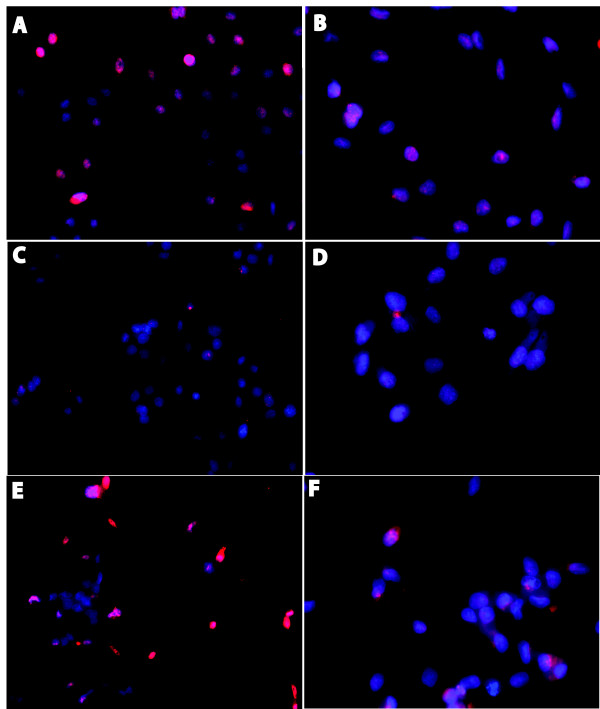
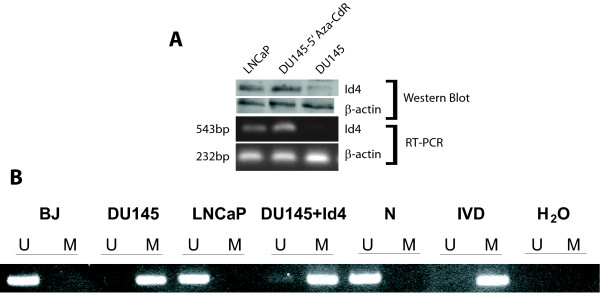
Data mining was used to demonstrate Id4 expression in prostate cancer. Methylation specific polymerase chain reaction (MSP) analysis was performed to understand molecular mechanisms associated with Id4 expression in prostate cancer cell lines. The effect of ectopic Id4 expression in DU145 cells was determined by cell cycle analysis (3H thymidine incorporation and FACS), expression of androgen receptor, p53 and cyclin dependent kinase inhibitors p27 and p21 by a combination of RT-PCR, real time-PCR, western blot and immuno-cytochemical analysis.
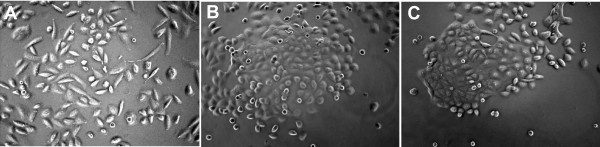
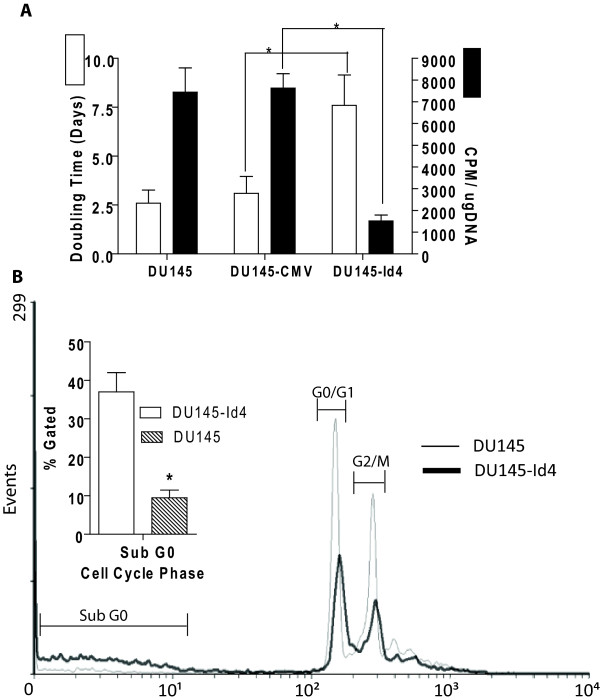
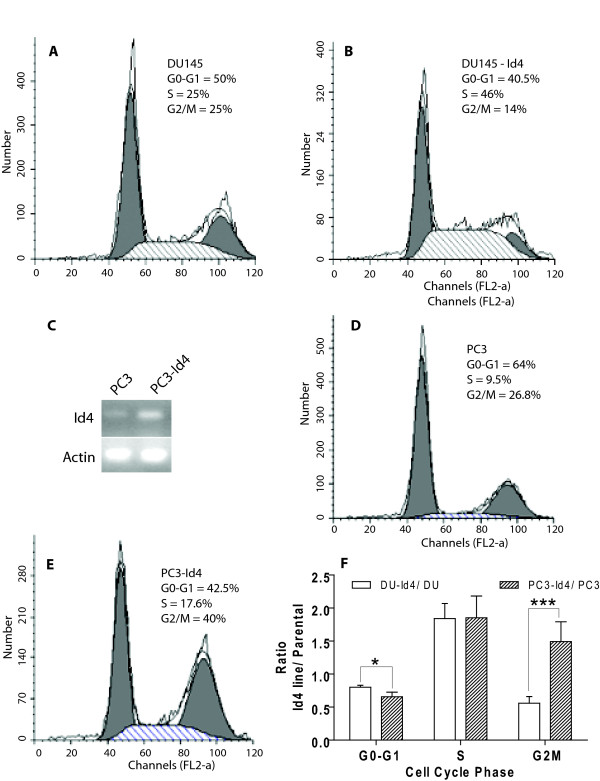
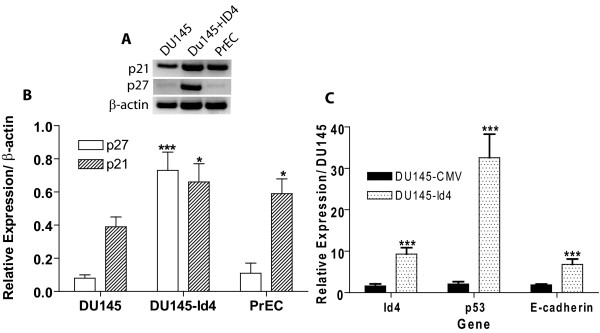
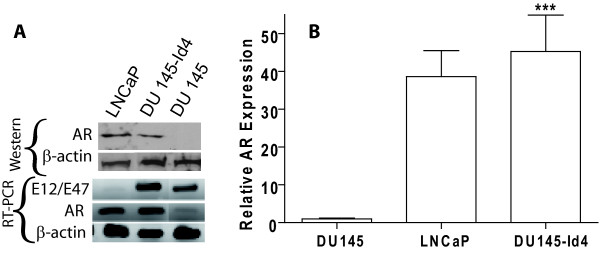
Id4 expression was down-regulated in prostate cancer. Id4 expression was also down-regulated in prostate cancer line DU145 due to promoter hyper-methylation. Ectopic Id4 expression in DU145 prostate cancer cell line led to increased apoptosis and decreased cell proliferation due in part by an S-phase arrest. In addition to S-phase arrest, ectopic Id4 expression in PC3 cells also resulted in prolonged G2/M phase. At the molecular level these changes were associated with increased androgen receptor (AR), p21, p27 and p53 expression in DU145 cells.
The results suggest that Id4 acts directly as a tumor suppressor by influencing a hierarchy of cellular processes at multiple levels that leads to a decreased cell proliferation and change in morphology that is possibly mediated through induction of previously silenced tumor suppressors.
分化抑制因子4(Id4)是Id基因家族的成员,也是碱性螺旋-环-螺旋(bHLH)转录因子的显性负调控因子。与Id基因家族的其他成员Id1、Id2和Id3相比,Id4的一些功能似乎具有独特性。在许多癌症中,Id4基因表达缺失并伴有启动子高甲基化,这使得人们提出Id4可能作为一种肿瘤抑制因子发挥作用。在本研究中,我们提供了功能证据,证明Id4确实作为肿瘤抑制因子发挥作用,并且是癌症相关表观遗传重编程的一部分。
通过数据挖掘来证明Id4在前列腺癌中的表达。进行甲基化特异性聚合酶链反应(MSP)分析,以了解前列腺癌细胞系中与Id4表达相关的分子机制。通过细胞周期分析(3H胸苷掺入和流式细胞术)、逆转录-聚合酶链反应(RT-PCR)、实时定量PCR、蛋白质免疫印迹和免疫细胞化学分析相结合的方法,检测异位表达Id4对DU145细胞中雄激素受体、p53以及细胞周期蛋白依赖性激酶抑制剂p27和p21表达的影响。
Id4在前列腺癌中表达下调。由于启动子高甲基化,Id4在前列腺癌细胞系DU145中的表达也下调。在DU145前列腺癌细胞系中异位表达Id4会导致细胞凋亡增加和细胞增殖减少,部分原因是S期阻滞。除了S期阻滞外,在PC3细胞中异位表达Id4还会导致G2/M期延长。在分子水平上,这些变化与DU145细胞中雄激素受体(AR)、p21、p27和p53表达增加有关。
结果表明,Id4通过影响多个水平的细胞过程层次结构直接作为肿瘤抑制因子发挥作用,这导致细胞增殖减少以及形态改变,这可能是通过诱导先前沉默的肿瘤抑制因子介导的。