Zhang Li-Yun, Yam Gary Hin-Fai, Tam Pancy Oi-Sin, Lai Ricky Yiu-Kwong, Lam Dennis Shun-Chiu, Pang Chi-Pui, Fan Dorothy Shu-Ping
Department of Ophthalmology and Visual Sciences, The Chinese University of Hong Kong, Hong Kong, China.
Mol Vis. 2009 Jun 4;15:1127-38.
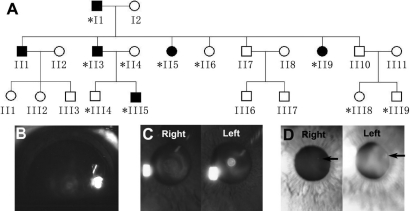
To investigate the clinical features and molecular basis of inherited cataract-microcornea caused by an alphaA-crystallin gene (CRYAA) mutation in a Chinese family.
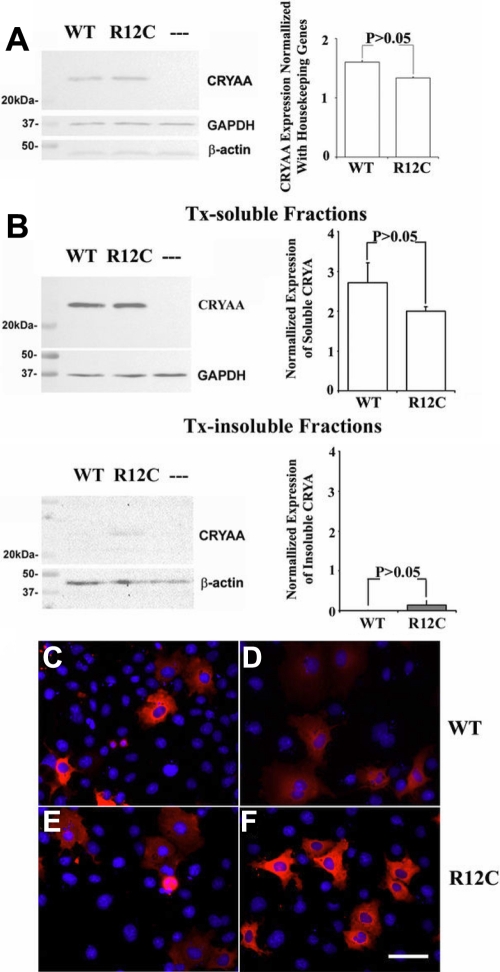
A three-generation Chinese family with members having autosomal dominant cataract and microcornea was recruited. Genomic DNA from peripheral blood or buccal swab samples of five affected and five unaffected members were obtained. Based on 15 genes known to cause autosomal dominant cataract, single nucleotide polymorphisms (SNPs) or microsatellite markers were selected and genotyped for two-point linkage analysis. Direct sequencing was performed to identify the disease-causing mutation. The expression construct coding for recombinant COOH-terminal myc-His-tagged wild type or R12C alphaA-crystallin protein (CRYAA) was expressed in COS-7 cells. Detergent solubility and subcellular distribution of wild type and R12C CRYAA were examined by western blotting and immunofluorescence, respectively. Heat-shock response was monitored by quantitative polymerase chain reaction (qPCR) of heat-shock proteins 70 and 90alpha (HSP70 and HSP90alpha).
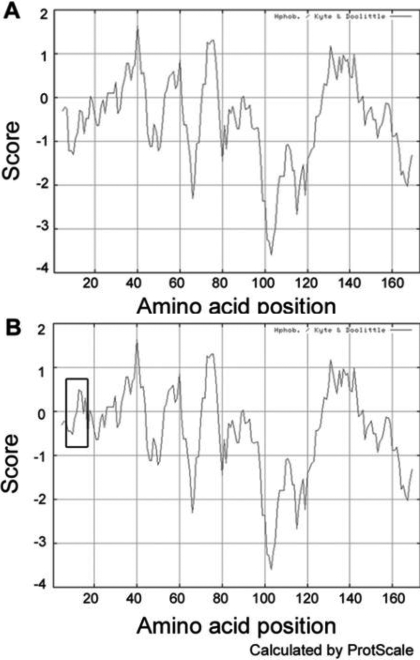
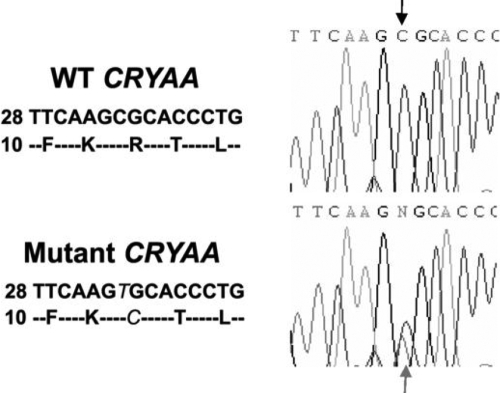
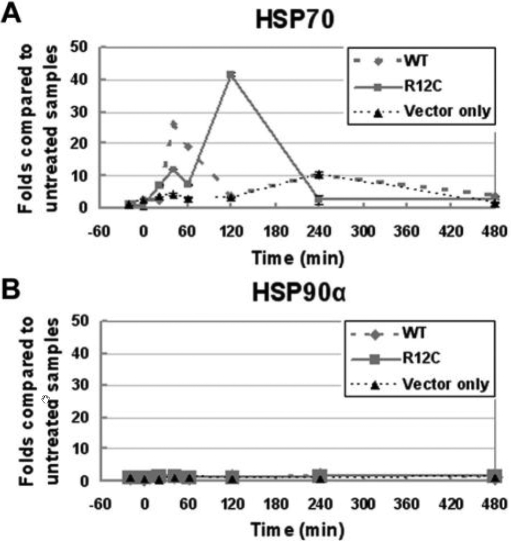
The five affected family members showed variable lens opacities and microcornea. Clinical features of cataract were asymmetric in two eyes of some affected subjects. A heterozygous missense substitution, c.34C>T, in CRYAA, which is responsible for the R12C amino acid change, segregated with autosomal dominant cataract (ADCC) in this family. This substitution was absent in 103 unrelated controls. When expressed in COS-7 cells, the R12C mutant CRYAA resembled the wild type protein in its solubility when extracted with 0.5% Triton X-100 and with its cytoplasmic localization. However, mutant cells exhibited an altered heat-shock response, evidenced by the delayed expression of HSP70, when compared to cells expressing wild type CRYAA.
The R12C mutation in CRYAA was responsible for a variable type of inherited cataract associated with microcornea in this Chinese family. The altered heat-shock response of mutant cells suggested a change of chaperoning capacity and networking, which could be associated with the pathogenesis of hereditary cataract-microcornea syndrome.
研究一个中国家系中由αA-晶体蛋白基因(CRYAA)突变引起的遗传性白内障-小角膜的临床特征和分子基础。
招募了一个三代中国家系,其成员患有常染色体显性白内障和小角膜。获取了5名患病成员和5名未患病成员外周血或口腔拭子样本的基因组DNA。基于已知可导致常染色体显性白内障的15个基因,选择单核苷酸多态性(SNP)或微卫星标记进行基因分型,以进行两点连锁分析。进行直接测序以鉴定致病突变。编码重组COOH末端myc-His标记的野生型或R12C αA-晶体蛋白(CRYAA)的表达构建体在COS-7细胞中表达。分别通过蛋白质免疫印迹和免疫荧光检测野生型和R12C CRYAA的去污剂溶解性和亚细胞分布。通过对热休克蛋白70和90α(HSP70和HSP90α)进行定量聚合酶链反应(qPCR)监测热休克反应。
5名患病家庭成员表现出不同程度的晶状体混浊和小角膜。一些患病受试者双眼白内障的临床特征不对称。CRYAA基因中一个杂合错义替代c.34C>T,导致R12C氨基酸变化,在该家系中与常染色体显性白内障(ADCC)共分离。在103名无关对照中未发现这种替代。当在COS-7细胞中表达时,R12C突变型CRYAA在用0.5% Triton X-100提取时的溶解性及其细胞质定位方面与野生型蛋白相似。然而,与表达野生型CRYAA的细胞相比,突变细胞表现出热休克反应改变,表现为HSP70表达延迟。
CRYAA基因中的R12C突变导致了这个中国家系中一种与小角膜相关的可变型遗传性白内障。突变细胞热休克反应的改变提示伴侣功能和网络的变化,这可能与遗传性白内障-小角膜综合征的发病机制有关。