Antai Diddy, Antai Justina
Division of Global Health & Inequalities, The Angels Trust - Nigeria, Abuja, Nigeria.
BMC Int Health Hum Rights. 2009 Jun 9;9:12. doi: 10.1186/1472-698X-9-12.
The Niger Delta region of Nigeria has been undergoing collective violence for over 25 years, which has constituted a major public health problem. The objectives of this study were to investigate the predictors of women's attitudes toward intimate partner violence in the Niger Delta in comparison to that of women in other parts of Nigeria.
The 2003 Nigeria Demographic and Health Survey was used for this study. Respondents were selected using a stratified two-stage cluster sampling procedure through which 3725 women were selected and interviewed. These women contributed 6029 live born children born to the survey. Internal consistency of the measure of the women's attitudes towards intimate partner violence against a woman was assessed using Cronbach's alpha (alpha). Percentage distributions of the relevant characteristics of the respondents were carried out, and multivariable logistic regression analysis was used to measure the magnitude and direction of the relationship between the outcome and predictor variables were expressed as odds ratios (OR) and statistical significance was determined at the 95 percent confident interval level (CI).
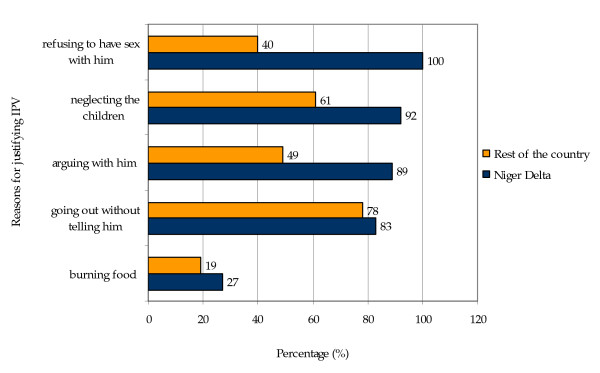
Tolerance for intimate partner violence among the women in the Niger delta (47 percent) was higher than that of women from the rest of the country (42 percent). Rural residence, lower household wealth, lower status occupations, and media access (newspaper and radio) were associated with lower risk of justifying IPV among the women in the Niger Delta. In contrast full or partial autonomy in household decisions regarding food to be cooked, and access to television were associated with a lower risk of justifying violence.
The increased justification of intimate partner violence among the women in the Niger Delta could be explained by a combination of factors, among which are cognitive dissonance theory (attitudes that do not fit with other opinions they hold as a means of coping with their situation), ecological theory (behaviour or attitudes being shaped by current factors in their neighbourhood, community or family), and gender-role attitudes. Further in-depth studies are required to fully understand women's attitudes toward violence in areas of conflict.
尼日利亚的尼日尔三角洲地区经历了超过25年的集体暴力,这已构成一个重大的公共卫生问题。本研究的目的是调查与尼日利亚其他地区的女性相比,尼日尔三角洲地区女性对亲密伴侣暴力态度的预测因素。
本研究使用了2003年尼日利亚人口与健康调查。通过分层两阶段整群抽样程序选择受访者,共选取了3725名女性进行访谈。这些女性生育了6029名参与调查的活产子女。使用克朗巴哈系数(α)评估女性对针对女性的亲密伴侣暴力态度测量的内部一致性。对受访者的相关特征进行百分比分布分析,并使用多变量逻辑回归分析来衡量结果变量与预测变量之间关系的大小和方向,以比值比(OR)表示,在95%置信区间水平(CI)确定统计显著性。
尼日尔三角洲地区女性对亲密伴侣暴力的容忍度(47%)高于该国其他地区的女性(42%)。农村居住、家庭财富较低、职业地位较低以及媒体接触(报纸和广播)与尼日尔三角洲地区女性为亲密伴侣暴力行为辩解的风险较低相关。相比之下,在烹饪食物的家庭决策中拥有完全或部分自主权以及接触电视与为暴力行为辩解的风险较低相关。
尼日尔三角洲地区女性对亲密伴侣暴力行为辩解的增加可能由多种因素共同解释,其中包括认知失调理论(作为应对自身处境的一种方式,态度与她们持有的其他观点不符)、生态理论(行为或态度受到其邻里、社区或家庭当前因素的影响)以及性别角色态度。需要进一步深入研究以全面了解冲突地区女性对暴力的态度。