Zhai G, van Meurs J B J, Livshits G, Meulenbelt I, Valdes A M, Soranzo N, Hart D, Zhang F, Kato B S, Richards J B, Williams F M K, Inouye M, Kloppenburg M, Deloukas P, Slagboom E, Uitterlinden A, Spector T D
Department of Twin Research & Genetic Epidemiology, King's College London, UK.
J Med Genet. 2009 Sep;46(9):614-6. doi: 10.1136/jmg.2009.067314. Epub 2009 Jun 8.
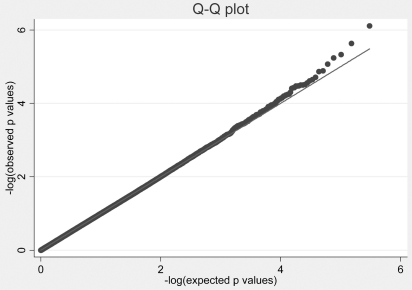
To identify the susceptibility gene in hand osteoarthritis (OA) the authors used a two-stage approach genome-wide association study using two discovery samples (the TwinsUK cohort and the Rotterdam discovery subset; a total of 1804 subjects) and four replication samples (the Chingford Study, the Chuvasha Skeletal Aging Study, the Rotterdam replication subset and the Genetics, Arthrosis, and Progression (GARP) Study; a total of 3266 people). Five single-nucleotide polymorphisms (SNPs) had a likelihood of association with hand OA in the discovery stage and one of them (rs716508), was successfully confirmed in the replication stage (meta-analysis p = 1.81x10(-5)). The C allele conferred a reduced risk of 33% to 41% using a case-control definition. The SNP is located in intron 1 of the A2BP1 gene. This study also found that the same allele of the SNP significantly reduced bone density at both the hip and spine (p<0.01), suggesting the potential mechanism of the gene in hand OA might be via effects on subchondral bone. The authors' findings provide a potential new insight into genetic mechanisms in the development of hand OA.
为了确定手部骨关节炎(OA)的易感基因,作者采用了两阶段全基因组关联研究方法,使用了两个发现样本(TwinsUK队列和鹿特丹发现子集;共1804名受试者)和四个重复样本(Chingford研究、楚瓦什骨骼老化研究、鹿特丹重复子集以及遗传学、关节炎与进展(GARP)研究;共3266人)。在发现阶段,有五个单核苷酸多态性(SNP)与手部OA存在关联可能性,其中一个(rs716508)在重复阶段得到成功确认(荟萃分析p = 1.81x10(-5))。使用病例对照定义,C等位基因使风险降低了33%至41%。该SNP位于A2BP1基因的内含子1中。这项研究还发现,该SNP的相同等位基因显著降低了髋部和脊柱的骨密度(p<0.01),这表明该基因在手部OA中的潜在机制可能是通过对软骨下骨的影响。作者的研究结果为手部OA发展的遗传机制提供了潜在的新见解。