MacGregor A J, Li Q, Spector T D, Williams F M K
School of Medicine, University of East Anglia, Norwich NR4 7TJ, UK.
Rheumatology (Oxford). 2009 Mar;48(3):277-80. doi: 10.1093/rheumatology/ken475. Epub 2009 Jan 19.
To identify whether a shared genetic influence accounts for the occurrence of OA at different skeletal sites.
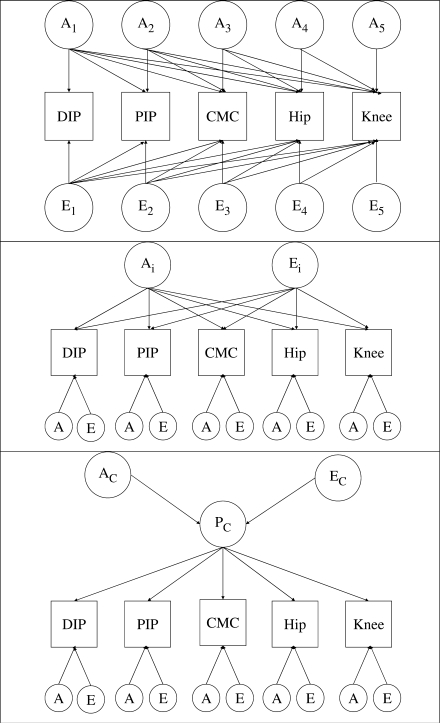
Multivariate modelling of data on prevalent radiographic OA at the hand (DIP, PIP and CMC joints), hip and knee joints assessed in 992 monozygotic and dizygotic female twin participants from the TwinsUK Registry.
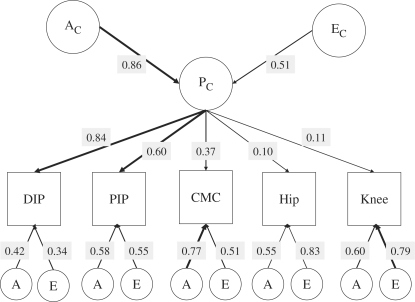
OA at all the five joint sites was heritable. Genetic influences were strongly correlated among joints in the hand; however, there was little evidence of common genetic pathways to account for the co-occurrence of OA at the hand, hip and knee.
While genetic influences are important in explaining the variation in occurrence of OA at the hand, hip and knee, there is no evidence that common or shared genetic factors determine the occurrence of disease across all these skeletal sites. The findings suggest that there are important aetiological differences in the disease that are site-specific in women. These results have implications for the design of studies examining the genetic basis of OA as well as for strategies aimed at preventing and treating the disease.
确定共同的遗传影响是否可解释不同骨骼部位骨关节炎(OA)的发生情况。
对来自英国双胞胎注册库的992名单卵和双卵女性双胞胎参与者的手部(远端指间关节、近端指间关节和掌指关节)、髋关节和膝关节的现患放射学OA数据进行多变量建模。
所有五个关节部位的OA都具有遗传性。手部关节之间的遗传影响高度相关;然而,几乎没有证据表明存在共同的遗传途径来解释手部、髋部和膝部OA的同时发生。
虽然遗传影响在解释手部、髋部和膝部OA发生的差异方面很重要,但没有证据表明共同或共享的遗传因素决定了所有这些骨骼部位疾病的发生。研究结果表明,该疾病存在重要的病因差异,且在女性中具有部位特异性。这些结果对研究OA遗传基础的研究设计以及预防和治疗该疾病的策略具有启示意义。