Division of Allergy and Respiratory System, Department of Oriental Internal Medicine, College of Oriental Medicine, Seoul 130-701, Republic of Korea.
Evid Based Complement Alternat Med. 2011;2011:498138. doi: 10.1093/ecam/nep053. Epub 2011 Feb 17.
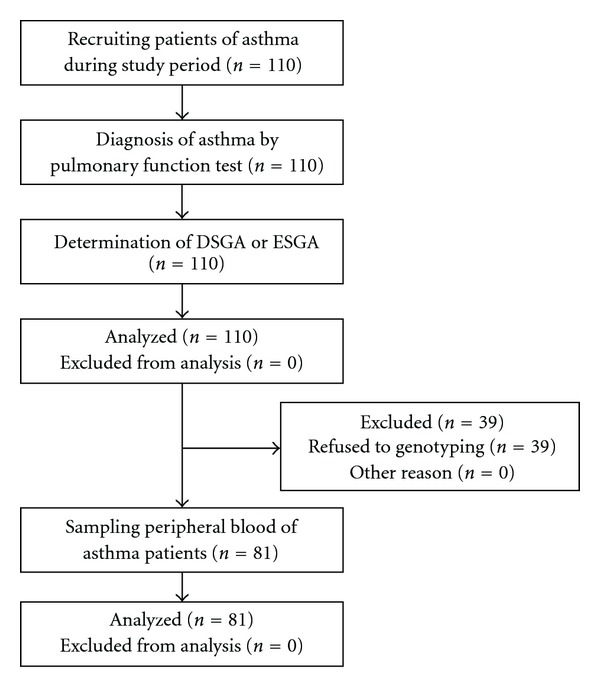
In this study, genetic analysis was conducted to investigate the association of angiotensin I converting enzyme (ACE) gene polymorphism with clinical phenotype based on differentiation-syndrome of bronchial asthma patients. Differentiation-syndrome is a traditional Korean medicine (TKM) theory in which patients are classified into a Deficiency Syndrome Group (DSG) and an Excess Syndrome Group (ESG) according to their symptomatic classification. For this study, 110 participants were evaluated by pulmonary function test. Among them, 39 patients were excluded because they refused genotyping. Of the remaining patients, 52 with DSG of asthma (DSGA) and 29 with ESG of asthma (ESGA), as determined by the differentiation-syndrome techniques were assessed by genetic analysis. ACE insertion/deletion (I/D) polymorphism analysis was conducted using polymerase chain reaction (PCR). Student's t, chi-square, Fisher and Hardy-Weinberg equilibrium tests were used to compare groups. No significant differences in pulmonary function were observed between DSGA and ESGA. The genotypic frequency of ACE I/D polymorphism was found to differ slightly between DSGA and ESGA (P = .0495). However, there were no significant differences in allelic frequency observed between DSGA and ESGA (P = .7006, OR = 1.1223). Interestingly, the allelic (P = .0043, OR = 3.4545) and genotypic (P = .0126) frequencies of the ACE I/D polymorphism in female patients differed significantly between DSGA and ESGA. Taken together, the results presented here indicate that the symptomatic classification of DSGA and ESGA by differentiation-syndrome in Korean asthma patients could be useful in evaluation of the pathogenesis of bronchial asthma.
在这项研究中,我们进行了基因分析,以探讨基于支气管哮喘患者辨证分型的血管紧张素 I 转换酶(ACE)基因多态性与临床表型的关系。辨证分型是一种传统的韩国医学(TKM)理论,根据症状分类将患者分为虚证组(DSG)和实证组(ESG)。在这项研究中,我们通过肺功能测试评估了 110 名参与者。其中,39 名患者因拒绝基因分型而被排除。在剩余的患者中,根据辨证分型技术,52 名哮喘虚证患者(DSGA)和 29 名哮喘实证患者(ESGA)进行了基因分析。采用聚合酶链反应(PCR)进行 ACE 插入/缺失(I/D)多态性分析。采用 Student's t 检验、卡方检验、Fisher 精确检验和 Hardy-Weinberg 平衡检验比较组间差异。DSGA 和 ESGA 之间的肺功能无显著差异。ACE I/D 多态性的基因型频率在 DSGA 和 ESGA 之间略有不同(P=0.0495)。然而,DSGA 和 ESGA 之间的等位基因频率无显著差异(P=0.7006,OR=1.1223)。有趣的是,在女性患者中,ACE I/D 多态性的等位基因(P=0.0043,OR=3.4545)和基因型(P=0.0126)频率在 DSGA 和 ESGA 之间存在显著差异。总之,本研究结果表明,韩国哮喘患者的辨证分型为 DSG 和 ESG 有助于评估支气管哮喘的发病机制。