Acupuncture, Moxibustion and Meridian Research Center, Korea Institute of Oriental Medicine, Daejeon, Republic of Korea.
Evid Based Complement Alternat Med. 2011;2011:798081. doi: 10.1093/ecam/nep240. Epub 2011 Feb 10.
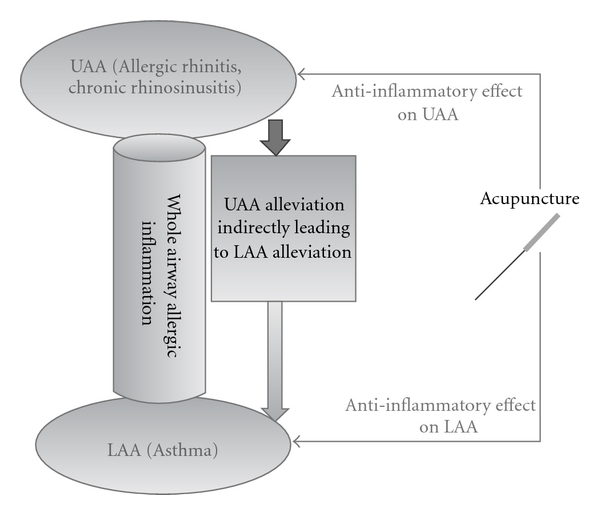
A pathophysiologic relationship between allergic rhinitis and rhinosinusitis and asthma has long been suggested. However, few clinical studies of acupuncture have been conducted on these comorbid conditions. A 48-year-old male suffering from persistent allergic rhinitis with comorbid chronic rhinosinusitis and asthma since the age of 18 years was studied. He complained of nasal obstruction, sneezing, cough, rhinorrhea and moderate dyspnea. He occasionally visited local ear-nose-throat clinics for his nasal symptoms, but gained only periodic symptom relief. The patient was treated with acupuncture, infrared radiation to the face and electro-acupuncture. Needles were inserted at bilateral LI20, GV23, LI4 and EX-1 sites with De-qi. Electro-acupuncture was performed simultaneously at both LI20 sites and additional traditional Korean acupuncture treatments were performed. Each session lasted for 10 min and the sessions were carried out twice a week for 5 weeks. The patient's Mini-Rhinoconjunctivitis Quality-of-Life Questionnaire score decreased from 38, at the beginning of treatment, to 23, 3 weeks after the last treatment. The Total Nasal Symptom Score was reduced from six (baseline) to five, 3 weeks after the last treatment. There was significant clinical improvement in the forced expiratory volume in 1 s-from 3.01 to 3.50 l-with discontinuation of the inhaled corticosteroid, and no asthma-related complaints were reported. Further clinical studies investigating the effectiveness of acupuncture for the patients suffering from allergic rhinitis and/or rhinosinusitis with comorbid asthma are needed.
变应性鼻炎和鼻-鼻窦炎与哮喘之间存在病理生理学关系早已得到证实。然而,针对这些合并症,很少有关于针刺的临床研究。我们研究了一位 48 岁的男性患者,他从 18 岁起就患有持续性变应性鼻炎,伴有慢性鼻-鼻窦炎和哮喘。他主诉有鼻塞、打喷嚏、咳嗽、流涕和中度呼吸困难。他偶尔会去当地耳鼻喉科诊所就诊治疗鼻部症状,但只能获得周期性的症状缓解。该患者接受了针刺、面部红外线辐射和电针治疗。在双侧 LI20、GV23、LI4 和 EX-1 穴位插入针,并获得气感。同时在双侧 LI20 穴位进行电针治疗,并进行额外的传统韩国针刺治疗。每次治疗持续 10 分钟,每周治疗 2 次,共进行 5 周。患者的迷你鼻结膜炎生活质量问卷评分从治疗开始时的 38 分降至治疗结束后 3 周时的 23 分。总鼻部症状评分从 6 分(基线)降至治疗结束后 3 周时的 5 分。在停用吸入性皮质类固醇后,用力呼气量从 3.01 升增加到 3.50 升,患者的第 1 秒用力呼气量有显著临床改善,且无哮喘相关投诉。需要进一步的临床研究来调查针刺治疗患有变应性鼻炎和/或鼻-鼻窦炎合并哮喘的患者的有效性。