Fadnes Bodil, Rekdal Oystein, Uhlin-Hansen Lars
Department of Medical Biochemistry, Institute of Medical Biology, University of Tromsø, Tromsø, Norway.
BMC Cancer. 2009 Jun 15;9:183. doi: 10.1186/1471-2407-9-183.
Cationic antimicrobial peptides (CAPs) with antitumor activity constitute a promising group of novel anticancer agents. These peptides induce lysis of cancer cells through interactions with the plasma membrane. It is not known which cancer cell membrane components influence their susceptibility to CAPs. We have previously shown that CAPs interact with the two glycosaminoglycans (GAGs), heparan sulfate (HS) and chondroitin sulfate (CS), which are present on the surface of most cells. The purpose of this study was to investigate the role of the two GAGs in the cytotoxic activity of CAPs.
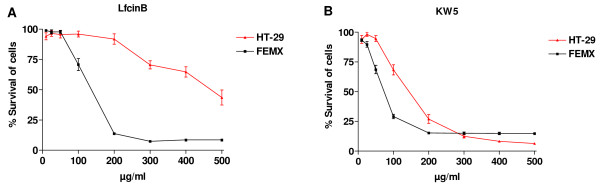
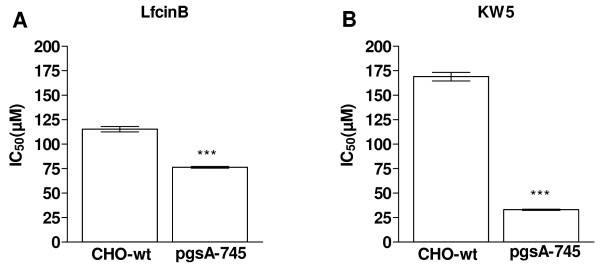
Various cell lines, expressing different levels of cell surface GAGs, were exposed to bovine lactoferricin (LfcinB) and the designer peptide, KW5. The cytotoxic effect of the peptides was investigated by use of the colorimetric MTT viability assay. The cytotoxic effect on wild type CHO cells, expressing normal amounts of GAGs on the cell surface, and the mutant pgsA-745, that has no expression of GAGs on the cell surface, was also investigated.
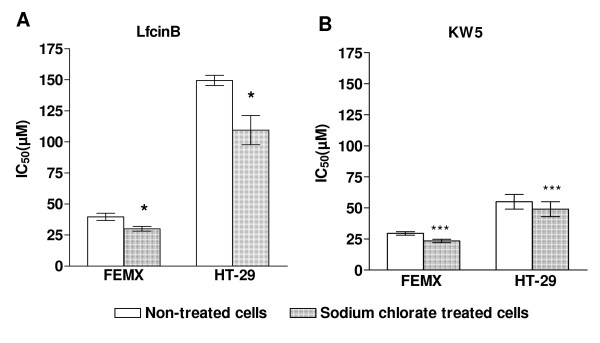
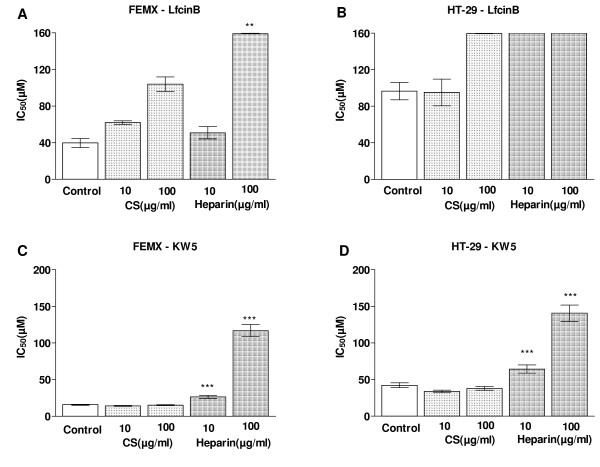
We show that cells not expressing HS were more susceptible to CAPs than cells expressing HS at the cell surface. Further, exogenously added heparin inhibited the cytotoxic effect of the peptides. Chondroitin sulfate had no effect on the cytotoxic activity of KW5 and only minor effects on LfcinB cytotoxicity.
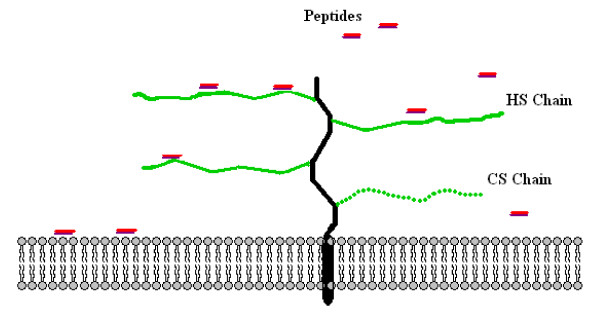
Our results show for the first time that negatively charged molecules at the surface of cancer cells inhibit the cytotoxic activity of CAPs. Our results indicate that HS at the surface of cancer cells sequesters CAPs away from the phospholipid bilayer and thereby impede their ability to induce cytolysis.
具有抗肿瘤活性的阳离子抗菌肽(CAPs)是一类很有前景的新型抗癌药物。这些肽通过与质膜相互作用诱导癌细胞裂解。目前尚不清楚哪些癌细胞膜成分会影响其对CAPs的敏感性。我们之前已经表明,CAPs与大多数细胞表面存在的两种糖胺聚糖(GAGs),即硫酸乙酰肝素(HS)和硫酸软骨素(CS)相互作用。本研究的目的是探讨这两种GAGs在CAPs细胞毒性活性中的作用。
将表达不同水平细胞表面GAGs的各种细胞系暴露于牛乳铁蛋白(LfcinB)和设计肽KW5。通过比色MTT活力测定法研究肽的细胞毒性作用。还研究了对细胞表面表达正常量GAGs的野生型CHO细胞和细胞表面不表达GAGs的突变体pgsA - 745的细胞毒性作用。
我们发现不表达HS的细胞比细胞表面表达HS的细胞对CAPs更敏感。此外,外源性添加的肝素抑制了肽的细胞毒性作用。硫酸软骨素对KW5的细胞毒性活性没有影响,对LfcinB的细胞毒性只有轻微影响。
我们的结果首次表明癌细胞表面带负电荷的分子会抑制CAPs的细胞毒性活性。我们的结果表明癌细胞表面的HS将CAPs从磷脂双层中隔离出来,从而阻碍其诱导细胞溶解的能力。