Hwang Jaewon, Kim Soyoun, Lee Daeyeol
Department of Brain and Cognitive Sciences, University of Rochester Rochester, NY, USA.
Front Behav Neurosci. 2009 Jun 11;3:9. doi: 10.3389/neuro.08.009.2009. eCollection 2009.
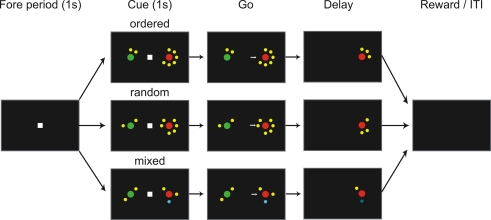
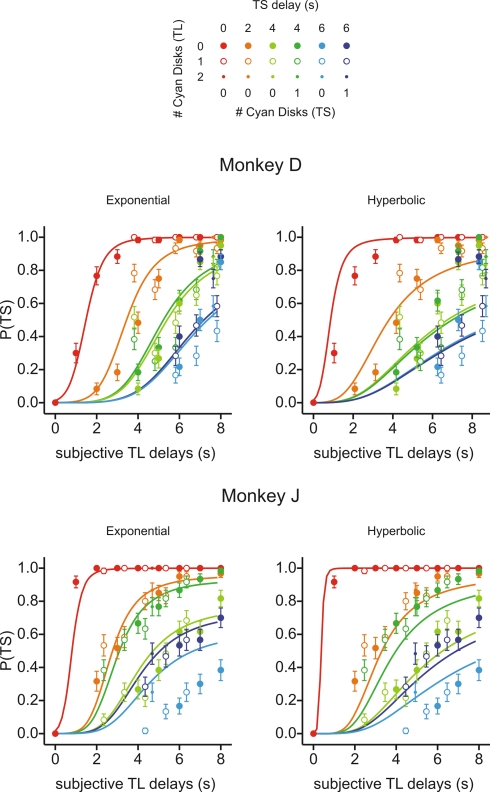
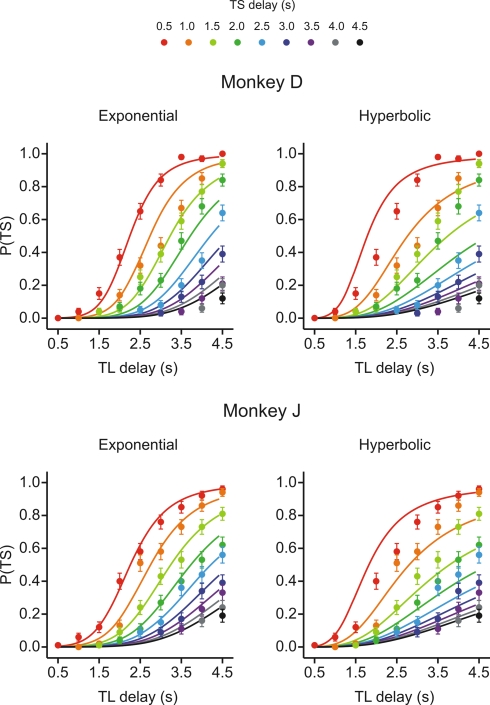
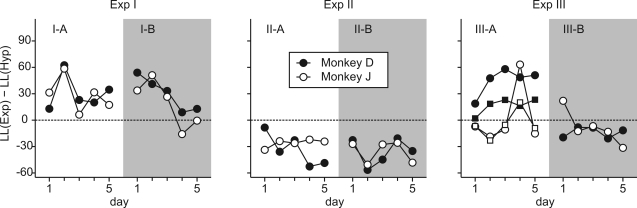
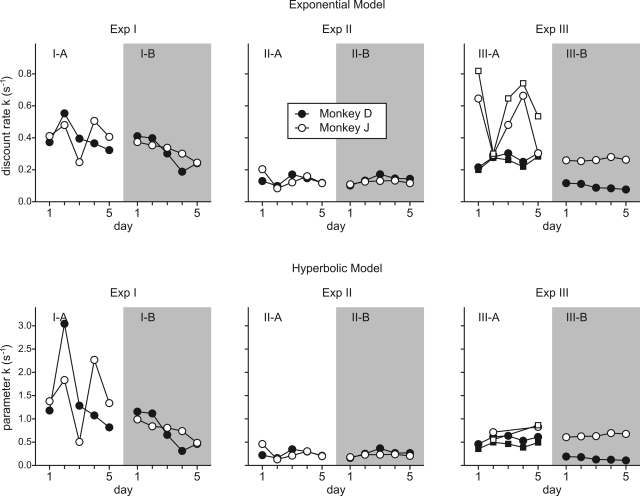
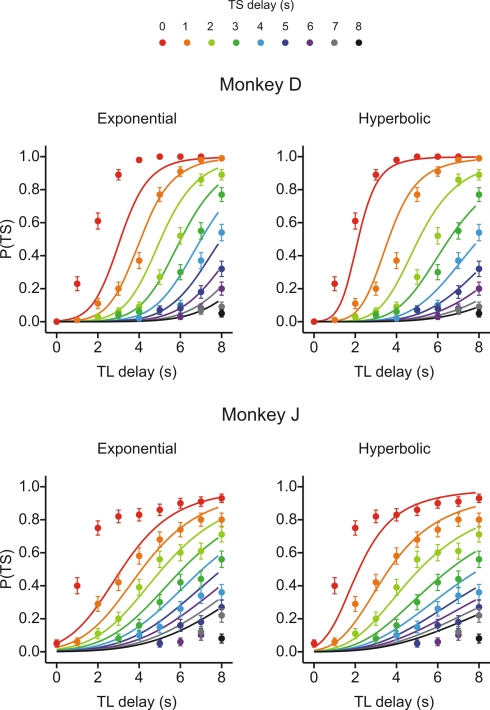
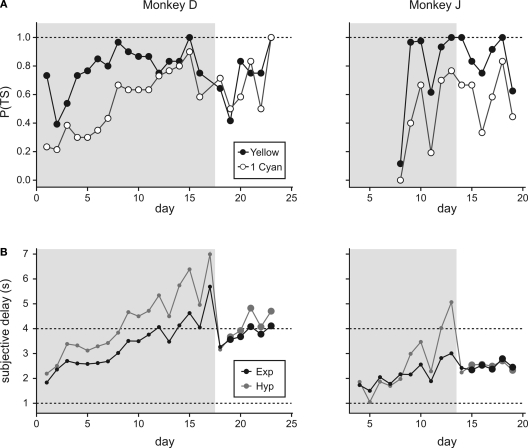
Humans and animals are more likely to take an action leading to an immediate reward than actions with delayed rewards of similar magnitudes. Although such devaluation of delayed rewards has been almost universally described by hyperbolic discount functions, the rate of this temporal discounting varies substantially among different animal species. This might be in part due to the differences in how the information about reward is presented to decision makers. In previous animal studies, reward delays or magnitudes were gradually adjusted across trials, so the animals learned the properties of future rewards from the rewards they waited for and consumed previously. In contrast, verbal cues have been used commonly in human studies. In the present study, rhesus monkeys were trained in a novel inter-temporal choice task in which the magnitude and delay of reward were indicated symbolically using visual cues and varied randomly across trials. We found that monkeys could extract the information about reward delays from visual symbols regardless of the number of symbols used to indicate the delay. The rate of temporal discounting observed in the present study was comparable to the previous estimates in other mammals, and the animal's choice behavior was largely consistent with hyperbolic discounting. Our results also suggest that the rate of temporal discounting might be influenced by contextual factors, such as the novelty of the task. The flexibility furnished by this new inter-temporal choice task might be useful for future neurobiological investigations on inter-temporal choice in non-human primates.
与获得同等大小但延迟的奖励相比,人类和动物更有可能采取能带来即时奖励的行动。尽管延迟奖励的这种贬值几乎普遍用双曲线折扣函数来描述,但这种时间折扣的速率在不同动物物种之间有很大差异。这可能部分归因于奖励信息呈现给决策者的方式不同。在以往的动物研究中,奖励延迟或大小在各试验中逐渐调整,因此动物从它们之前等待和消耗的奖励中了解未来奖励的属性。相比之下,在人类研究中通常使用语言提示。在本研究中,恒河猴接受了一项新的跨期选择任务训练,其中奖励的大小和延迟用视觉提示象征性地表示,并在各试验中随机变化。我们发现,无论用于表示延迟的符号数量如何,猴子都能从视觉符号中提取有关奖励延迟的信息。本研究中观察到的时间折扣速率与之前在其他哺乳动物中的估计相当,并且动物的选择行为在很大程度上与双曲线折扣一致。我们的结果还表明,时间折扣速率可能受情境因素影响,如任务的新颖性。这种新的跨期选择任务所提供的灵活性可能对未来关于非人类灵长类动物跨期选择的神经生物学研究有用。