Silveira Erica Duarte, Alves-Ferreira Márcio, Guimarães Larissa Arrais, da Silva Felipe Rodrigues, Carneiro Vera Tavares de Campos
Embrapa Genetic Resources and Biotechnology, Parque Estação Biológica, PqEB Av, W5 Norte (final) Caixa Postal 02372, Brasília, Brasil.
BMC Plant Biol. 2009 Jul 2;9:84. doi: 10.1186/1471-2229-9-84.
Brachiaria brizantha is an important forage grass. The occurrence of both apomictic and sexual reproduction within Brachiaria makes it an interesting system for understanding the molecular pathways involved in both modes of reproduction. Quantitative real time PCR (qRT-PCR) has emerged as an important technique to compare expression profile of target genes and, in order to obtain reliable results, it is important to have suitable reference genes. In this work, we evaluated eight potential reference genes for B. brizantha qRT-PCR experiments, isolated from cDNA ovary libraries. Vegetative and reproductive tissues of apomictic and sexual B. brizantha were tested to validate the reference genes, including the female gametophyte, where differences in the expression profile between sexual and apomictic plants must occur.
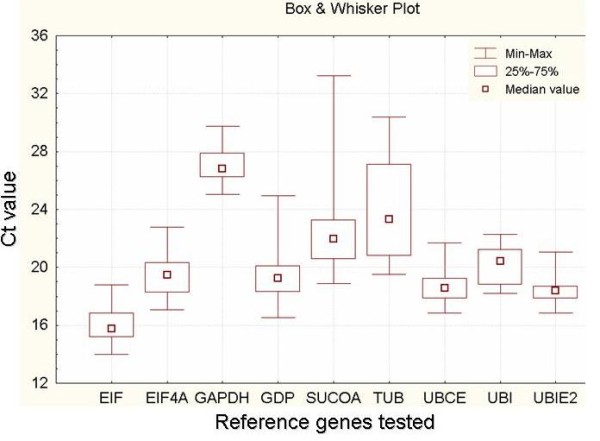
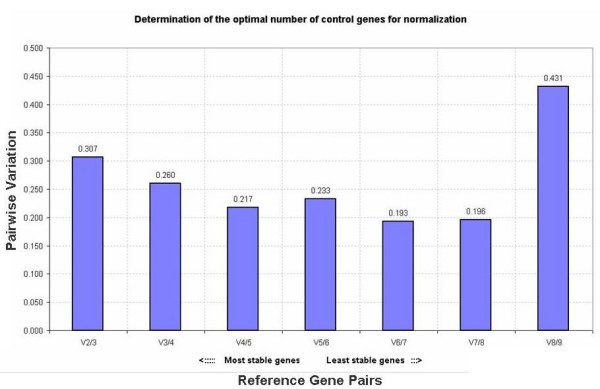
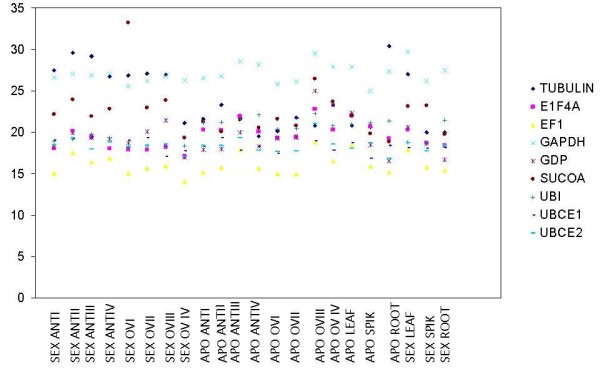
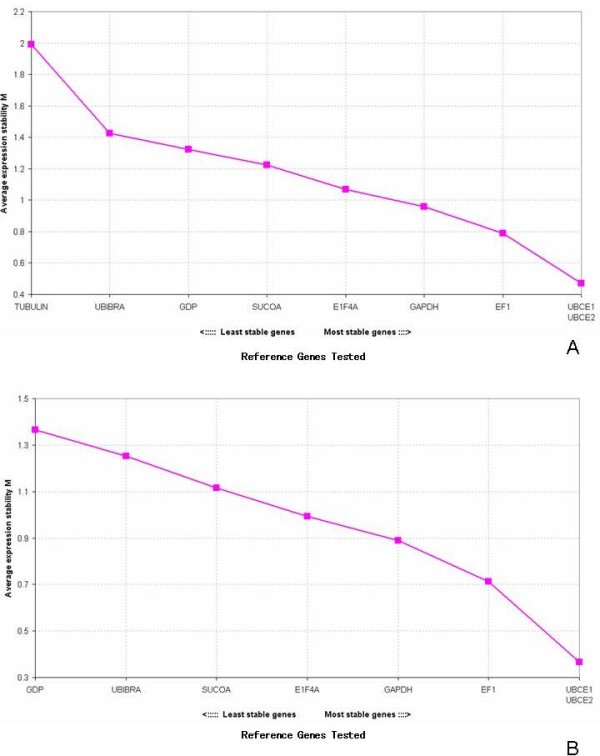
Eight genes were selected from a cDNA library of ovaries of B. brizantha considering the similarity to reference genes: EF1 (elongation factor 1 alpha), E1F4A (eukaryotic initiation factor 4A), GAPDH (glucose-6-phosphate dehydrogenase), GDP (glyceroldehyde-3-phosphate dehydrogenase), SUCOA (succinyl-CoA ligase), TUB (tubulin), UBCE (ubiquitin conjugating enzyme), UBI (ubiquitin). For the analysis, total RNA was extracted from 22 samples and raw Ct data after qRT-PCR reaction was analyzed for primer efficiency and for an overall analysis of Ct range among the different samples. Elongation factor 1 alpha showed the highest expression levels, whereas succinyl-CoA ligase showed the lowest within the chosen set of samples. GeNorm application was used for evaluation of the best reference genes, and according to that, the least stable genes, with the highest M values were tubulin and succinyl-CoA ligase and the most stable ones, with the lowest M values were elongation factor 1 alpha and ubiquitin conjugating enzyme, when both reproductive and vegetative samples were tested. For ovaries and spikelets of both sexual and apomictic B. brizantha the genes with the lowest M values were BbrizUBCE, BbrizE1F4A and BbrizEF1.
In total, eight genes belonging to different cellular processes were tested. Out of them, BbrizTUB was the less stable while BbrizEF1 followed by BbrizUBCE were the more stable genes considering male and female reproductive tissues, spikelets, roots and leaves. Regarding the best reference genes for ovary tissues, where apomictic and sexual reproduction must occur, the best reference genes were BbrizUBCE, BbrizE1F4A and BbrizEF1. Our results provide crucial information for transcriptional analysis in the Brachiaria ssp, helping to improve the quality of gene expression data in these species, which constitute an excellent plant system for the study of apomixis.
臂形草是一种重要的饲草。臂形草中无融合生殖和有性生殖的同时存在,使其成为研究这两种生殖方式所涉及分子途径的有趣系统。定量实时荧光定量PCR(qRT-PCR)已成为比较靶基因表达谱的重要技术,为获得可靠结果,拥有合适的内参基因很重要。在本研究中,我们评估了从cDNA卵巢文库中分离出的8个潜在内参基因用于臂形草qRT-PCR实验。对无融合生殖和有性生殖的臂形草的营养和生殖组织进行测试以验证这些内参基因,包括雌配子体,在雌配子体中,有性和无融合生殖植物之间的表达谱必定存在差异。
从臂形草卵巢cDNA文库中选择了8个与内参基因相似的基因:EF1(延伸因子1α)、E1F4A(真核生物起始因子4A)、GAPDH(葡萄糖-6-磷酸脱氢酶)、GDP(甘油醛-3-磷酸脱氢酶)、SUCOA(琥珀酰辅酶A连接酶)、TUB(微管蛋白)、UBCE(泛素缀合酶)、UBI(泛素)。为进行分析,从22个样本中提取总RNA,并对qRT-PCR反应后的原始Ct数据进行引物效率分析以及不同样本间Ct范围的综合分析。延伸因子1α在所选样本组中表达水平最高,而琥珀酰辅酶A连接酶表达水平最低。使用GeNorm软件评估最佳内参基因,据此,M值最高的最不稳定基因是微管蛋白和琥珀酰辅酶A连接酶,而M值最低的最稳定基因是延伸因子1α和泛素缀合酶,这是在对生殖和营养样本进行测试时得出的结果。对于有性和无融合生殖的臂形草的卵巢和小穗,M值最低的基因是BbrizUBCE、BbrizE1F4A和BbrizEF1。
总共测试了属于不同细胞过程的8个基因。其中,考虑到雄性和雌性生殖组织、小穗、根和叶,BbrizTUB是最不稳定的基因,而BbrizEF1其次是BbrizUBCE是最稳定的基因。关于卵巢组织(必定发生无融合生殖和有性生殖)的最佳内参基因,最佳内参基因是BbrizUBCE、BbrizE1F4A和BbrizEF1。我们的结果为臂形草属的转录分析提供了关键信息,有助于提高这些物种中基因表达数据的质量,这些物种构成了研究无融合生殖的优良植物系统。