Brahmachari Saurav, Pahan Kalipada
Department of Neurological Sciences, Rush University Medical Center, Chicago, IL 60612, USA.
J Immunol. 2009 Aug 1;183(3):2045-58. doi: 10.4049/jimmunol.0800276. Epub 2009 Jul 8.
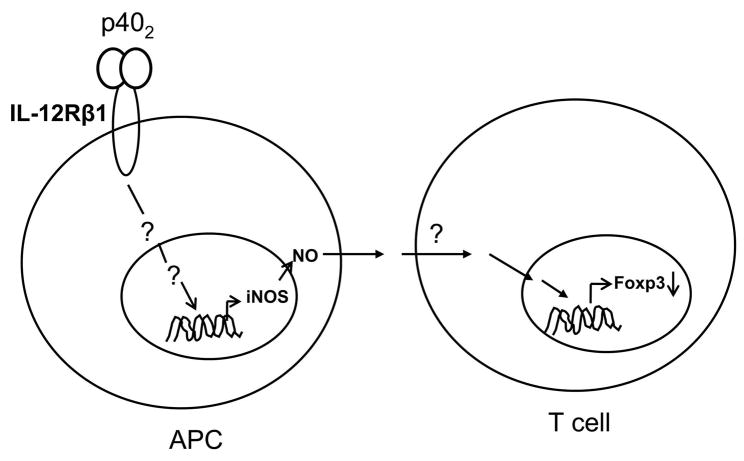
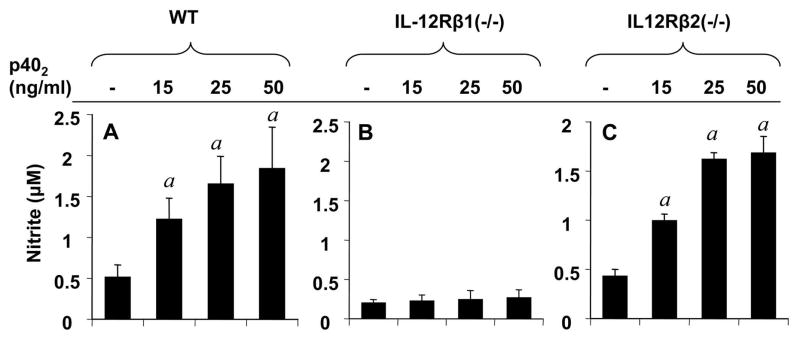
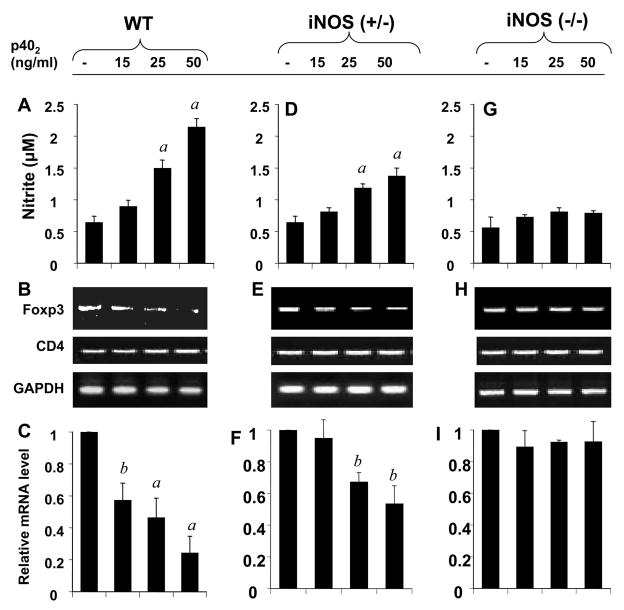
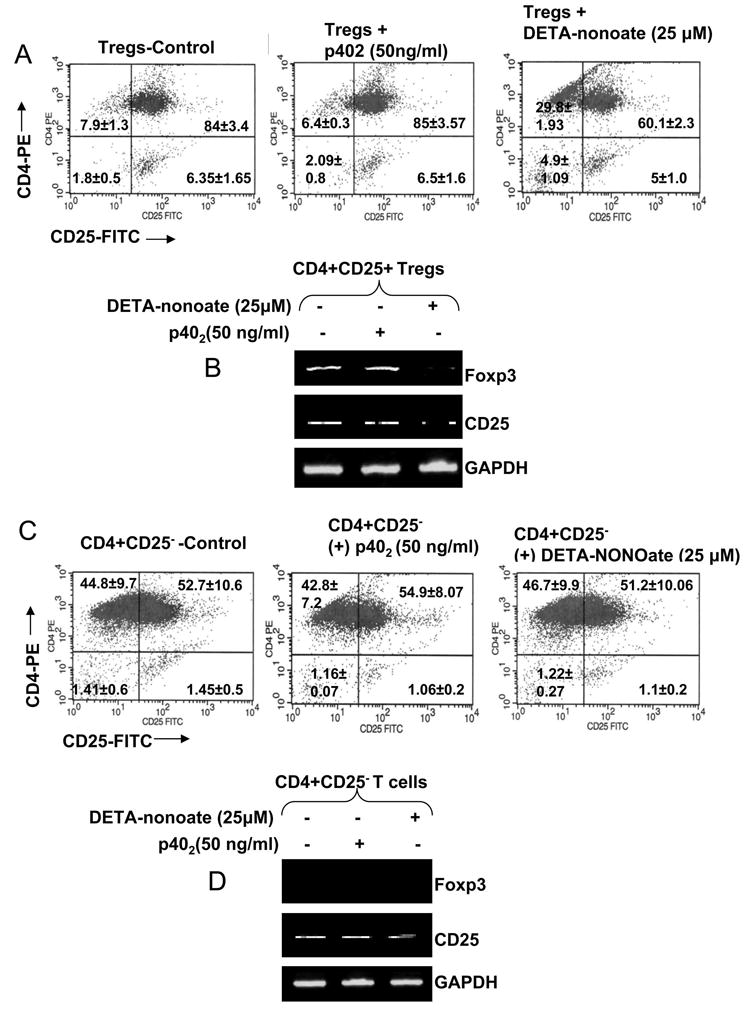
Regulatory T cells (Tregs) play a pivotal role in the maintenance of homeostasis between immune response and immune tolerance. The transcription factor Foxp3 and the surface protein CD25 are the two key molecules characterizing Tregs. In autoimmune and various other chronic inflammatory diseases, the expression of Foxp3 is severely down-regulated. However, the molecular mechanism underlying the down-regulation of Foxp3 is not understood yet. Because the IL-12p40 homodimer (p40(2)) is markedly up-regulated in response to various inflammatory stimuli, the present study was undertaken to explore the role of p40(2) in the regulation of Foxp3 in naive mouse splenocytes. IL-12p40(2) dose-dependently inhibited the expression of Foxp3 and CD25, but not CD4. Interestingly, this inhibition was absent in splenocytes of IL-12Rbeta1(-/-), but not IL-12Rbeta2(-/-), mice. Moreover, suppression of Foxp3 in wild-type and IL-12Rbeta2(-/-) splenocytes was accompanied by production of NO. Consistently, l-N(6)-(1-iminoethyl)-lysine hydrochloride, an inhibitor of inducible NO synthase (iNOS), and PTIO, a scavenger of NO, restored the expression of Foxp3 and CD25 in p40(2)-stimulated splenocytes, and p40(2) was unable to down-regulate Foxp3 and CD25 in splenocytes from iNOS(-/-) mice. Furthermore, NO, but not p40(2), was able to inhibit Foxp3 in purified CD4(+)CD25(+) T cells in the absence of iNOS-expressing cells. Hence, our results clearly demonstrate that p40(2) induces NO production via IL-12Rbeta1 and that NO subsequently suppresses Tregs in naive mouse splenocytes. This study, therefore, delineates an unprecedented biological function of p40(2) in the regulation of Foxp3 via IL-12Rbeta1-mediated NO production.
调节性T细胞(Tregs)在维持免疫反应和免疫耐受之间的平衡中起关键作用。转录因子Foxp3和表面蛋白CD25是表征Tregs的两个关键分子。在自身免疫性疾病和各种其他慢性炎症性疾病中,Foxp3的表达严重下调。然而,Foxp3下调的分子机制尚不清楚。由于IL-12p40同二聚体(p40(2))在各种炎症刺激下明显上调,因此本研究旨在探讨p40(2)在调节未活化小鼠脾细胞中Foxp3的作用。IL-12p40(2)以剂量依赖的方式抑制Foxp3和CD25的表达,但不抑制CD4的表达。有趣的是,这种抑制在IL-12Rβ1(-/-)小鼠的脾细胞中不存在,但在IL-12Rβ2(-/-)小鼠的脾细胞中存在。此外,野生型和IL-12Rβ2(-/-)脾细胞中Foxp3的抑制伴随着NO的产生。一致地,诱导型一氧化氮合酶(iNOS)的抑制剂盐酸l-N(6)-(1-亚氨基乙基)-赖氨酸和NO清除剂PTIO恢复了p40(2)刺激的脾细胞中Foxp3和CD25的表达,并且p40(2)无法下调iNOS(-/-)小鼠脾细胞中Foxp3和CD25的表达。此外,在没有表达iNOS的细胞的情况下,NO而不是p40(2)能够抑制纯化的CD4(+)CD25(+)T细胞中的Foxp3。因此,我们的结果清楚地表明p40(2)通过IL-12Rβ1诱导NO产生,并且NO随后抑制未活化小鼠脾细胞中的Tregs。因此,本研究描绘了p40(2)通过IL-12Rβ1介导的NO产生调节Foxp3的前所未有的生物学功能。