Persson Frederik, Rossing Peter, Reinhard Henrik, Juhl Tina, Stehouwer Coen D A, Schalkwijk Casper, Danser A H Jan, Boomsma Frans, Frandsen Erik, Parving Hans-Henrik
Steno Diabetes Center, Gentofte, Denmark.
Diabetes Care. 2009 Oct;32(10):1873-9. doi: 10.2337/dc09-0168. Epub 2009 Jul 8.
We investigated whether the antiproteinuric effect of the direct renin inhibitor aliskiren is comparable to that of irbesartan and the effect of the combination.
This was a double-blind, randomized, crossover trial. After a 1-month washout period, 26 patients with type 2 diabetes, hypertension, and albuminuria (>100 mg/day) were randomly assigned to four 2-month treatment periods in random order with placebo, 300 mg aliskiren once daily, 300 mg irbesartan once daily, or the combination using identical doses. Patients received furosemide in a stable dose throughout the study. The primary end point was a change in albuminuria. Secondary measures included change in 24-h blood pressure and glomerular filtration rate (GFR).
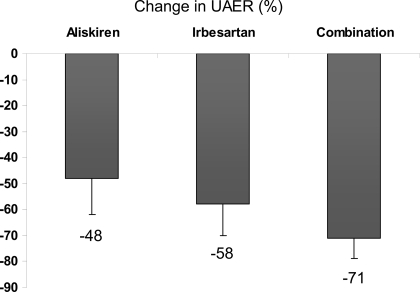
Placebo geometric mean albuminuria was 258 mg/day (range 84-2,361), mean +/- SD 24-h blood pressure was 140/73 +/- 15/8 mmHg, and GFR was 89 +/- 27 ml/min per 1.73 m(2). Aliskiren treatment reduced albuminuria by 48% (95% CI 27-62) compared with placebo (P < 0.001), not significantly different from the 58% (42-79) reduction with irbesartan treatment (P < 0.001 vs. placebo). Combination treatment reduced albuminuria by 71% (59-79), more than either monotherapy (P < 0.001 and P = 0.028). Fractional clearances of albumin were significantly reduced (46, 56, and 67% reduction vs. placebo). Twenty-four-hour blood pressure was reduced 3/4 mmHg by aliskiren (NS/P = 0.009), 12/5 mmHg by irbesartan (P < 0.001/P = 0.002), and 10/6 mmHg by the combination (P = 0.001/P < 0.001). GFR was significantly reduced 4.6 (95% CI 0.3-8.8) ml/min per 1.73 m(2) by aliskiren, 8.0 (3.6-12.3) ml/min per 1.73 m(2) by irbesartan, and 11.7 (7.4-15.9) ml/min per 1.73 m(2) by the combination.
The combination of aliskiren and irbesartan is more antiproteinuric in type 2 diabetic patients with albuminuria than monotherapy.
我们研究了直接肾素抑制剂阿利吉仑的抗蛋白尿作用是否与厄贝沙坦相当以及联合用药的效果。
这是一项双盲、随机、交叉试验。经过1个月的洗脱期后,26例2型糖尿病、高血压和蛋白尿(>100mg/天)患者被随机分配,按随机顺序接受四个为期2个月的治疗期,分别使用安慰剂、每日一次300mg阿利吉仑、每日一次300mg厄贝沙坦或相同剂量的联合用药。在整个研究过程中,患者接受稳定剂量的呋塞米。主要终点是蛋白尿的变化。次要指标包括24小时血压和肾小球滤过率(GFR)的变化。
安慰剂组蛋白尿几何平均值为258mg/天(范围84 - 2361),24小时血压平均值±标准差为140/73±15/8mmHg,GFR为89±27ml/min per 1.73m²。与安慰剂相比,阿利吉仑治疗使蛋白尿减少了48%(95%CI 27 - 62)(P < 0.001),与厄贝沙坦治疗使蛋白尿减少58%(42 - 79)相比无显著差异(与安慰剂相比P < 0.001)。联合治疗使蛋白尿减少了71%(59 - 79),比单一疗法更有效(P < 0.001和P = 0.028)。白蛋白的分数清除率显著降低(与安慰剂相比分别降低46%、56%和67%)。阿利吉仑使24小时血压降低3/4mmHg(无统计学意义/P = 0.009),厄贝沙坦使血压降低12/5mmHg(P < 0.001/P = 0.002),联合用药使血压降低10/6mmHg(P = 0.001/P < 0.001)。阿利吉仑使GFR显著降低4.6(95%CI 0.3 - 8.8)ml/min per 1.73m²,厄贝沙坦使GFR降低8.0(3.6 - 12.3)ml/min per 1.73m²,联合用药使GFR降低11.7(7.4 - 15.9)ml/min per 1.73m²。
在伴有蛋白尿的2型糖尿病患者中,阿利吉仑与厄贝沙坦联合用药的抗蛋白尿作用比单一疗法更强。