Semmens Brice X, Ward Eric J, Moore Jonathan W, Darimont Chris T
Northwest Fisheries Science Center, National Marine Fisheries Service, National Oceanic & Atmospheric Administration, Seattle, Washington, USA.
PLoS One. 2009 Jul 9;4(7):e6187. doi: 10.1371/journal.pone.0006187.
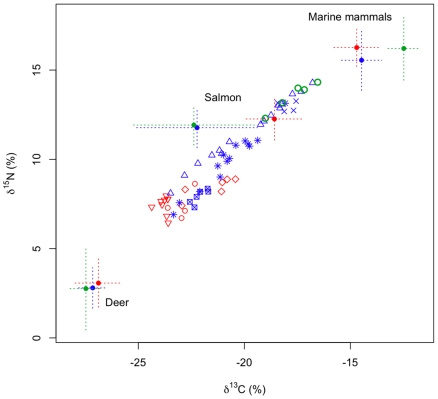
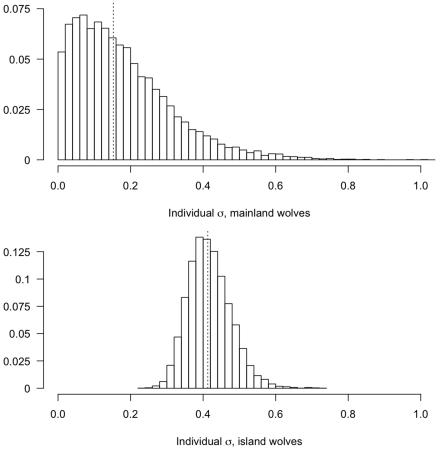
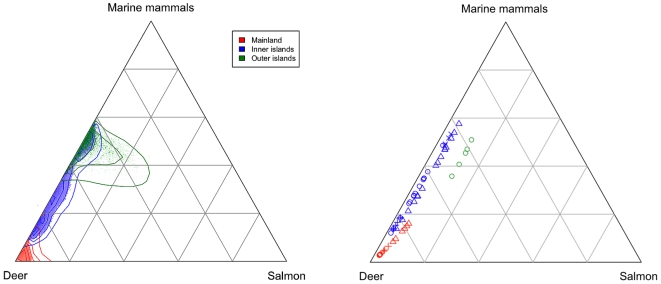
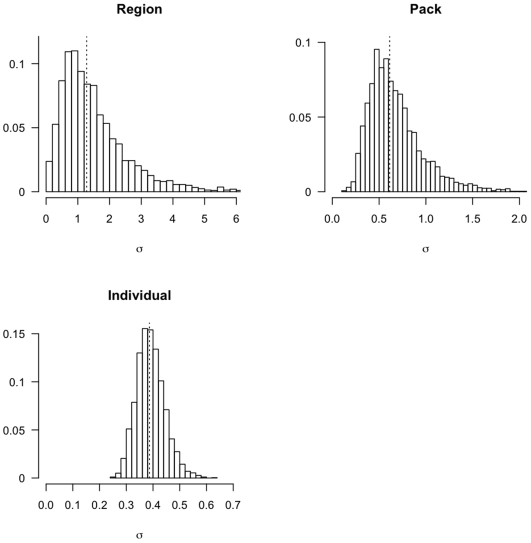
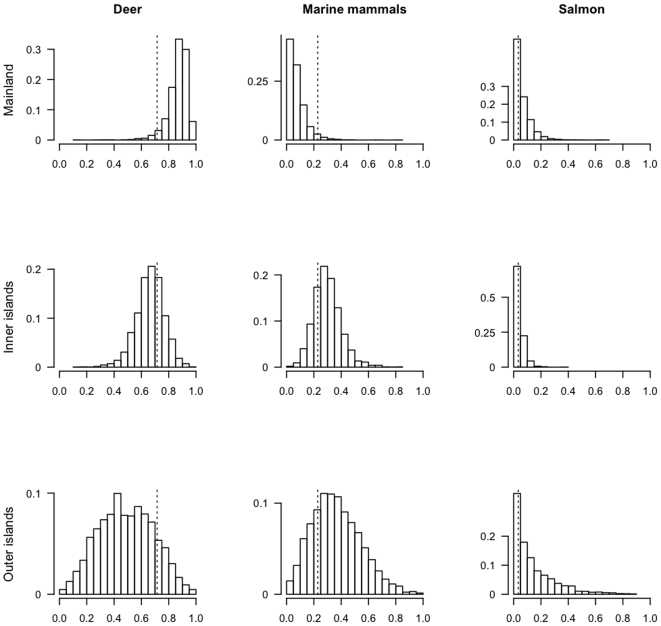
Variability in resource use defines the width of a trophic niche occupied by a population. Intra-population variability in resource use may occur across hierarchical levels of population structure from individuals to subpopulations. Understanding how levels of population organization contribute to population niche width is critical to ecology and evolution. Here we describe a hierarchical stable isotope mixing model that can simultaneously estimate both the prey composition of a consumer diet and the diet variability among individuals and across levels of population organization. By explicitly estimating variance components for multiple scales, the model can deconstruct the niche width of a consumer population into relevant levels of population structure. We apply this new approach to stable isotope data from a population of gray wolves from coastal British Columbia, and show support for extensive intra-population niche variability among individuals, social groups, and geographically isolated subpopulations. The analytic method we describe improves mixing models by accounting for diet variability, and improves isotope niche width analysis by quantitatively assessing the contribution of levels of organization to the niche width of a population.
资源利用的变异性决定了一个种群所占据的营养生态位的宽度。种群内部在资源利用上的变异性可能会出现在从个体到亚种群的种群结构层次中。了解种群组织层次如何影响种群生态位宽度对于生态学和进化研究至关重要。在此,我们描述了一种分层稳定同位素混合模型,该模型能够同时估计消费者饮食中的猎物组成以及个体之间和种群组织层次之间的饮食变异性。通过明确估计多个尺度的方差成分,该模型可以将消费者种群的生态位宽度解构为相关的种群结构层次。我们将这种新方法应用于来自不列颠哥伦比亚省沿海地区的灰狼种群的稳定同位素数据,并表明个体、社会群体和地理隔离的亚种群之间存在广泛的种群内部生态位变异性。我们所描述的分析方法通过考虑饮食变异性改进了混合模型,并通过定量评估组织层次对种群生态位宽度的贡献改进了同位素生态位宽度分析。