Department of Integrative Biology, University of South Florida, Tampa, FL, United States of America.
PLoS One. 2019 Feb 15;14(2):e0212448. doi: 10.1371/journal.pone.0212448. eCollection 2019.
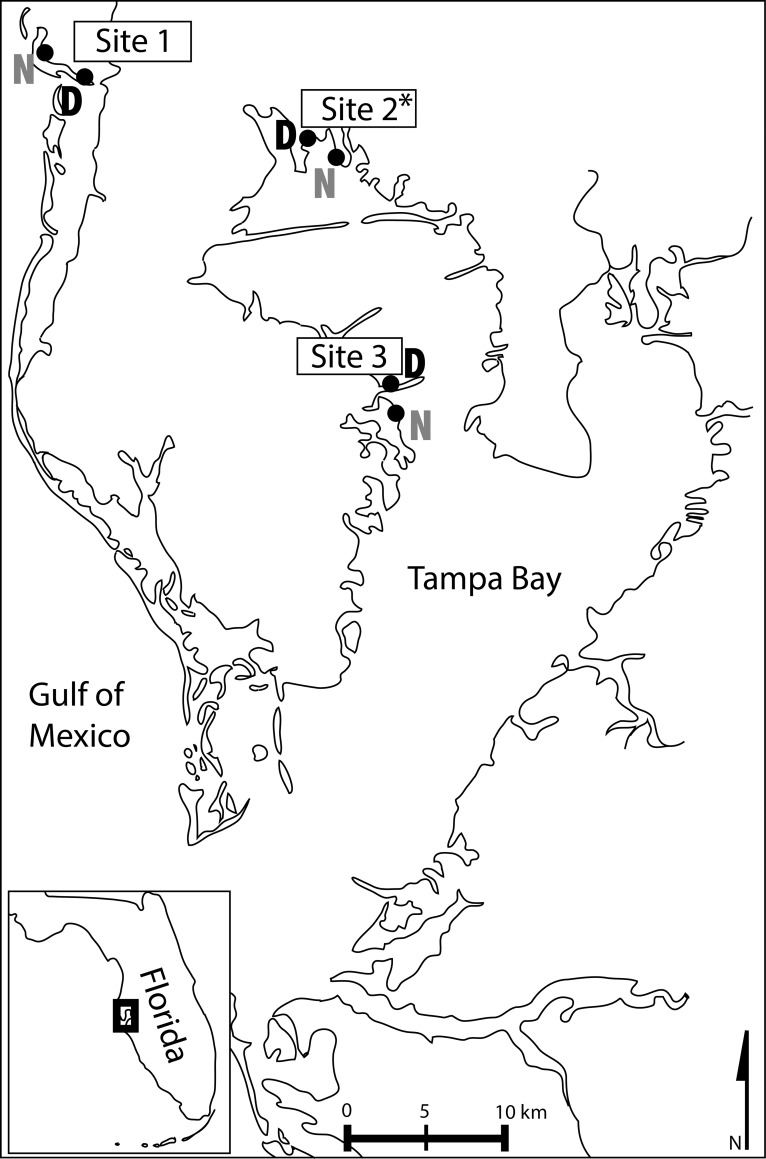
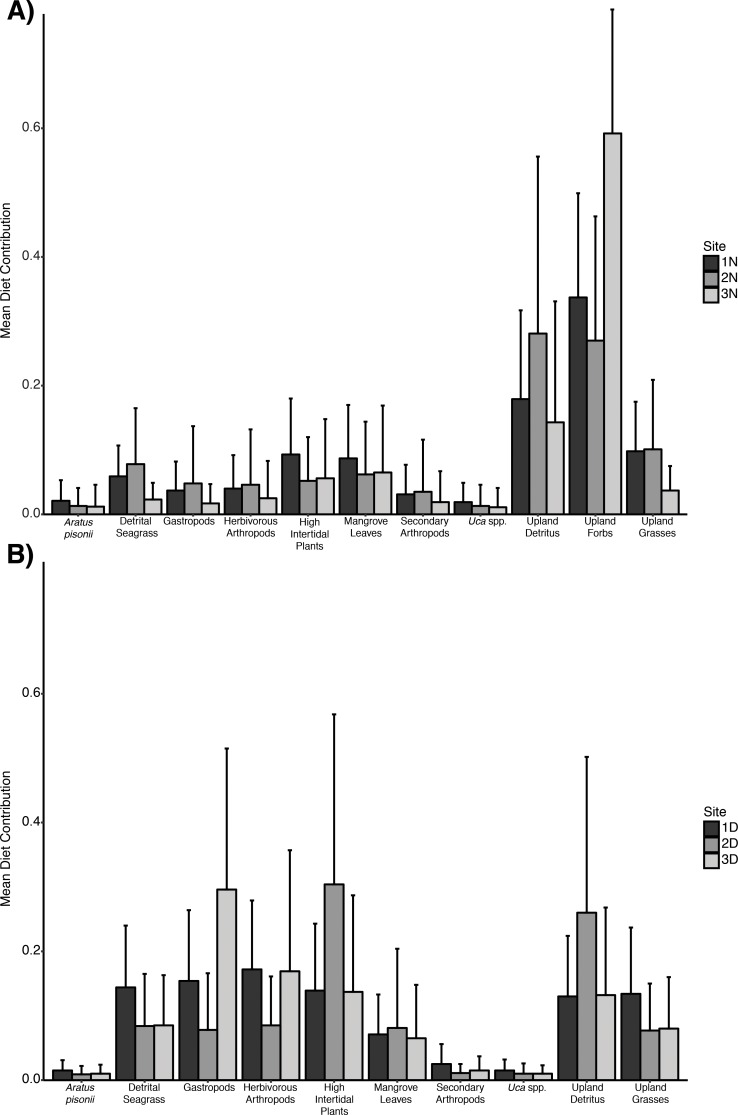
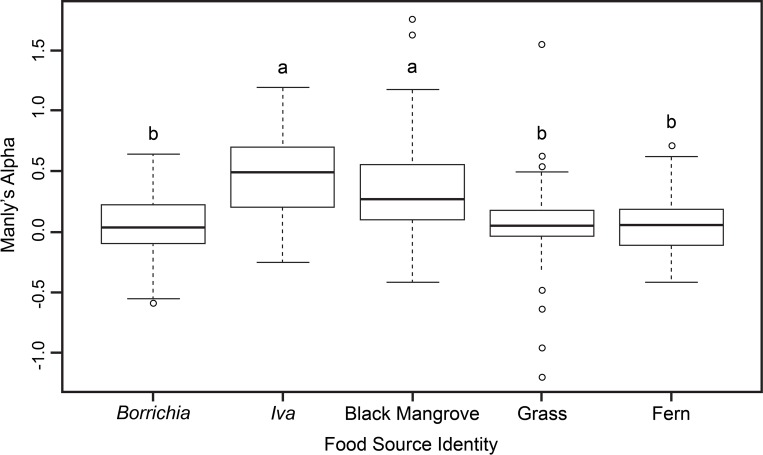
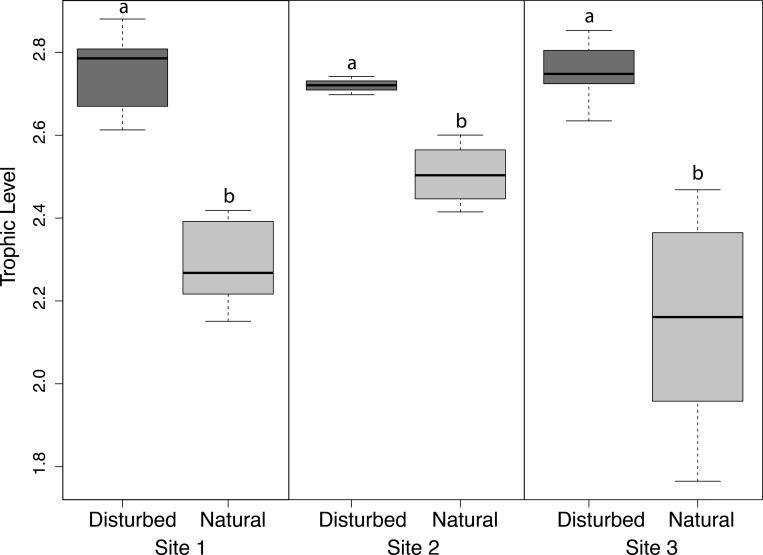
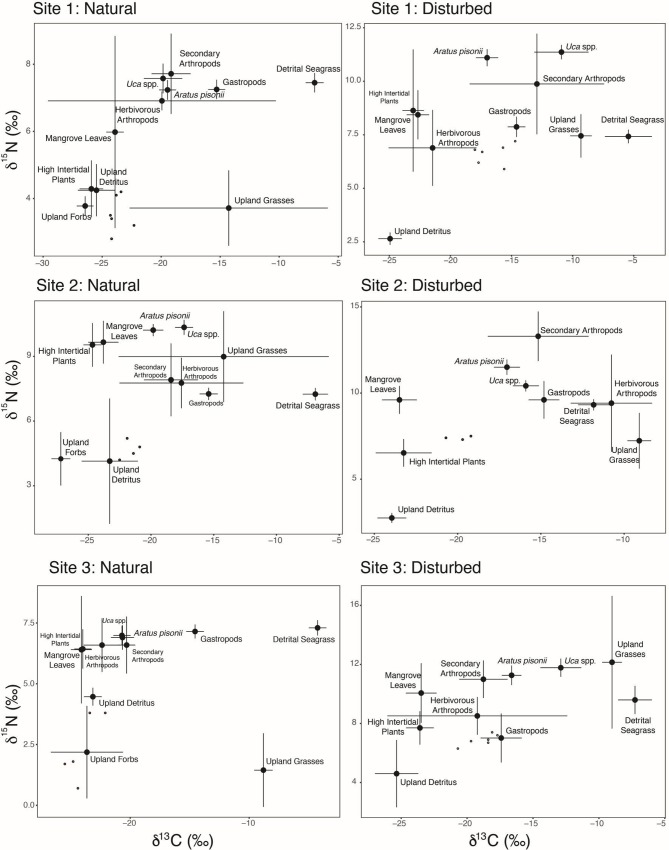
In Florida, resource use patterns by Armases cinereum (Armases), a highly abundant crab in coastal habitats, may serve as important indicators of habitat condition. Here we investigated feeding patterns of Armases in coastal palm scrub forest to intertidal mangrove forest transition zones (transitions) as well as the relationship between habitat disturbance and Armases' trophic position across three pairs of geographically separated populations in Tampa FL, USA. Each pair of sites represented an unmodified "natural" location as well as a "disturbed" location lacking upland terrestrial palm scrub forested habitat. Laboratory experiments established a baseline understanding of feeding preference of Armases offered strictly mangrove material as well as sources abundant at the transition. In-situ feeding behavior was examined using MixSIAR mixing models with δ13C and δ15N stable isotope tracers. Armases showed a strong preference for consuming partially-decomposed mangrove material from Avicennia germinans and an equally strong preference for Iva frutescens. Armases also displayed predatory behavior under laboratory conditions, confirming omnivory in the presence of mangrove material. Stable isotopes revealed a pattern of elevated trophic position of Armases in disturbed habitats over paired natural locations. Diet reconstruction provided coarse resolution of in-situ feeding and results show high spatial variation: in natural habitats, Armases appears to rely heavily upon upland plant material compared to disturbed habitats where it may consume more animal prey. Combined, these findings support that Armases trophic position and diet may indicate habitat quality in mangrove transitions in the southeastern United States.
在佛罗里达州,数量丰富的滨岸栖地蟹 Armases cinereum 的资源利用模式可能是栖息地状况的重要指标。本研究调查了 Armases 在滨海扇榈灌丛森林到潮间带红树林过渡带的摄食模式,以及在佛罗里达州坦帕市的三个地理分隔的种群中,生境干扰与 Armases 营养位之间的关系。每对地点代表一个未受干扰的“自然”地点和一个缺乏高地陆生扇榈灌丛生境的“干扰”地点。实验室实验建立了 Armases 对严格的红树林物质以及过渡带丰富来源的摄食偏好的基线理解。使用 MixSIAR 混合模型和 δ13C 和 δ15N 稳定同位素示踪剂研究了原位摄食行为。Armases 表现出强烈的偏好,消耗部分分解的来自 A. germinans 的红树林物质和 I. frutescens 同样强烈的偏好。Armases 在实验室条件下也表现出捕食行为,这证实了在有红树林物质存在的情况下的杂食性。稳定同位素揭示了干扰生境中 Armases 营养位高于配对自然地点的模式。饮食重建提供了原位摄食的粗略分辨率,结果显示出高度的空间变异性:在自然栖息地中,Armases 似乎严重依赖高地植物物质,而在干扰生境中,它可能会消耗更多的动物猎物。综合这些发现表明,Armases 的营养位和饮食可能表明美国东南部红树林过渡带的栖息地质量。