
淀粉样生成决定簇通常不被掩埋。
Amyloidogenic determinants are usually not buried.
作者信息
Frousios Kimon K, Iconomidou Vassiliki A, Karletidi Carolina-Maria, Hamodrakas Stavros J
机构信息
Department of Cell Biology and Biophysics, Faculty of Biology, University of Athens, Panepistimiopolis, Athens 15701, Greece.
出版信息
BMC Struct Biol. 2009 Jul 9;9:44. doi: 10.1186/1472-6807-9-44.
BACKGROUND
Amyloidoses are a group of usually fatal diseases, probably caused by protein misfolding and subsequent aggregation into amyloid fibrillar deposits. The mechanisms involved in amyloid fibril formation are largely unknown and are the subject of current, intensive research. In an attempt to identify possible amyloidogenic regions in proteins for further experimental investigation, we have developed and present here a publicly available online tool that utilizes five different and independently published methods, to form a consensus prediction of amyloidogenic regions in proteins, using only protein primary structure data.
RESULTS
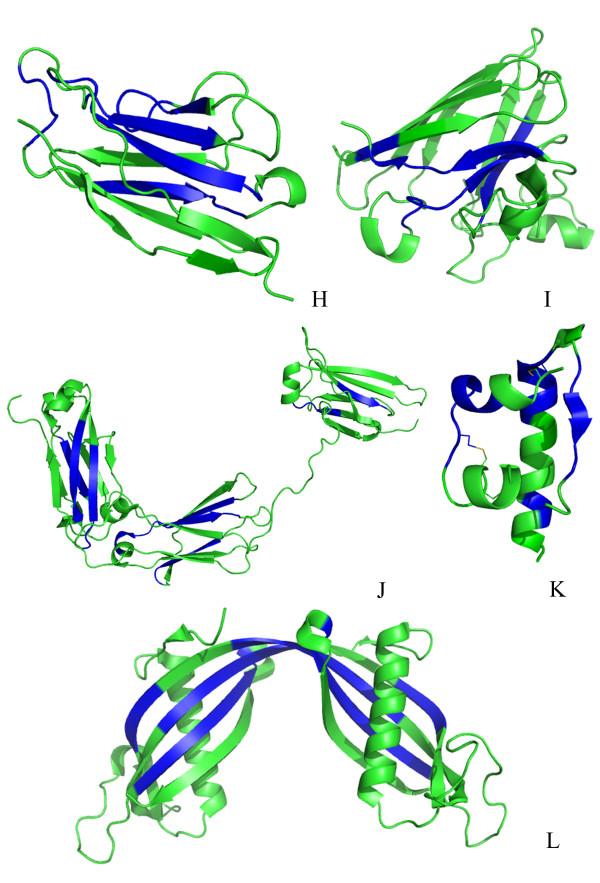
It appears that the consensus prediction tool is slightly more objective than individual prediction methods alone and suggests several previously not identified amino acid stretches as potential amyloidogenic determinants, which (although several of them may be overpredictions) require further experimental studies. The tool is available at: http://biophysics.biol.uoa.gr/AMYLPRED. Utilizing molecular graphics programs, like O and PyMOL, as well as the algorithm DSSP, it was found that nearly all experimentally verified amyloidogenic determinants (short peptide stretches favouring aggregation and subsequent amyloid formation), and several predicted, with the aid of the tool AMYLPRED, but not experimentally verified amyloidogenic determinants, are located on the surface of the relevant amyloidogenic proteins. This finding may be important in efforts directed towards inhibiting amyloid fibril formation.
CONCLUSION
The most significant result of this work is the observation that virtually all, to date, experimentally determined amyloidogenic determinants and the majority of predicted, but not yet experimentally verified short amyloidogenic stretches, lie 'exposed' on the surface of the relevant amyloidogenic proteins, and also several of them have the ability to act as conformational 'switches'. Experiments, focused on these fragments, should be performed to test this idea.
背景
淀粉样变性是一组通常致命的疾病,可能由蛋白质错误折叠以及随后聚集成淀粉样纤维沉积物所致。淀粉样纤维形成所涉及的机制在很大程度上尚不清楚,是当前深入研究的主题。为了识别蛋白质中可能的淀粉样生成区域以便进行进一步的实验研究,我们开发并在此展示了一种公开可用的在线工具,该工具利用五种不同且独立发表的方法,仅使用蛋白质一级结构数据,对蛋白质中的淀粉样生成区域形成一致性预测。
结果
似乎一致性预测工具比单独的个体预测方法稍显客观,并提示了几个先前未识别的氨基酸序列作为潜在的淀粉样生成决定因素,这些因素(尽管其中一些可能是过度预测)需要进一步的实验研究。该工具可在以下网址获取:http://biophysics.biol.uoa.gr/AMYLPRED。利用诸如O和PyMOL等分子图形程序以及算法DSSP,发现几乎所有经实验验证的淀粉样生成决定因素(有利于聚集和随后淀粉样形成的短肽段),以及借助AMYLPRED工具预测但未经实验验证的几个淀粉样生成决定因素,都位于相关淀粉样生成蛋白的表面。这一发现对于抑制淀粉样纤维形成的努力可能很重要。
结论
这项工作最显著的结果是观察到,几乎所有迄今为止经实验确定的淀粉样生成决定因素以及大多数预测但尚未经实验验证的短淀粉样生成片段,都“暴露”在相关淀粉样生成蛋白的表面,并且其中一些具有作为构象“开关”的能力。应围绕这些片段开展实验以验证这一观点。

 Zotero 插件