Rappaport Stephen M, Kim Sungkyoon, Lan Qing, Vermeulen Roel, Waidyanatha Suramya, Zhang Luoping, Li Guilan, Yin Songnian, Hayes Richard B, Rothman Nathaniel, Smith Martyn T
School of Public Health, University of California at Berkeley, Berkeley, California 94720-7356, USA.
Environ Health Perspect. 2009 Jun;117(6):946-52. doi: 10.1289/ehp.0800510. Epub 2009 Feb 19.
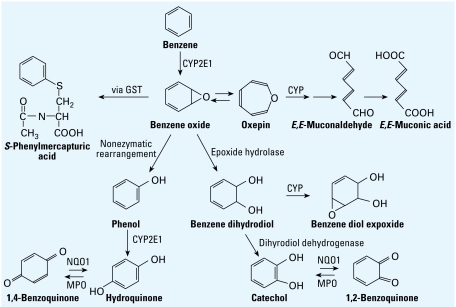
Recent evidence has shown that humans metabolize benzene more efficiently at environmental air concentrations than at concentrations > 1 ppm. This led us to speculate that an unidentified metabolic pathway was mainly responsible for benzene metabolism at ambient levels.
We statistically tested whether human metabolism of benzene is better fitted by a kinetic model having two pathways rather than one.
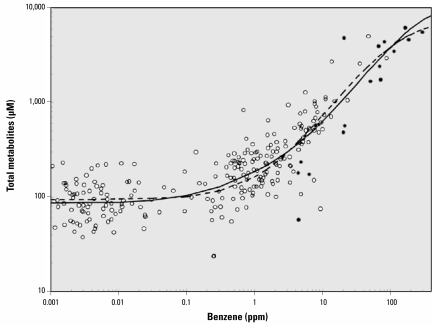
We fit Michaelis-Menten-like models to levels of urinary benzene metabolites and the corresponding air concentrations for 263 nonsmoking Chinese females. Estimated benzene concentrations ranged from less than 0.001 ppm to 299 ppm, with 10th and 90th percentile values of 0.002 ppm and 8.97 ppm, respectively.
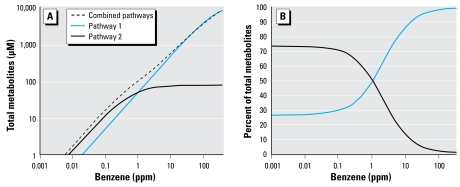
Using values of Akaike's information criterion obtained under the two models, we found strong statistical evidence favoring two metabolic pathways, with respective affinities (benzene air concentrations analogous to K(m) values) of 301 ppm for the low-affinity pathway (probably dominated by cytochrome P450 enzyme 2E1) and 0.594 ppm for the high-affinity pathway (unknown). The exposure-specific metabolite level predicted by our two-pathway model at nonsaturating concentrations was 184 muM/ppm of benzene, a value close to an independent estimate of 194 muM/ppm for a typical nonsmoking Chinese female. Our results indicate that a nonsmoking woman would metabolize about three times more benzene from the ambient environment under the two-pathway model (184 muM/ppm) than under the one-pathway model (68.6 muM/ppm). In fact, 73% of the ambient benzene dose would be metabolized via the unidentified high-affinity pathway.
Because regulatory risk assessments have assumed nonsaturating metabolism of benzene in persons exposed to air concentrations well above 10 ppm, our findings suggest that the true leukemia risks could be substantially greater than currently thought at ambient levels of exposure-about 3-fold higher among nonsmoking females in the general population.
最近的证据表明,与浓度大于1 ppm时相比,人类在环境空气浓度下对苯的代谢效率更高。这使我们推测,一种尚未确定的代谢途径主要负责环境水平下苯的代谢。
我们通过统计学方法检验了苯的人体代谢是否更适合由具有两条途径而非一条途径的动力学模型来描述。
我们将类似米氏方程的模型拟合到263名不吸烟中国女性的尿中苯代谢物水平及相应的空气浓度。估计的苯浓度范围从小于0.001 ppm到299 ppm,第10百分位数和第90百分位数分别为0.002 ppm和8.97 ppm。
利用在两种模型下获得的赤池信息准则值,我们发现有强有力的统计学证据支持两条代谢途径,低亲和力途径(可能主要由细胞色素P450酶2E1主导)的亲和力(类似于米氏常数K(m)值的苯空气浓度)为301 ppm,高亲和力途径(未知)的亲和力为0.594 ppm。我们的双途径模型在非饱和浓度下预测的暴露特异性代谢物水平为184 μM/ppm苯,该值接近对典型不吸烟中国女性的194 μM/ppm的独立估计值。我们的结果表明,在双途径模型(184 μM/ppm)下,不吸烟女性从环境中代谢的苯比单途径模型(68.6 μM/ppm)下大约多三倍。事实上,73%的环境苯剂量将通过未确定的高亲和力途径代谢。
由于监管风险评估假设暴露于远高于10 ppm空气浓度的人群中苯的代谢不饱和,我们的研究结果表明,在环境暴露水平下,实际白血病风险可能比目前认为的要高得多——在一般人群的不吸烟女性中大约高3倍。