Department of Chemistry, Wakayama Medical University, 580 Mikazura, Wakayama 641-0011, Japan.
J Clin Biochem Nutr. 2009 Jul;45(1):49-55. doi: 10.3164/jcbn.08-258. Epub 2009 Jun 30.
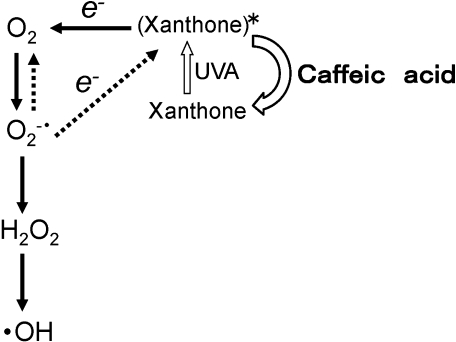
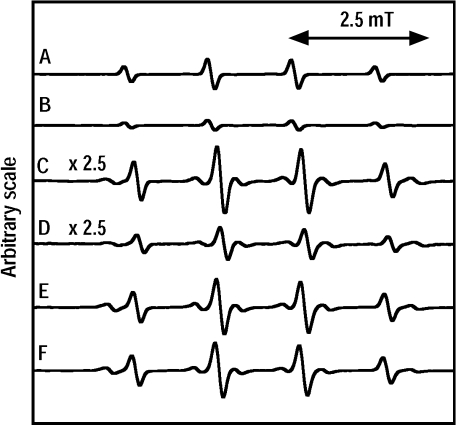
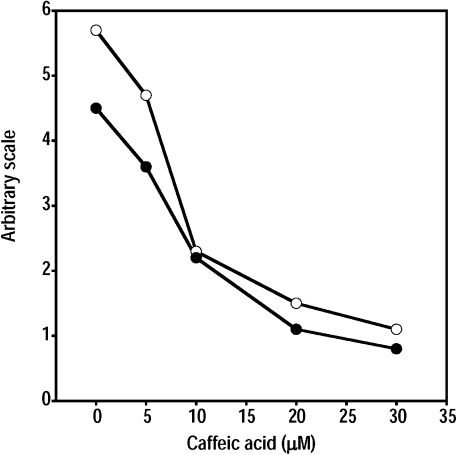
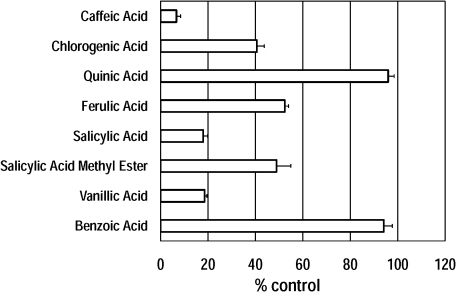
Effect of caffeic acid on the formation of hydroxyl radicals was examined during xanthone-mediated photosensitization. The reaction was performed on irradiation (lambda = 365 nm) of the standard reaction mixture containing 15 microM xanthone, 0.1 M 5,5-dimethyl-1-pyrroline N-oxide (DMPO) and 20 mM phosphate buffer (pH 7.4) using electron paramagnetic resonance (EPR) with spin trapping. Caffeic acid inhibited the formation of hydroxyl radicals. Caffeic acid hardly scavenged both hydroxyl radicals and superoxide radicals under conditions employed in this paper in spite of its ability to act as a hydrogen donor or a reagent for the aromatic hydroxylation, because high concentration of DMPO trapped hydroxyl radicals overwhelmingly. Furthermore, caffeic acid inhibited the formation of hydroxyl radicals in the standard reaction mixture with EDTA under UVA irradiation. Accordingly, the inhibitory effect of caffeic acid on the formation of hydroxyl radicals in the standard reaction mixture under UVA irradiation is not due to its ability to chelate iron. Thus, the inhibitory effect of caffeic acid seems to occur in the standard reaction mixture under UVA irradiation through a novel antioxidation activity, i.e., ability to quench the exited xanthone.
在蒽酮介导的光致敏化过程中,研究了咖啡酸对羟自由基形成的影响。该反应在标准反应混合物的照射(λ=365nm)下进行,该混合物包含 15μM 蒽酮、0.1M5,5-二甲基-1-吡咯啉 N-氧化物(DMPO)和 20mM 磷酸盐缓冲液(pH7.4),并使用电子顺磁共振(EPR)与自旋捕获进行。咖啡酸抑制了羟自由基的形成。尽管咖啡酸具有作为氢供体或芳族羟化试剂的能力,但在本文所采用的条件下,它几乎不能清除羟自由基和超氧自由基,因为高浓度的 DMPO 会捕获羟自由基。此外,在 UVA 照射下,咖啡酸抑制了 EDTA 存在下标准反应混合物中羟自由基的形成。因此,咖啡酸在 UVA 照射下标准反应混合物中抑制羟自由基形成的作用不是由于其螯合铁的能力。因此,咖啡酸在 UVA 照射下标准反应混合物中的抑制作用似乎是通过一种新的抗氧化活性发生的,即淬灭激发态蒽酮的能力。