Wilson Melissa A, Makova Kateryna D
Department of Biology, Pennsylvania State University, University Park, PA, USA.
PLoS Genet. 2009 Jul;5(7):e1000568. doi: 10.1371/journal.pgen.1000568. Epub 2009 Jul 17.
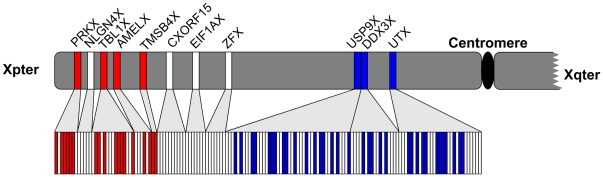
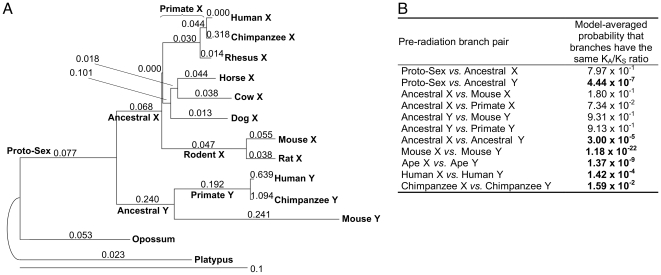
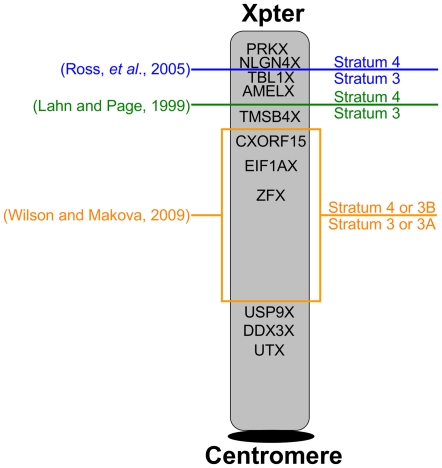
Since the two eutherian sex chromosomes diverged from an ancestral autosomal pair, the X has remained relatively gene-rich, while the Y has lost most of its genes through the accumulation of deleterious mutations in nonrecombining regions. Presently, it is unclear what is distinctive about genes that remain on the Y chromosome, when the sex chromosomes acquired their unique evolutionary rates, and whether X-Y gene divergence paralleled that of paralogs located on autosomes. To tackle these questions, here we juxtaposed the evolution of X and Y homologous genes (gametologs) in eutherian mammals with their autosomal orthologs in marsupial and monotreme mammals. We discovered that genes on the X and Y acquired distinct evolutionary rates immediately following the suppression of recombination between the two sex chromosomes. The Y-linked genes evolved at higher rates, while the X-linked genes maintained the lower evolutionary rates of the ancestral autosomal genes. These distinct rates have been maintained throughout the evolution of X and Y. Specifically, in humans, most X gametologs and, curiously, also most Y gametologs evolved under stronger purifying selection than similarly aged autosomal paralogs. Finally, after evaluating the current experimental data from the literature, we concluded that unique mRNA/protein expression patterns and functions acquired by Y (versus X) gametologs likely contributed to their retention. Our results also suggest that either the boundary between sex chromosome strata 3 and 4 should be shifted or that stratum 3 should be divided into two strata.
自从两条真兽亚纲的性染色体从一对祖先常染色体分化而来后,X染色体一直相对富含基因,而Y染色体由于在非重组区域积累了有害突变,失去了大部分基因。目前尚不清楚Y染色体上留存的基因有何独特之处,性染色体何时获得了其独特的进化速率,以及X-Y基因分歧是否与常染色体上的旁系同源基因的分歧情况相似。为了解决这些问题,我们将真兽亚纲哺乳动物中X和Y同源基因(性染色体同源基因)的进化与其有袋类和单孔类哺乳动物中的常染色体直系同源基因的进化进行了对比。我们发现,在两条性染色体之间的重组被抑制后,X和Y染色体上的基因立即获得了不同的进化速率。Y连锁基因进化速率更高,而X连锁基因则保持了祖先常染色体基因较低的进化速率。这些不同的速率在X和Y的整个进化过程中都得以维持。具体而言,在人类中,大多数X性染色体同源基因,奇怪的是,大多数Y性染色体同源基因也比同样古老的常染色体旁系同源基因在更强的纯化选择下进化。最后,在评估了文献中的现有实验数据后,我们得出结论,Y(相对于X)性染色体同源基因获得的独特mRNA/蛋白质表达模式和功能可能有助于它们的保留。我们的结果还表明,要么性染色体层3和层4之间的边界应该移动,要么层3应该分为两层。