International Health Division, Abt Associates Inc., Bethesda, Maryland, USA.
Hum Resour Health. 2009 Jul 21;7:58. doi: 10.1186/1478-4491-7-58.
Kenya, like many other countries in sub-Saharan Africa, has been affected by shortages of health workers in the public sector. Data on the rates and leading reasons for health workers attrition in the public sector are key in developing effective, evidence-based planning and policy on human resources for health.
This study analysed data from a human resources health facility survey conducted in 2005 in 52 health centres and 22 public hospitals (including all provincial hospitals) across all eight provinces in Kenya. The study looked into the status of attrition rates and the proportion of attrition due to retirement, resignation or death among doctors, clinical officers, nurses and laboratory and pharmacy specialists in surveyed facilities.
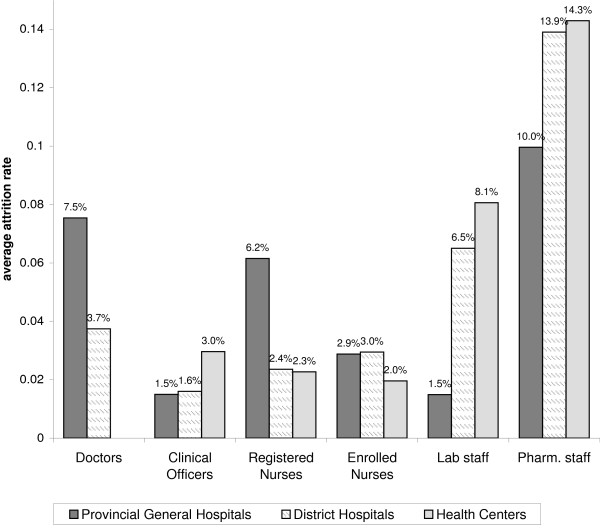
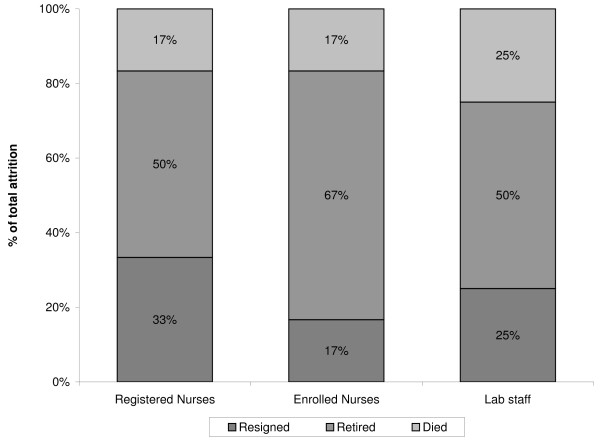
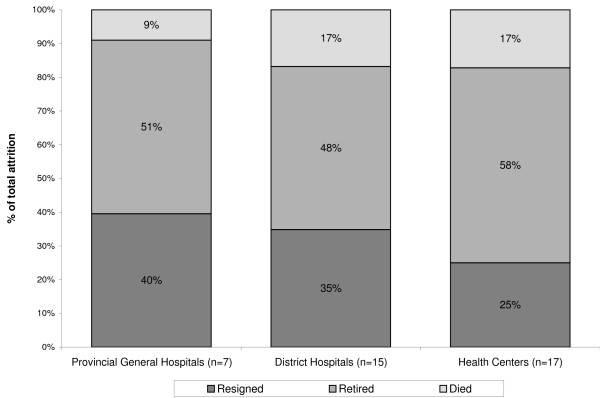
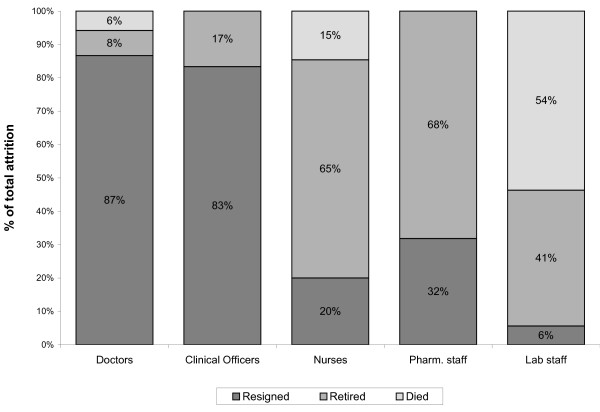
Overall health workers attrition rates from 2004 to 2005 were similar across type of health facility: provincial hospitals lost on average 4% of their health workers, compared to 3% for district hospitals and 5% for health centres. However, there are differences in the patterns of attrition rates by cadre. Attrition among doctors and registered nurses was much higher at the provincial hospitals than at district hospitals or health centres, whereas the opposite pattern was observed for laboratory and pharmacy staff (lost at a higher rate in lower-level facilities). In provincial hospitals, doctors had higher attrition rates than clinical officers, and registered nurses had higher attrition rates than enrolled nurses. In contrast, attrition of enrolled and registered nurses in district hospitals and health centres was similar. The main reason for health worker attrition (all cadres combined) at each level of facility was retirement, followed by resignation and death. However, resignation drives attrition among doctors and clinical officers; retirement accounts for the main share of attrition among nurses and pharmacy staff; and death is the primary reason for attrition among laboratory staff, particularly in district hospitals. One limitation of the data is that sampling of health centres was non-random and the results may thus not be representative of all health centres.
Our findings indicate that appropriate policies to retain staff in the public health sector may need to be tailored for different cadres and level of health facility. Further studies, perhaps employing qualitative research, need to investigate the importance of different factors in the decision of health workers to resign.
肯尼亚和撒哈拉以南非洲的许多其他国家一样,受到公共部门卫生工作者短缺的影响。公共部门卫生工作者离职率及其主要原因的数据对于制定有效的人力资源卫生规划和政策至关重要。
本研究分析了 2005 年在肯尼亚 8 个省的所有省级医院以及 52 个卫生中心和 22 所公立医院进行的一项人力资源卫生设施调查的数据。该研究调查了调查设施中医生、临床医生、护士以及实验室和药房专家的离职率和因退休、辞职或死亡而离职的比例。
2004 年至 2005 年,各类卫生设施的卫生工作者离职率总体相似:省级医院平均失去 4%的卫生工作者,而区医院和卫生中心分别为 3%和 5%。然而,不同职级的离职率模式存在差异。省级医院的医生和注册护士离职率明显高于区医院和卫生中心,而实验室和药房工作人员则相反(较低级别设施的离职率更高)。在省级医院,医生的离职率高于临床医生,注册护士的离职率高于注册护士。相比之下,区医院和卫生中心的注册护士和注册护士的离职率相似。每个设施级别离职的主要原因(所有职级合并)都是退休,其次是辞职和死亡。然而,辞职是医生和临床医生离职的主要原因;退休是护士和药房工作人员离职的主要原因;死亡是实验室工作人员离职的主要原因,尤其是在区医院。数据的一个限制是卫生中心的抽样是非随机的,因此结果可能无法代表所有卫生中心。
我们的研究结果表明,可能需要为不同职级和卫生设施级别制定适当的政策来留住公共卫生部门的工作人员。需要进一步研究,也许采用定性研究,调查卫生工作者辞职决定中不同因素的重要性。