Tennessen Jacob A, Woodhams Douglas C, Chaurand Pierre, Reinert Laura K, Billheimer Dean, Shyr Yu, Caprioli Richard M, Blouin Michael S, Rollins-Smith Louise A
Department of Zoology, Oregon State University, Corvallis, OR 97331, USA.
Dev Comp Immunol. 2009 Dec;33(12):1247-57. doi: 10.1016/j.dci.2009.07.004. Epub 2009 Aug 3.
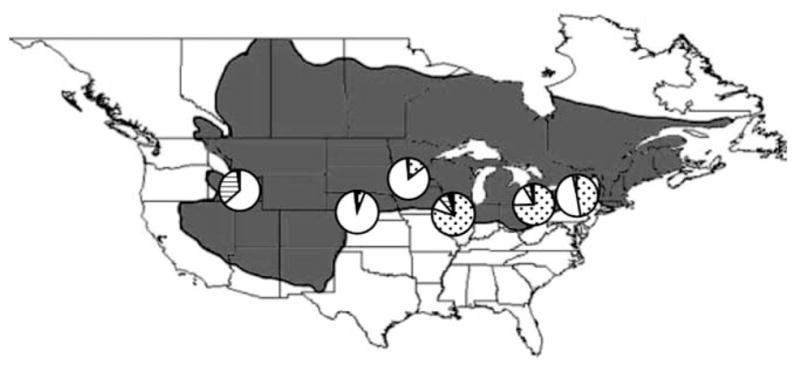
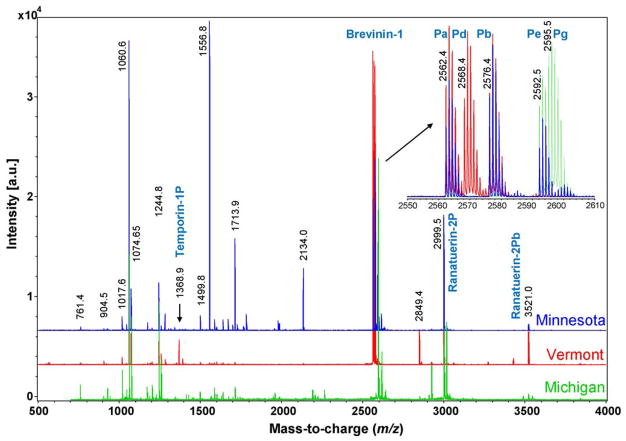
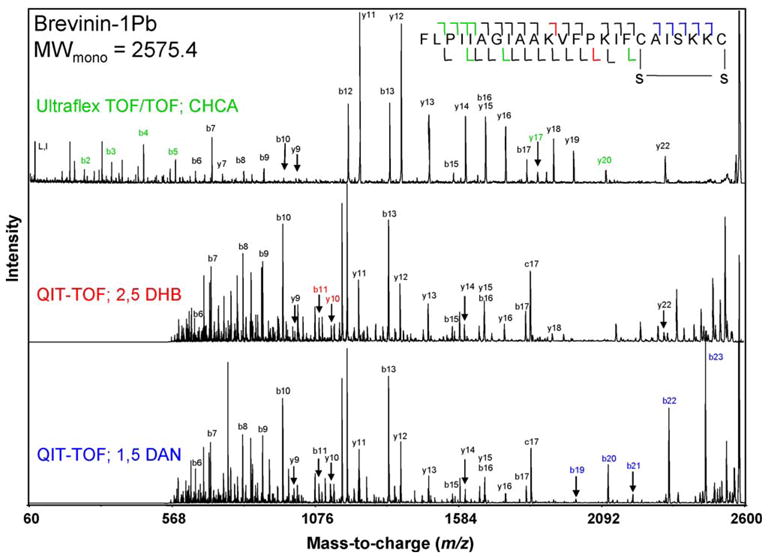
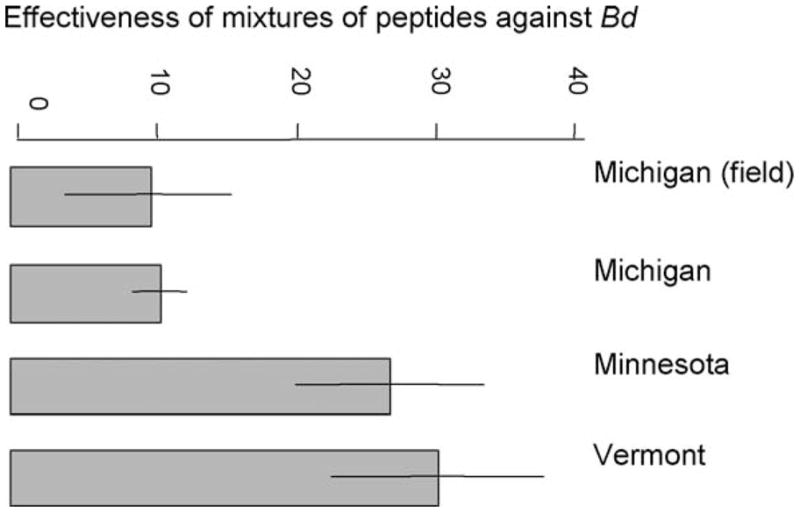
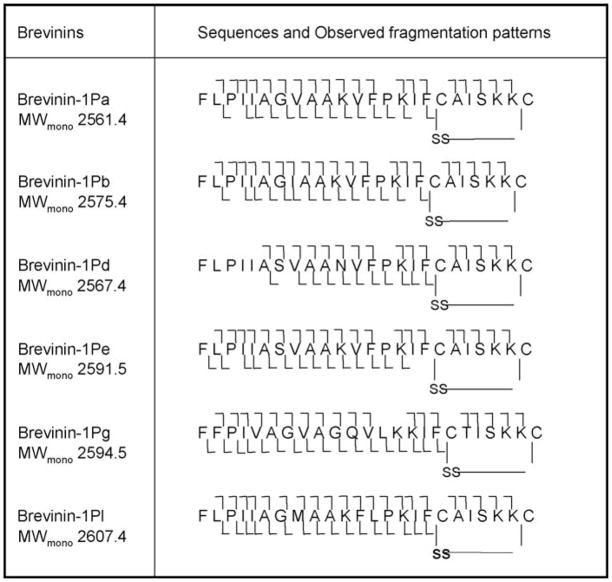
The northern leopard frog (Rana pipiens or Lithobates pipiens) is historically found in most of the provinces of Canada and the northern and southwest states of the United States. In the last 50 years, populations have suffered significant losses, especially in the western regions of the species range. Using a peptidomics approach, we show that the pattern of expressed antimicrobial skin peptides of frogs from three geographically separated populations are distinct, and we report the presence of four peptides (brevinin-1Pg, brevinin-1Pl, ranatuerin-2Pb, and ranatuerin-2Pc) that have not previously been found in skin secretions. The differences in expressed peptides reflect differences in the distribution of alleles for the newly described Brevinin1.1 locus in the three populations. When enriched peptide mixtures were tested for their ability to inhibit growth of the pathogenic amphibian chytrid (Batrachochytrium dendrobatidis), peptides from Minnesota or Vermont frogs were more effective that peptides from Michigan frogs. Four of the purified peptides were tested for their ability to inhibit growth of two bacterial pathogens (Aeromonas hydrophila and Staphylococcus epidermidis) and B. dendrobatidis. Three of the four were effective inhibitors of B. dendrobatidis and S. epidermidis, but none inhibited A. hydrophila. We interpret these differences in expression and activity of antimicrobial peptides as evidence to suggest that each population may have been selected to express a suite of peptides that reflects current and past encounters with skin microbes.
北美豹蛙(Rana pipiens或Lithobates pipiens)历史上在加拿大的大部分省份以及美国北部和西南部各州都有发现。在过去的50年里,其种群数量大幅减少,尤其是在该物种分布范围的西部地区。我们采用肽组学方法发现,来自三个地理隔离种群的青蛙所表达的抗菌皮肤肽模式各不相同,并且我们报告了四种以前未在皮肤分泌物中发现的肽(brevinin - 1Pg、brevinin - 1Pl、ranatuerin - 2Pb和ranatuerin - 2Pc)。所表达肽的差异反映了三个种群中新描述的Brevinin1.1基因座等位基因分布的差异。当测试富集的肽混合物抑制致病性两栖类壶菌(Batrachochytrium dendrobatidis)生长的能力时,来自明尼苏达州或佛蒙特州青蛙的肽比来自密歇根州青蛙的肽更有效。对四种纯化的肽测试了它们抑制两种细菌病原体(嗜水气单胞菌和表皮葡萄球菌)以及两栖类壶菌生长的能力。四种肽中的三种是两栖类壶菌和表皮葡萄球菌的有效抑制剂,但均未抑制嗜水气单胞菌。我们将抗菌肽表达和活性的这些差异解释为证据,表明每个种群可能经过选择以表达一组反映当前和过去与皮肤微生物接触情况的肽。