Division of Molecular Biology, The Netherlands Cancer Institute, Amsterdam, The Netherlands.
J Cell Mol Med. 2010 Jun;14(6B):1657-67. doi: 10.1111/j.1582-4934.2009.00847.x. Epub 2009 Jul 20.
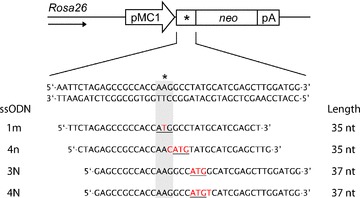
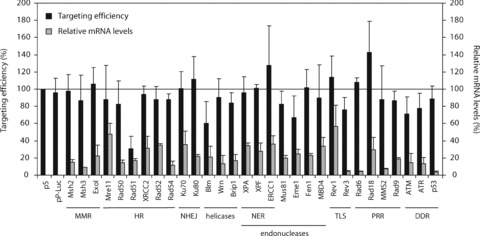
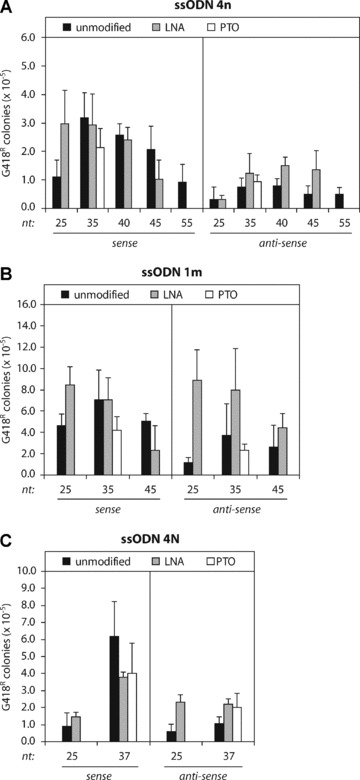
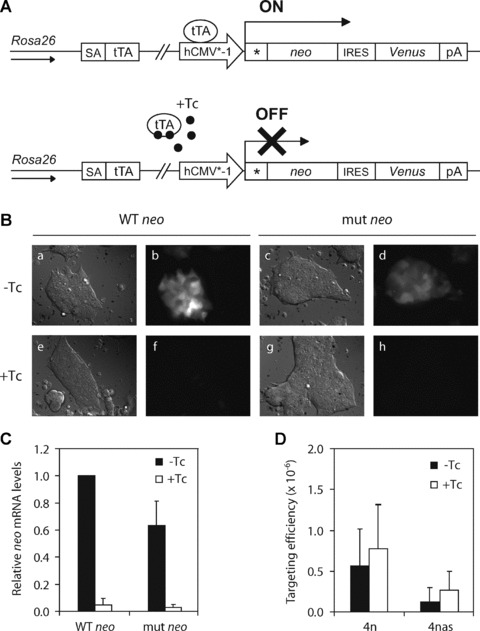
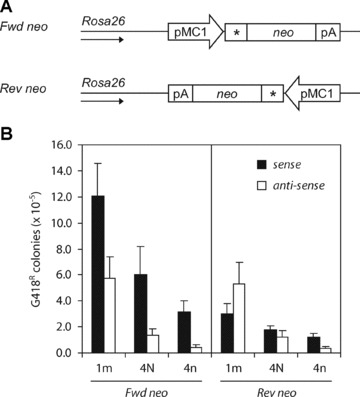
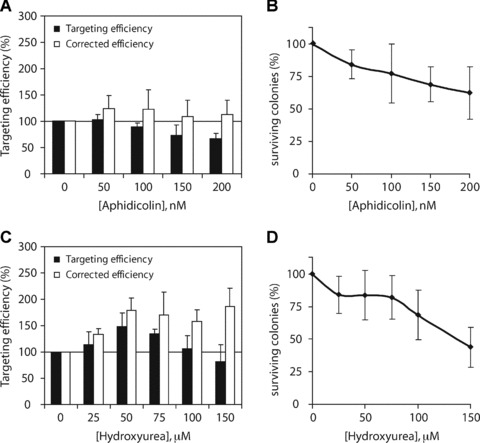
Gene targeting by single-stranded oligodeoxyribonucleotides (ssODNs) is emerging as a powerful tool for the introduction of subtle gene modifications in mouse embryonic stem (ES) cells and the generation of mutant mice. Here, we have studied the role of ssODN composition, transcription and replication of the target locus, and DNA repair pathways to gain more insight into the parameters governing ssODN-mediated gene targeting in mouse ES cells. We demonstrated that unmodified ssODNs of 35-40 nt were most efficient in correcting a chromosomally integrated mutant neomycin reporter gene. Addition of chemical modifications did not further enhance the efficacy of these ssODNs. The observed strand bias was not affected by transcriptional activity and may rather be caused by the different accessibility of the DNA strands during DNA replication. Consistently, targeting frequencies were enhanced when cells were treated with hydroxyurea to reduce the rate of replication fork progression. Transient down-regulation of various DNA repair genes by RNAi had no effect on the targeting frequency. Taken together, our data suggest that ssODN-mediated gene targeting occurs within the context of a replication fork. This implies that any given genomic sequence, irrespective of transcriptional status, should be amenable to ssODN-mediated gene targeting. The ability of ES cells to differentiate into various cell types after ssODN-mediated gene targeting may offer opportunities for future therapeutic applications.
单链寡脱氧核苷酸(ssODNs)的基因靶向技术正逐渐成为在小鼠胚胎干细胞(ES 细胞)中引入细微基因修饰和产生突变小鼠的有力工具。在这里,我们研究了 ssODN 组成、靶基因座的转录和复制以及 DNA 修复途径,以更深入地了解调控 ssODN 介导的小鼠 ES 细胞基因靶向的参数。我们证明,35-40 个核苷酸的未修饰 ssODN 可最有效地校正染色体整合的突变新霉素报告基因。添加化学修饰并不能进一步提高这些 ssODN 的效率。观察到的链偏向性不受转录活性的影响,而可能是由于 DNA 复制过程中 DNA 链的不同可及性引起的。一致地,当用羟基脲处理细胞以降低复制叉前进的速度时,靶向频率会增强。通过 RNAi 短暂下调各种 DNA 修复基因对靶向频率没有影响。总之,我们的数据表明,ssODN 介导的基因靶向发生在复制叉的背景下。这意味着任何给定的基因组序列,无论转录状态如何,都应该能够进行 ssODN 介导的基因靶向。ES 细胞在 ssODN 介导的基因靶向后分化为各种细胞类型的能力为未来的治疗应用提供了机会。