Betancur-R Ricardo
Department of Biological Sciences, Auburn University, Auburn, AL 36849, USA.
BMC Evol Biol. 2009 Jul 23;9:175. doi: 10.1186/1471-2148-9-175.
Ariids or sea catfishes are one of the two otophysan fish families (out of about 67 families in four orders) that inhabit mainly marine and brackish waters (although some species occur strictly in fresh waters). The group includes over 150 species placed in approximately 29 genera and two subfamilies (Galeichthyinae and Ariinae). Despite their global distribution, ariids are largely restricted to the continental shelves due in part to their specialized reproductive behavior (i.e., oral incubation). Thus, among marine fishes, ariids offer an excellent opportunity for inferring historical biogeographic scenarios. Phylogenetic hypotheses available for ariids have focused on restricted geographic areas and comprehensive phylogenies are still missing. This study inferred phylogenetic hypotheses for 123 ariid species in 28 genera from different biogeographic provinces using both mitochondrial and nuclear sequences (up to approximately 4 kb).
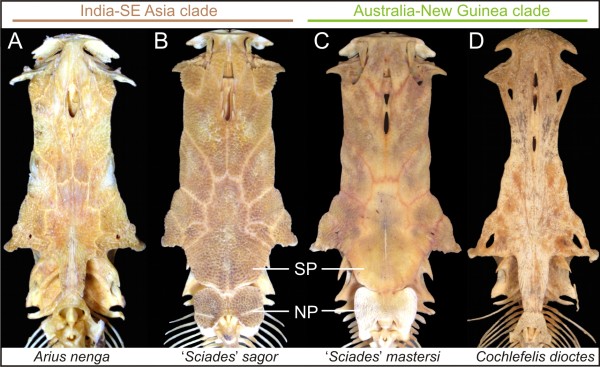
While the topologies obtained support the monophyly of basal groups, up to ten genera validated in previous morphological studies were incongruent with the molecular topologies. New World ariines were recovered as paraphyletic and Old World ariines were grouped into a well-supported clade that was further divided into subclades mainly restricted to major Gondwanan landmasses. A general area cladogram derived from the area cladograms of ariines and three other fish groups was largely congruent with the geological area cladogram of Gondwana. Nonetheless, molecular clock estimations provided variable results on the timing of ariine diversification (approximately 105-41 mya).
This study provides the most comprehensive phylogeny of sea catfishes to date and highlights the need for re-assessment of their classification. While from a topological standpoint the evolutionary history of ariines is mostly congruent with vicariance associated with the sequence of events during Gondwanan fragmentation, ambiguous divergence time estimations hinders assessing the vicariant hypothesis on a temporal framework. Further examination of ariid fossils might provide the basis for more accurate inferences on the timing of ariine diversification.
海鲶科鱼类或海鲶是两个骨鳔总目鱼类家族之一(在四个目约67个家族中),主要栖息于海洋和咸淡水水域(尽管有些物种仅生活在淡水环境中)。该类群包括超过150个物种,分置于约29个属和两个亚科(海鲶亚科和阿里鲶亚科)。尽管海鲶分布于全球,但部分由于其特殊的繁殖行为(即口孵),它们主要局限于大陆架区域。因此,在海洋鱼类中,海鲶为推断历史生物地理情景提供了绝佳机会。现有的海鲶系统发育假说聚焦于有限的地理区域,全面的系统发育研究仍付阙如。本研究利用线粒体和核序列(总长约4 kb),推断了来自不同生物地理省份的28个属中123种海鲶的系统发育假说。
虽然所获拓扑结构支持基部类群的单系性,但先前形态学研究中确认的多达十个属与分子拓扑结构不一致。新大陆阿里鲶亚科被发现为并系群,而旧大陆阿里鲶亚科被归入一个得到有力支持的分支,该分支进一步分为主要局限于冈瓦纳大陆主要陆块的亚分支。从阿里鲶亚科和其他三个鱼类类群的区域分支图得出的总体区域分支图与冈瓦纳地质区域分支图基本一致。然而,分子钟估计在阿里鲶亚科多样化的时间(约1.05亿至4100万年前)上给出了不同结果。
本研究提供了迄今为止最全面的海鲶系统发育研究,并强调了重新评估其分类的必要性。从拓扑结构角度看,阿里鲶亚科的进化历史大多与冈瓦纳大陆分裂期间一系列事件相关的隔离分化相一致,但模糊的分歧时间估计阻碍了在时间框架内评估隔离分化假说。对海鲶化石的进一步研究可能为更准确推断阿里鲶亚科多样化时间提供依据。