Blum Galia, Weimer Robby M, Edgington Laura E, Adams Walter, Bogyo Matthew
Department of Pathology, Stanford University School of Medicine, Stanford, California, United States of America.
PLoS One. 2009 Jul 28;4(7):e6374. doi: 10.1371/journal.pone.0006374.
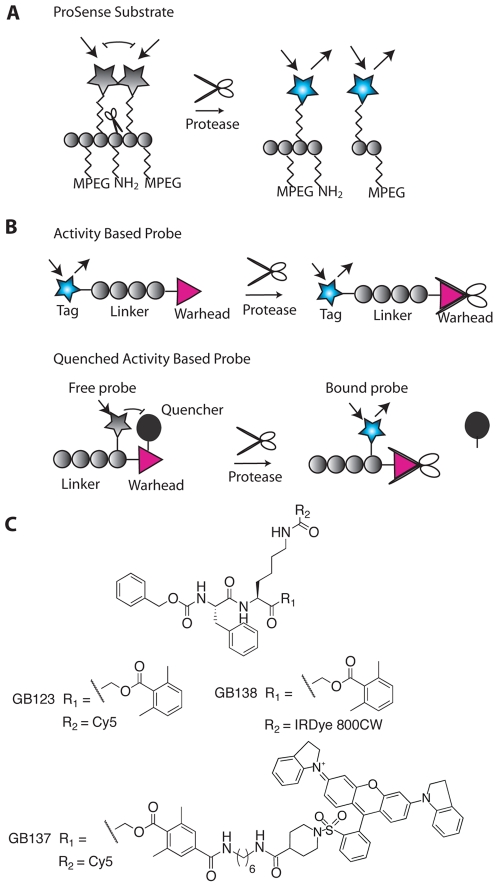
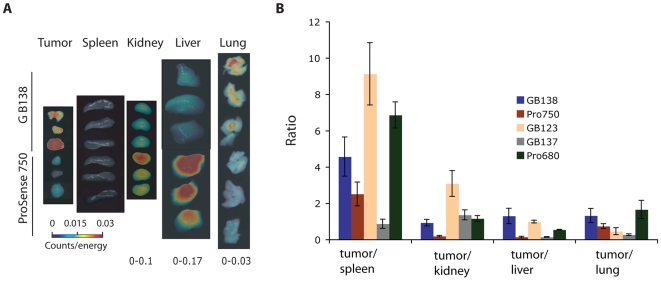
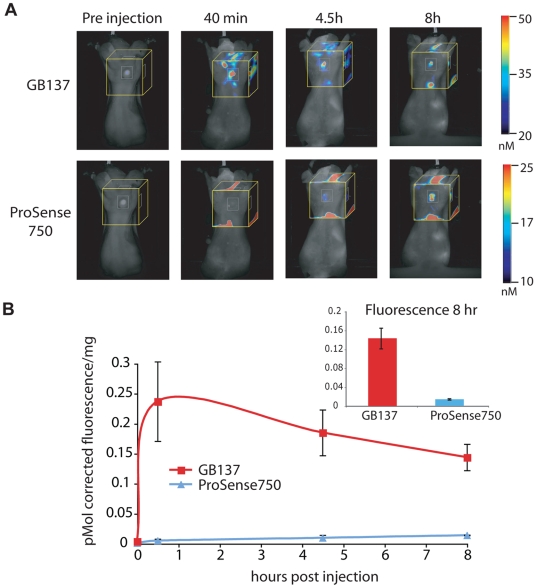
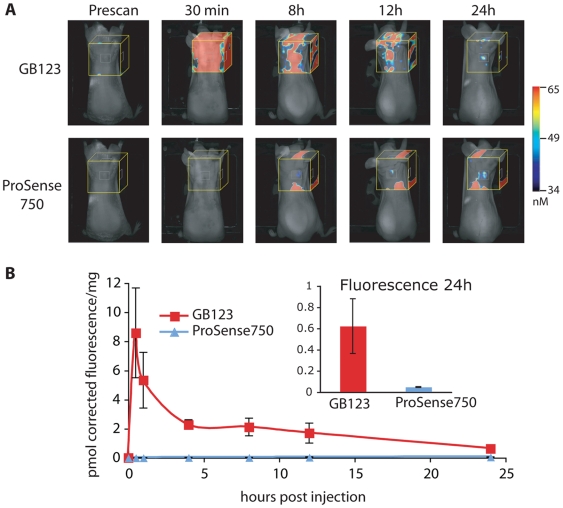
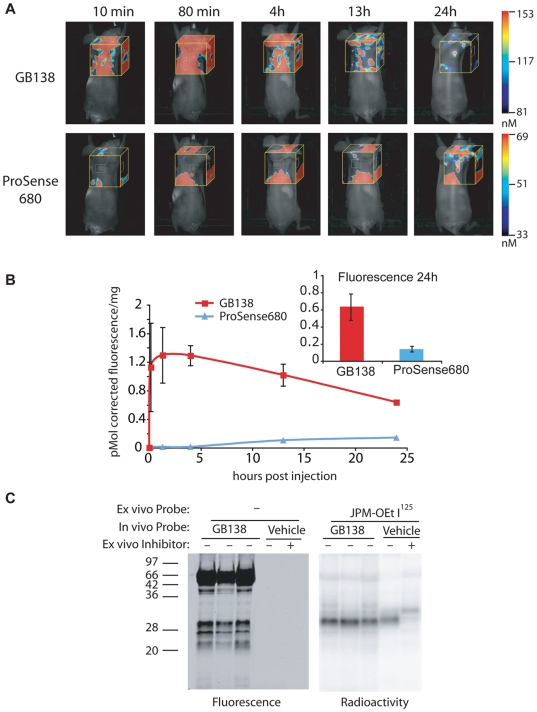
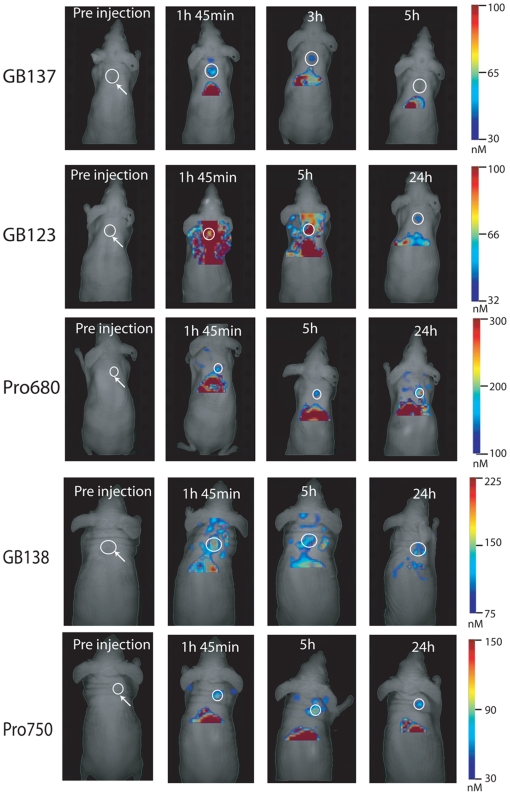
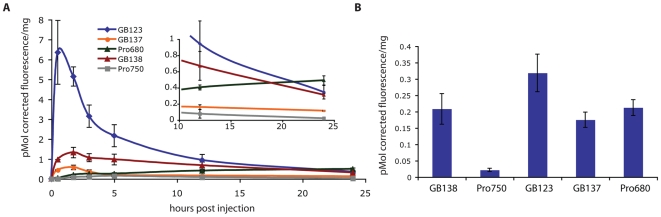
Recent advances in the field of non-invasive optical imaging have included the development of contrast agents that report on the activity of enzymatic targets associated with disease pathology. In particular, proteases have proven to be ideal targets for development of optical sensors for cancer. Recently developed contrast agents for protease activity include both small peptides and large polymer-based quenched fluorescent substrates as well as fluorescently labeled activity based probes (ABPs). While substrates produce a fluorescent signal as a result of processing by a protease, ABPs are retained at the site of proteolysis due to formation of a permanent covalent bond with the active site catalytic residue. Both methods have potential advantages and disadvantages yet a careful comparison of substrates and ABPs has not been performed. Here we present the results of a direct comparison of commercially available protease substrates with several recently described fluorescent ABPs in a mouse model of cancer. The results demonstrate that fluorescent ABPs show more rapid and selective uptake into tumors as well as overall brighter signals compared to substrate probes. These data suggest that the lack of signal amplification for an ABP is offset by the increased kinetics of tissue uptake and prolonged retention of the probes once bound to a protease target. Furthermore, fluorescent ABPs can be used as imaging reagents with similar or better results as the commercially available protease substrates.
非侵入性光学成像领域的最新进展包括开发了能够报告与疾病病理相关的酶靶点活性的造影剂。特别是,蛋白酶已被证明是开发癌症光学传感器的理想靶点。最近开发的用于蛋白酶活性的造影剂包括小肽和基于聚合物的大型淬灭荧光底物以及荧光标记的活性基探针(ABP)。虽然底物在蛋白酶处理后会产生荧光信号,但由于与活性位点催化残基形成永久共价键,ABP会保留在蛋白水解位点。这两种方法都有潜在的优缺点,但尚未对底物和ABP进行仔细比较。在此,我们展示了在癌症小鼠模型中对市售蛋白酶底物与几种最近描述的荧光ABP进行直接比较的结果。结果表明,与底物探针相比,荧光ABP显示出更快、更具选择性地摄取到肿瘤中,以及整体更亮的信号。这些数据表明,ABP缺乏信号放大的问题被组织摄取动力学的增加以及探针一旦与蛋白酶靶点结合后的延长保留所抵消。此外,荧光ABP可以用作成像试剂,其结果与市售蛋白酶底物相似或更好。