Madroñal Noelia, Gruart Agnès, Delgado-García José M
División de Neurociencias, Universidad Pablo de Olavide Sevilla, Spain.
Front Behav Neurosci. 2009 May 29;3:7. doi: 10.3389/neuro.08.007.2009. eCollection 2009.
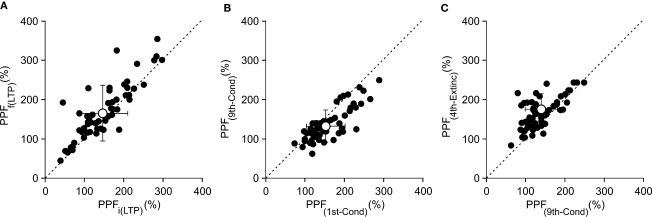
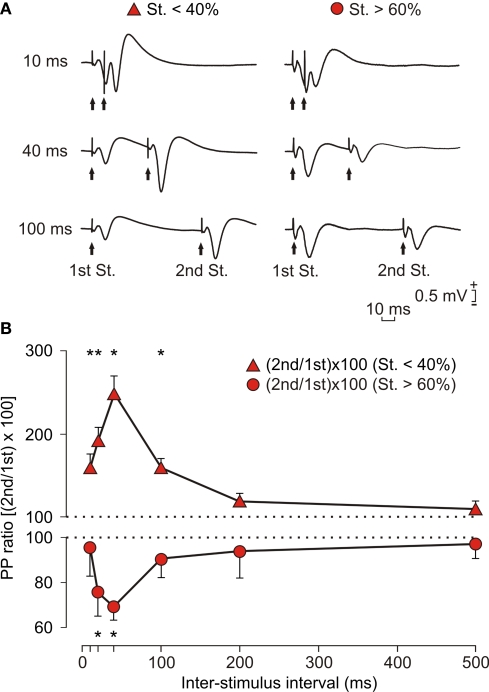
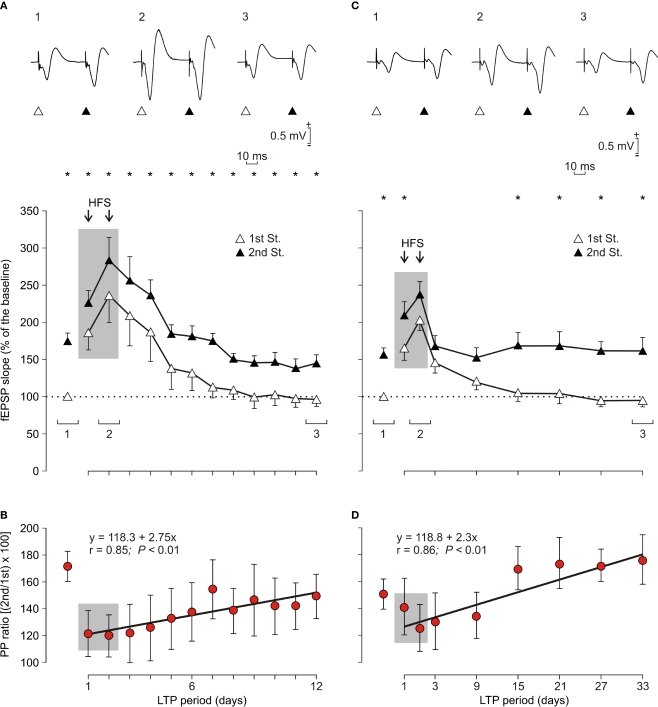
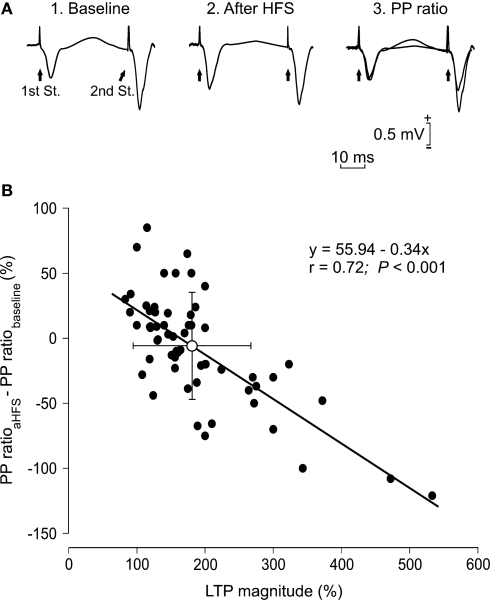
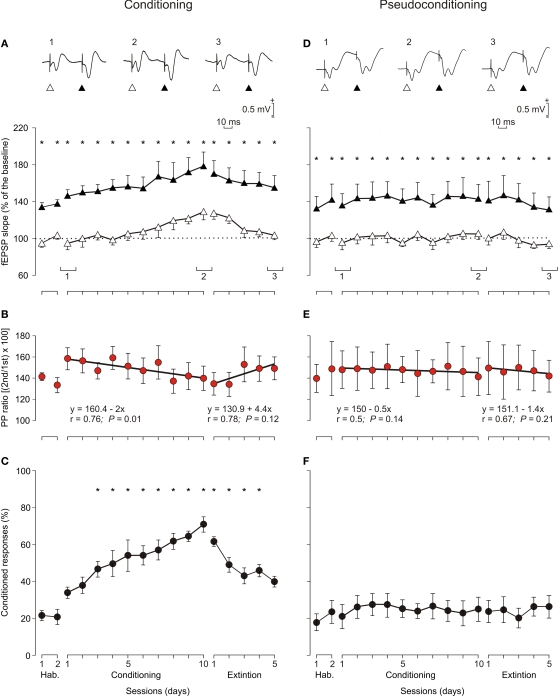
The hippocampal CA3-CA1 synapse is an excellent experimental model for studying the interactions between short- and long-term plastic changes taking place following high-frequency stimulation (HFS) of Schaffer collaterals and during the acquisition and extinction of a classical eyeblink conditioning in behaving mice. Input/output curves and a full-range paired-pulse study enabled determining the optimal intensities and inter-stimulus intervals for evoking paired-pulse facilitation (PPF) or depression (PPD) at the CA3-CA1 synapse. Long-term potentiation (LTP) induced by HFS lasted approximately 10 days. HFS-induced LTP evoked an initial depression of basal PPF. Recovery of PPF baseline values was a steady and progressive process lasting approximately 20 days, i.e., longer than the total duration of the LTP. In a subsequent series of experiments, we checked whether PPF was affected similarly during activity-dependent synaptic changes. Animals were conditioned using a trace paradigm, with a tone as a conditioned stimulus (CS) and an electrical shock to the trigeminal nerve as an unconditioned stimulus (US). A pair of pulses (40 ms interval) was presented to the Schaffer collateral-commissural pathway to evoke field EPSPs (fEPSPs) during the CS-US interval. Basal PPF decreased steadily across conditioning sessions (i.e., in the opposite direction to that during LTP), reaching a minimum value during the 10th conditioning session. Thus, LTP and classical eyeblink conditioning share some presynaptic mechanisms, but with an opposite evolution. Furthermore, PPF and PPD might play a homeostatic role during long-term plastic changes at the CA3-CA1 synapse.
海马体CA3-CA1突触是一个出色的实验模型,可用于研究在对行为小鼠的施affer侧支进行高频刺激(HFS)后以及在经典眨眼条件反射的习得和消退过程中发生的短期和长期可塑性变化之间的相互作用。输入/输出曲线和全范围配对脉冲研究能够确定在CA3-CA1突触处诱发配对脉冲易化(PPF)或抑制(PPD)的最佳强度和刺激间隔。HFS诱导的长时程增强(LTP)持续约10天。HFS诱导的LTP引起基础PPF的初始抑制。PPF基线值的恢复是一个持续约20天的稳定且渐进的过程,即长于LTP的总持续时间。在随后的一系列实验中,我们检查了在活动依赖性突触变化期间PPF是否受到类似影响。使用痕迹范式对动物进行条件训练,以音调作为条件刺激(CS),对三叉神经施加电击作为非条件刺激(US)。在CS-US间隔期间,向施affer侧支-连合通路施加一对脉冲(间隔40毫秒)以诱发场兴奋性突触后电位(fEPSP)。基础PPF在整个条件训练过程中稳步下降(即与LTP期间的方向相反),在第10次条件训练期间达到最小值。因此,LTP和经典眨眼条件反射共享一些突触前机制,但具有相反的演变。此外,PPF和PPD可能在CA3-CA1突触的长期可塑性变化中发挥稳态作用。