Fleury Elodie, Huvet Arnaud, Lelong Christophe, de Lorgeril Julien, Boulo Viviane, Gueguen Yannick, Bachère Evelyne, Tanguy Arnaud, Moraga Dario, Fabioux Caroline, Lindeque Penelope, Shaw Jenny, Reinhardt Richard, Prunet Patrick, Davey Grace, Lapègue Sylvie, Sauvage Christopher, Corporeau Charlotte, Moal Jeanne, Gavory Frederick, Wincker Patrick, Moreews François, Klopp Christophe, Mathieu Michel, Boudry Pierre, Favrel Pascal
UMR M100 Ifremer-Université de Caen Basse-Normandie Physiologie et Ecophysiologie des Mollusques Marins, Centre de Brest, B,P, 70, 29280 Plouzané/IBFA, IFR ICORE 146, Esplanade de la Paix, 14032 Caen Cedex, France.
BMC Genomics. 2009 Jul 29;10:341. doi: 10.1186/1471-2164-10-341.
Although bivalves are among the most-studied marine organisms because of their ecological role and economic importance, very little information is available on the genome sequences of oyster species. This report documents three large-scale cDNA sequencing projects for the Pacific oyster Crassostrea gigas initiated to provide a large number of expressed sequence tags that were subsequently compiled in a publicly accessible database. This resource allowed for the identification of a large number of transcripts and provides valuable information for ongoing investigations of tissue-specific and stimulus-dependant gene expression patterns. These data are crucial for constructing comprehensive DNA microarrays, identifying single nucleotide polymorphisms and microsatellites in coding regions, and for identifying genes when the entire genome sequence of C. gigas becomes available.
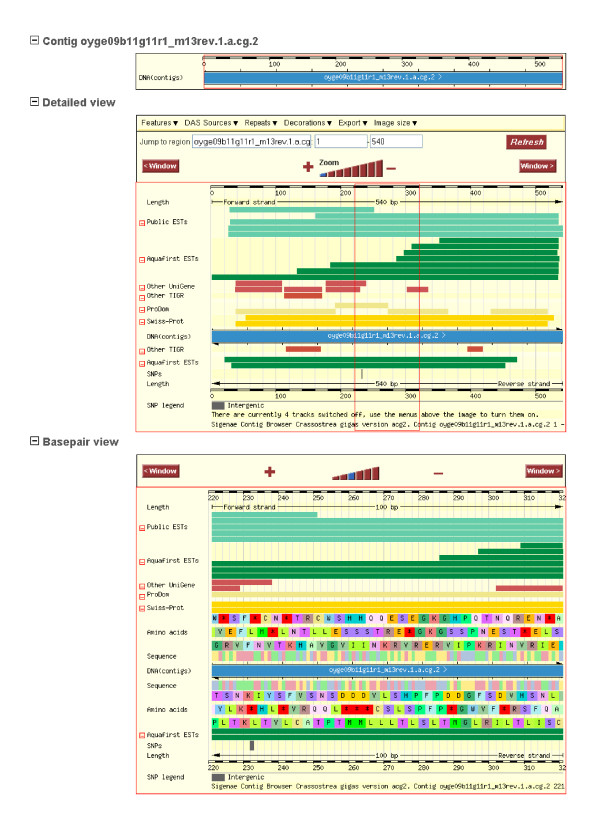
In the present paper, we report the production of 40,845 high-quality ESTs that identify 29,745 unique transcribed sequences consisting of 7,940 contigs and 21,805 singletons. All of these new sequences, together with existing public sequence data, have been compiled into a publicly-available Website http://public-contigbrowser.sigenae.org:9090/Crassostrea_gigas/index.html. Approximately 43% of the unique ESTs had significant matches against the SwissProt database and 27% were annotated using Gene Ontology terms. In addition, we identified a total of 208 in silico microsatellites from the ESTs, with 173 having sufficient flanking sequence for primer design. We also identified a total of 7,530 putative in silico, single-nucleotide polymorphisms using existing and newly-generated EST resources for the Pacific oyster.
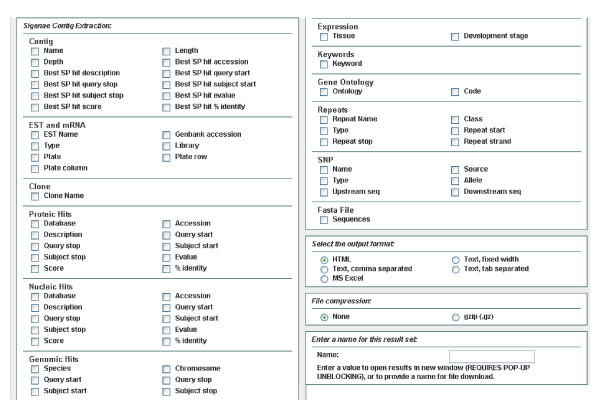
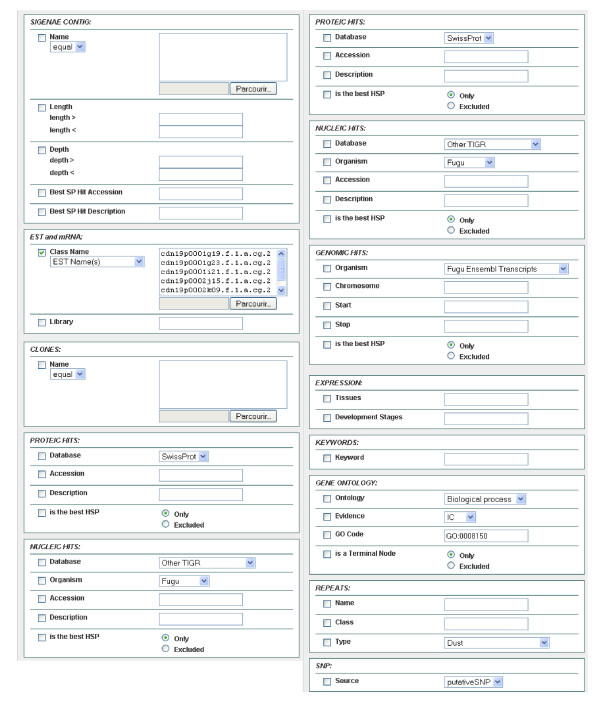
A publicly-available database has been populated with 29,745 unique sequences for the Pacific oyster Crassostrea gigas. The database provides many tools to search cleaned and assembled ESTs. The user may input and submit several filters, such as protein or nucleotide hits, to select and download relevant elements. This database constitutes one of the most developed genomic resources accessible among Lophotrochozoans, an orphan clade of bilateral animals. These data will accelerate the development of both genomics and genetics in a commercially-important species with the highest annual, commercial production of any aquatic organism.
双壳贝类因其生态作用和经济重要性而成为研究最多的海洋生物之一,但关于牡蛎物种基因组序列的信息却非常少。本报告记录了针对太平洋牡蛎(Crassostrea gigas)开展的三个大规模cDNA测序项目,旨在提供大量表达序列标签,这些标签随后被汇编到一个可公开访问的数据库中。该资源有助于识别大量转录本,并为正在进行的组织特异性和刺激依赖性基因表达模式研究提供有价值的信息。这些数据对于构建全面的DNA微阵列、识别编码区域中的单核苷酸多态性和微卫星,以及在太平洋牡蛎全基因组序列可用时识别基因至关重要。
在本文中,我们报告了40,845个高质量EST的产生,这些EST识别出29,745个独特的转录序列,包括7,940个重叠群和21,805个单拷贝序列。所有这些新序列,连同现有的公共序列数据,已被汇编到一个可公开访问的网站http://public-contigbrowser.sigenae.org:9090/Crassostrea_gigas/index.html中。约43%的独特EST与SwissProt数据库有显著匹配,27%使用基因本体术语进行了注释。此外,我们从EST中总共鉴定出208个电子微卫星,其中173个具有足够的侧翼序列用于引物设计。我们还利用太平洋牡蛎现有的和新生成的EST资源总共鉴定出7,530个推定的电子单核苷酸多态性。
一个可公开访问的数据库已收录了29,745个太平洋牡蛎(Crassostrea gigas)的独特序列。该数据库提供了许多工具来搜索经过清理和组装的EST。用户可以输入并提交几个筛选条件,如蛋白质或核苷酸匹配,以选择和下载相关元件。该数据库是触手冠动物(双侧动物的一个孤立分支)中最发达的基因组资源之一。这些数据将加速一个商业上重要物种的基因组学和遗传学发展,该物种的年商业产量在所有水生生物中最高。