Fregel Rosa, Gomes Verónica, Gusmão Leonor, González Ana M, Cabrera Vicente M, Amorim António, Larruga Jose M
Department of Genetics, University of La Laguna, Avda. Astrofísico Fco, Sánchez, La Laguna, 38271 Santa Cruz de Tenerife, Spain.
BMC Evol Biol. 2009 Aug 3;9:181. doi: 10.1186/1471-2148-9-181.
The origin and prevalence of the prehispanic settlers of the Canary Islands has attracted great multidisciplinary interest. However, direct ancient DNA genetic studies on indigenous and historical 17th-18th century remains, using mitochondrial DNA as a female marker, have only recently been possible. In the present work, the analysis of Y-chromosome polymorphisms in the same samples, has shed light on the way the European colonization affected male and female Canary Island indigenous genetic pools, from the conquest to present-day times.
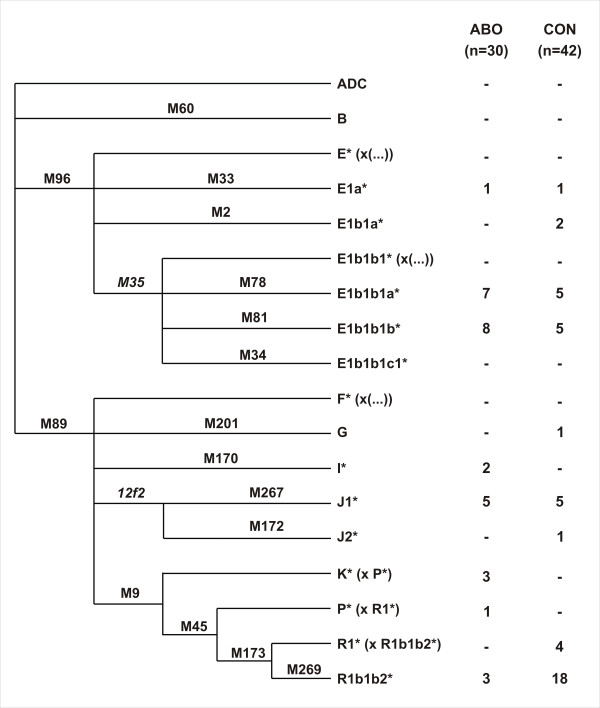
Autochthonous (E-M81) and prominent (E-M78 and J-M267) Berber Y-chromosome lineages were detected in the indigenous remains, confirming a North West African origin for their ancestors which confirms previous mitochondrial DNA results. However, in contrast with their female lineages, which have survived in the present-day population since the conquest with only a moderate decline, the male indigenous lineages have dropped constantly being substituted by European lineages. Male and female sub-Saharan African genetic inputs were also detected in the Canary population, but their frequencies were higher during the 17th-18th centuries than today.
The European colonization of the Canary Islands introduced a strong sex-biased change in the indigenous population in such a way that indigenous female lineages survived in the extant population in a significantly higher proportion than their male counterparts.
加那利群岛前西班牙时期定居者的起源和流行情况引起了多学科的极大兴趣。然而,直到最近才有可能对17至18世纪本土和历史遗迹进行直接的古DNA基因研究,使用线粒体DNA作为女性标记。在本研究中,对相同样本中的Y染色体多态性进行分析,揭示了从征服时期到现代欧洲殖民对加那利群岛本土男性和女性基因库的影响方式。
在本土遗迹中检测到了本土的(E-M81)以及显著的(E-M78和J-M267)柏柏尔人Y染色体谱系,证实了其祖先来自西北非,这与之前线粒体DNA的研究结果相符。然而,与女性谱系自征服时期以来在现代人群中仅适度减少而得以留存不同,男性本土谱系持续减少,被欧洲谱系所取代。在加那利人群中也检测到了撒哈拉以南非洲人的男性和女性基因输入,但它们在17至18世纪的频率高于当今。
加那利群岛的欧洲殖民对本土人口引入了强烈的性别偏向性变化,使得本土女性谱系在现存人群中的留存比例显著高于男性。