Populations Genetics and Identification Group, Institute of Genetics, Universidad Nacional de Colombia, Bogotá, Colombia.
Laboratório de Toxicologia e Química Farmacêutica, Departamento de Ciências da Saúde e Biológicas, Universidade Federal do Amapá, Macapá, Brazil.
PLoS One. 2018 Nov 15;13(11):e0207130. doi: 10.1371/journal.pone.0207130. eCollection 2018.
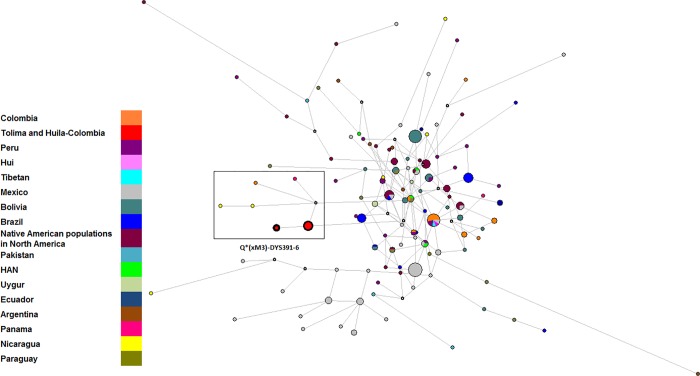
The valley of the Magdalena River is one of the main population pathways in Colombia. The gene pool and spatial configuration of human groups in this territory have been outlined throughout three historical stages: the Native pre-Hispanic world, Spanish colonization, and XIX century migrations. This research was designed with the goal of characterizing the diversity and distribution pattern of Y-chromosome lineages that are currently present in the Tolima and Huila departments (middle Magdalena River region). Historic cartography was used to identify the main geographic sites where the paternal lineages belonging to this area have gathered. Twelve municipalities were chosen, and a survey that included genealogical information was administered. Samples collected from 83 male volunteers were analyzed for 48 Y-SNPs and 17 Y-STRs. The results showed a highly diverse region characterized by the presence of 16 sublineages within the major clades R, Q, J, G, T and E and revealed that 93% (n = 77) of haplotypes were different. Among these haplogroups, European-specific R1b-M269 lineages were the most representative (57.83%), with six different subhaplogroups and 43 unique haplotypes. Native American paternal ancestry was also detected based on the presence of the Q1a2-M3*(xM19, M194, M199) and Q1a2-M346*(xM3) lineages. Interestingly, all Q1a2-M346*(xM3) samples (n = 7, with five different haplotypes) carried allele six at the DYS391 locus. This allele has a worldwide frequency of 0.169% and was recently associated with a new Native subhaplogroup. An in-depth phylogenetic analysis of these samples suggests the Tolima and Huila region to be the principal area in all Central and South America where this particular Native lineage is found. This lineage has been present in the region for at least 1,809 (+/- 0,5345) years.
马格达莱纳河谷是哥伦比亚主要的人口通道之一。该地区人类群体的基因库和空间结构可以追溯到三个历史阶段:土著前西班牙时期、西班牙殖民时期和 19 世纪的移民时期。这项研究的目的是描述目前在托利马省和胡拉省(马格达莱纳河中游地区)存在的 Y 染色体谱系的多样性和分布模式。历史制图学被用来确定属于该地区的父系谱系主要聚集的主要地理地点。选择了 12 个城市,并进行了一项包括家谱信息的调查。从 83 名男性志愿者中采集的样本用于分析 48 个 Y-SNPs 和 17 个 Y-STRs。结果表明,该地区是一个高度多样化的地区,主要支系 R、Q、J、G、T 和 E 中存在 16 个亚支系,表明 93%(n=77)的单倍型不同。在这些单倍群中,欧洲特有的 R1b-M269 谱系最为代表(57.83%),有六个不同的亚支系和 43 个独特的单倍型。基于 Q1a2-M3*(xM19、M194、M199)和 Q1a2-M346*(xM3)谱系的存在,也检测到了美洲原住民的父系祖先。有趣的是,所有 Q1a2-M346*(xM3)样本(n=7,有 5 个不同的单倍型)在 DYS391 基因座上携带等位基因 6。该等位基因在全球的频率为 0.169%,最近与一个新的美洲原住民亚支系有关。对这些样本的深入系统发育分析表明,托利马省和胡拉省是该特定美洲原住民谱系在整个中美洲和南美洲发现的主要地区。该谱系在该地区已经存在了至少 1809(+/-0.5345)年。