Foncéka Daniel, Hodo-Abalo Tossim, Rivallan Ronan, Faye Issa, Sall Mbaye Ndoye, Ndoye Ousmane, Fávero Alessandra P, Bertioli David J, Glaszmann Jean-Christophe, Courtois Brigitte, Rami Jean-Francois
Centre de Coopération Internationale en Recherche Agronomique pour le Développement (Cirad), UMR Développement et Amélioration des Plantes, TA A96/3 Avenue Agropolis, Montpellier, France.
BMC Plant Biol. 2009 Aug 3;9:103. doi: 10.1186/1471-2229-9-103.
Peanut (Arachis hypogaea L.) is widely used as a food and cash crop around the world. It is considered to be an allotetraploid (2n = 4x = 40) originated from a single hybridization event between two wild diploids. The most probable hypothesis gave A. duranensis as the wild donor of the A genome and A. ipaënsis as the wild donor of the B genome. A low level of molecular polymorphism is found in cultivated germplasm and up to date few genetic linkage maps have been published. The utilization of wild germplasm in breeding programs has received little attention due to the reproductive barriers between wild and cultivated species and to the technical difficulties encountered in making large number of crosses. We report here the development of a SSR based genetic map and the analysis of genome-wide segment introgressions into the background of a cultivated variety through the utilization of a synthetic amphidiploid between A. duranensis and A. ipaënsis.
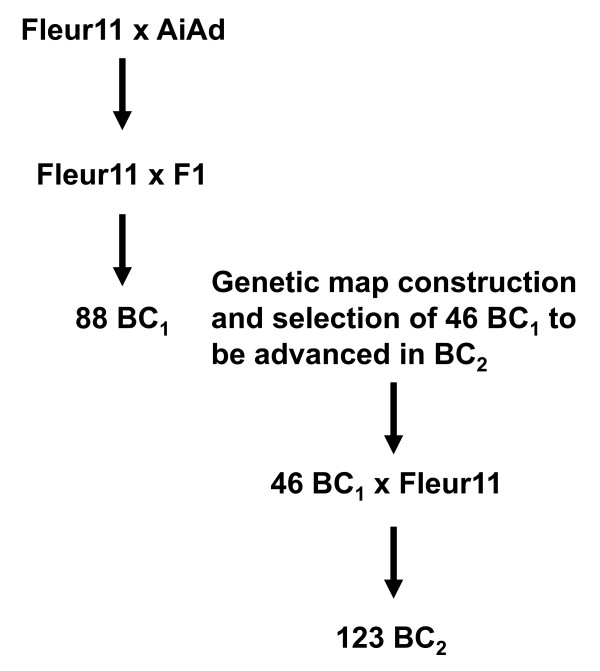
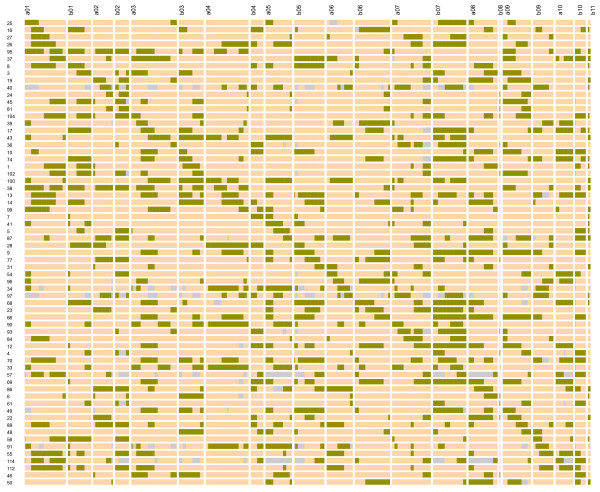
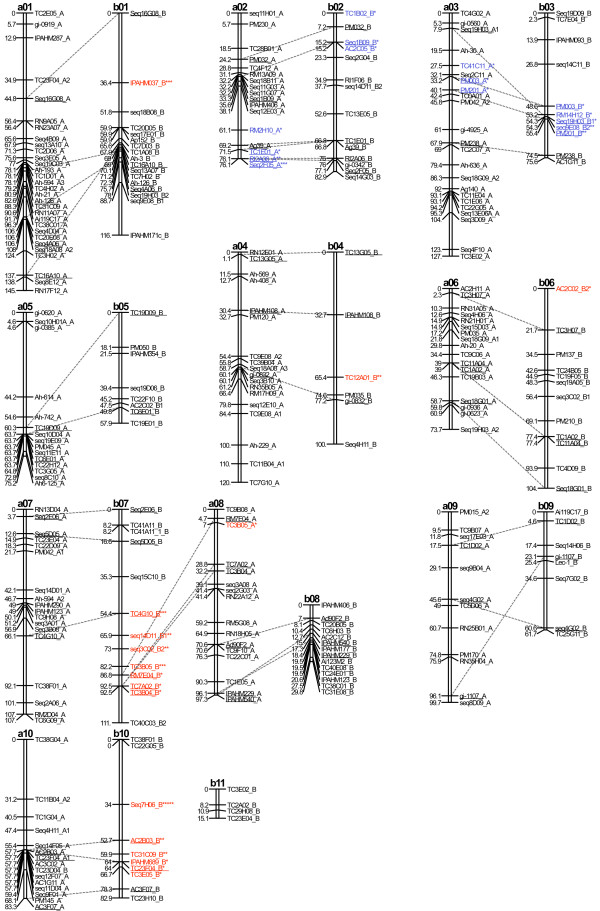
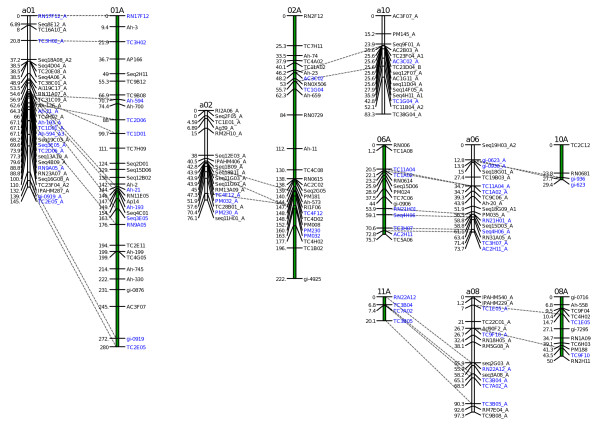
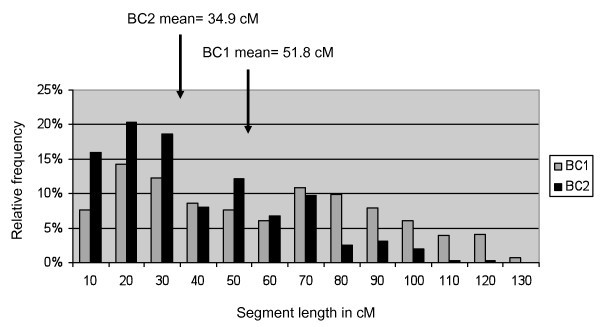
Two hundred ninety eight (298) loci were mapped in 21 linkage groups (LGs), spanning a total map distance of 1843.7 cM with an average distance of 6.1 cM between adjacent markers. The level of polymorphism observed between the parent of the amphidiploid and the cultivated variety is consistent with A. duranensis and A. ipaënsis being the most probable donor of the A and B genomes respectively. The synteny analysis between the A and B genomes revealed an overall good collinearity of the homeologous LGs. The comparison with the diploid and tetraploid maps shed new light on the evolutionary forces that contributed to the divergence of the A and B genome species and raised the question of the classification of the B genome species. Structural modifications such as chromosomal segment inversions and a major translocation event prior to the tetraploidisation of the cultivated species were revealed. Marker assisted selection of BC1F1 and then BC2F1 lines carrying the desirable donor segment with the best possible return to the background of the cultivated variety provided a set of lines offering an optimal distribution of the wild introgressions.
The genetic map developed, allowed the synteny analysis of the A and B genomes, the comparison with diploid and tetraploid maps and the analysis of the introgression segments from the wild synthetic into the background of a cultivated variety. The material we have produced in this study should facilitate the development of advanced backcross and CSSL breeding populations for the improvement of cultivated peanut.
花生(Arachis hypogaea L.)在全球广泛用作粮食和经济作物。它被认为是一种异源四倍体(2n = 4x = 40),起源于两个野生二倍体之间的一次杂交事件。最有可能的假说是,A基因组的野生供体为A. duranensis,B基因组的野生供体为A. ipaënsis。在栽培种质中发现的分子多态性水平较低,迄今为止几乎没有已发表的遗传连锁图谱。由于野生种与栽培种之间的生殖障碍以及进行大量杂交时遇到的技术困难,野生种质在育种计划中的利用很少受到关注。我们在此报告基于简单序列重复(SSR)的遗传图谱的构建,以及通过利用A. duranensis和A. ipaënsis之间的合成双二倍体,对栽培品种背景下全基因组片段渗入情况的分析。
298个位点被定位到21个连锁群(LGs)中,总图距为1843.7厘摩(cM),相邻标记之间的平均距离为6.1 cM。在双二倍体亲本与栽培品种之间观察到的多态性水平与A. duranensis和A. ipaënsis分别作为A和B基因组最有可能的供体一致。A和B基因组之间的共线性分析揭示了同源LGs总体上具有良好的共线性。与二倍体和四倍体图谱的比较为导致A和B基因组物种分化的进化力量提供了新的线索,并引发了B基因组物种分类的问题。揭示了栽培物种四倍体化之前的结构修饰,如染色体片段倒位和一次主要的易位事件。通过标记辅助选择携带理想供体片段且尽可能回归栽培品种背景的BC1F1和随后的BC2F1株系,提供了一组具有野生渗入最佳分布的株系。
所构建的遗传图谱允许对A和B基因组进行共线性分析、与二倍体和四倍体图谱进行比较,以及分析从野生合成种到栽培品种背景的渗入片段。我们在本研究中产生的材料应有助于开发用于改良栽培花生的高级回交和染色体片段代换系(CSSL)育种群体。