Hrisos Susan, Eccles Martin P, Francis Jill J, Bosch Marije, Dijkstra Rob, Johnston Marie, Grol Richard, Kaner Eileen F S, Steen Ian N
Institute of Health and Society, Newcastle University, Newcastle Upon Tyne, UK.
BMC Health Serv Res. 2009 Aug 5;9:140. doi: 10.1186/1472-6963-9-140.
Long term management of patients with Type 2 diabetes is well established within Primary Care. However, despite extensive efforts to implement high quality care both service provision and patient health outcomes remain sub-optimal. Several recent studies suggest that psychological theories about individuals' behaviour can provide a valuable framework for understanding generalisable factors underlying health professionals' clinical behaviour. In the context of the team management of chronic disease such as diabetes, however, the application of such models is less well established. The aim of this study was to identify motivational factors underlying health professional teams' clinical management of diabetes using a psychological model of human behaviour.
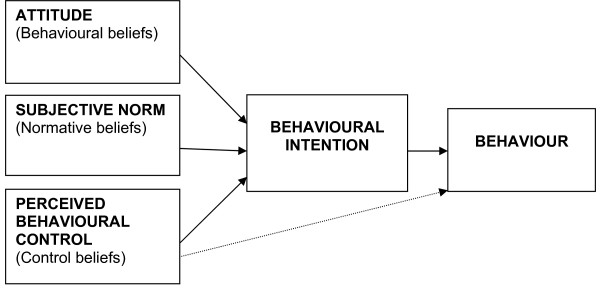
A predictive questionnaire based on the Theory of Planned Behaviour (TPB) investigated health professionals' (HPs') cognitions (e.g., beliefs, attitudes and intentions) about the provision of two aspects of care for patients with diabetes: prescribing statins and inspecting feet.General practitioners and practice nurses in England and the Netherlands completed parallel questionnaires, cross-validated for equivalence in English and Dutch. Behavioural data were practice-level patient-reported rates of foot examination and use of statin medication. Relationships between the cognitive antecedents of behaviour proposed by the TPB and healthcare teams' clinical behaviour were explored using multiple regression.
In both countries, attitude and subjective norm were important predictors of health professionals' intention to inspect feet (Attitude: beta = .40; Subjective Norm: beta = .28; Adjusted R2 = .34, p < 0.01), and their intention to prescribe statins (Attitude: beta = .44; Adjusted R2 = .40, p < 0.01). Individuals' self-reported intention did not predict practice-level performance of either clinical behaviour.
Using the TPB, we identified modifiable factors underlying health professionals' intentions to perform two clinical behaviours, providing a rationale for the development of targeted interventions. However, we did not observe a relationship between health professionals' intentions and our proxy measure of team behaviour. Significant methodological issues were highlighted concerning the use of models of individual behaviour to explain behaviours performed by teams. In order to investigate clinical behaviours performed by teams it may be necessary to develop measures that reflect the collective cognitions of the members of the team to facilitate the application of these theoretical models to team behaviours.
2型糖尿病患者的长期管理在基层医疗中已得到充分确立。然而,尽管为实施高质量护理付出了巨大努力,但服务提供和患者健康结果仍不尽人意。最近的几项研究表明,关于个体行为的心理学理论可以为理解健康专业人员临床行为背后的普遍因素提供有价值的框架。然而,在糖尿病等慢性病的团队管理背景下,此类模型的应用尚不十分成熟。本研究的目的是使用人类行为心理学模型来确定健康专业团队糖尿病临床管理背后的动机因素。
基于计划行为理论(TPB)的预测性问卷调查了健康专业人员(HPs)对为糖尿病患者提供两方面护理的认知(如信念、态度和意图):开具他汀类药物和检查足部。英格兰和荷兰的全科医生和执业护士完成了平行问卷,并对英文和荷兰文版本进行了等效性交叉验证。行为数据是实践层面患者报告的足部检查率和他汀类药物使用情况。使用多元回归探讨了TPB提出的行为认知前因与医疗团队临床行为之间的关系。
在两个国家,态度和主观规范都是健康专业人员检查足部意图的重要预测因素(态度:β = 0.40;主观规范:β = 0.28;调整后R² = 0.34,p < 0.01),以及他们开具他汀类药物的意图(态度:β = 0.44;调整后R² = 0.40,p < 0.01)。个体自我报告的意图并不能预测这两种临床行为在实践层面的表现。
使用TPB,我们确定了健康专业人员执行两种临床行为意图背后的可改变因素,为制定有针对性的干预措施提供了理论依据。然而,我们没有观察到健康专业人员的意图与我们对团队行为的替代指标之间的关系。关于使用个体行为模型来解释团队行为,突出了重大的方法学问题。为了研究团队执行的临床行为,可能有必要开发反映团队成员集体认知的测量方法,以促进这些理论模型在团队行为中的应用。