Mehrotra Rajnish, Kermah Dulcie A, Salusky Isidro B, Wolf Myles S, Thadhani Ravi I, Chiu Yi-Wen, Martins David, Adler Sharon G, Norris Keith C
Division of Nephrology and Hypertension, Department of Medicine, Los Angeles Biomedical Research Institute, Torrance, California 90502, USA.
Kidney Int. 2009 Nov;76(9):977-83. doi: 10.1038/ki.2009.288. Epub 2009 Aug 5.
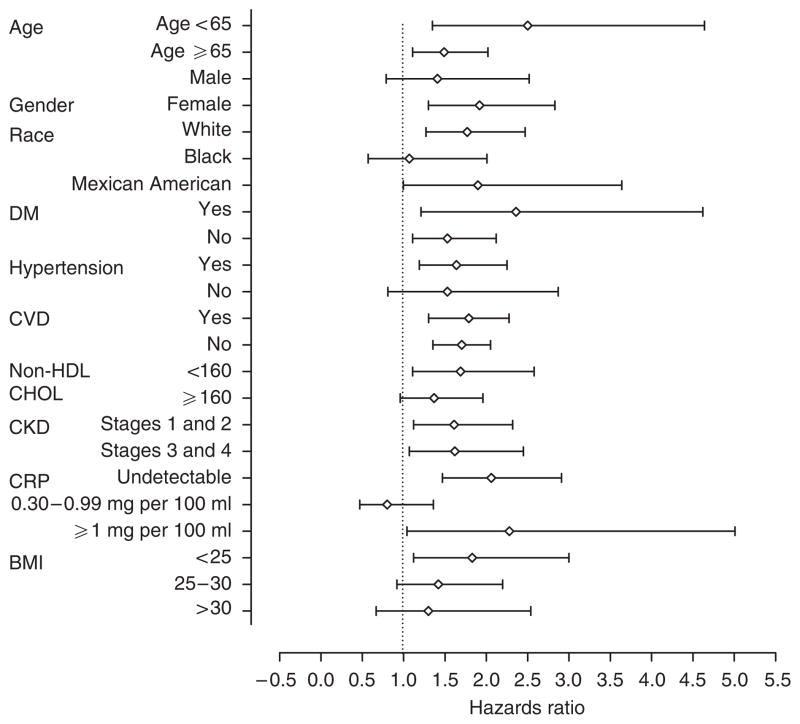
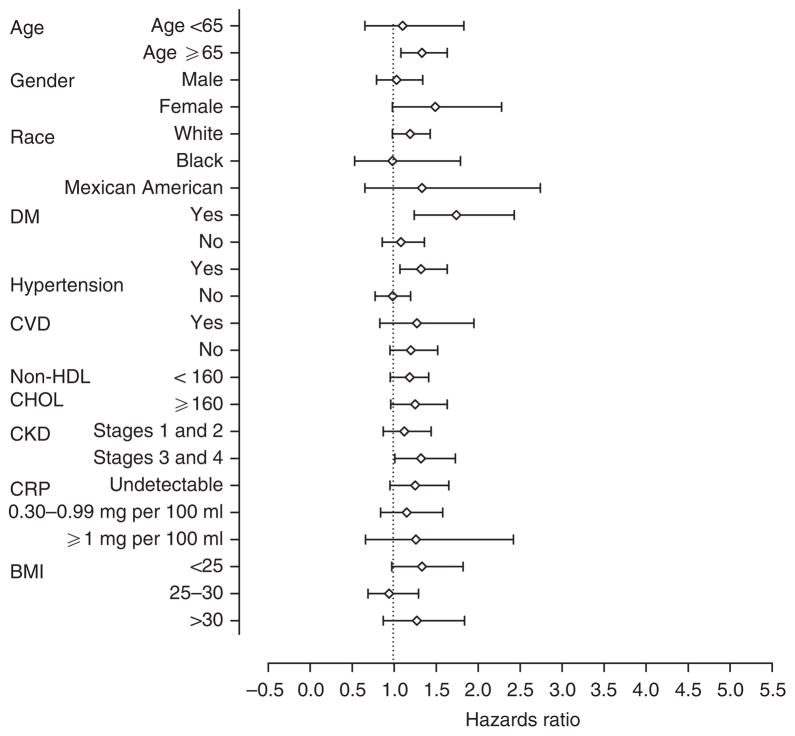
Low serum 25-hydroxy vitamin D (25OHD) predicts a higher cardiovascular risk in the general population. Because patients with chronic kidney disease are more likely to have low serum 25OHD, we determined the relationship between hypovitaminosis D and death in this group. Analysis was done using a cohort composed of 3011 patients from the Third National Health and Nutrition Examination Survey who had chronic kidney disease but were not on dialysis and who had a mean follow-up of 9 years. In analyses adjusted for demographics, cardiovascular risk factors, serum phosphorus, albumin, hemoglobin, stage of chronic kidney disease, albuminuria, and socioeconomic status, individuals with serum 25OHD levels less than 15 ng/ml had an increased risk for all-cause mortality when compared to those with levels over 30 ng/ml. This significantly higher risk for death with low serum 25OHD was evident in 15 of the 23 subgroups. The higher risk for cardiovascular and non-cardiovascular mortality became statistically nonsignificant on multivariable adjustment. The trend for higher mortality in patients with 25OHD levels 15-30 ng/ml was not statistically significant. Our results indicate there is a graded relationship between serum 25OHD and the risk for death among subjects with chronic kidney disease who are not undergoing dialysis. Randomized, controlled trials are needed to conclusively determine whether vitamin D supplementation reduces mortality.
血清25-羟维生素D(25OHD)水平低预示着普通人群心血管疾病风险更高。由于慢性肾脏病患者更易出现血清25OHD水平低的情况,我们确定了该人群中维生素D缺乏与死亡之间的关系。分析采用了来自第三次全国健康与营养检查调查的3011例慢性肾脏病患者组成的队列,这些患者未接受透析治疗,平均随访9年。在对人口统计学、心血管危险因素、血清磷、白蛋白、血红蛋白、慢性肾脏病分期、蛋白尿和社会经济状况进行校正后的分析中,血清25OHD水平低于15 ng/ml的个体与水平高于30 ng/ml的个体相比,全因死亡率风险增加。血清25OHD水平低导致的死亡风险显著更高在23个亚组中的15个亚组中很明显。在多变量校正后,心血管和非心血管死亡率的较高风险在统计学上不再显著。25OHD水平在15 - 30 ng/ml的患者中死亡率较高的趋势在统计学上不显著。我们的结果表明,在未接受透析治疗的慢性肾脏病患者中,血清25OHD与死亡风险之间存在分级关系。需要进行随机对照试验来最终确定补充维生素D是否能降低死亡率。