Lara Pedro C, Lloret Marta, Clavo Bernardino, Apolinario Rosa M, Henríquez-Hernández Luis Alberto, Bordón Elisa, Fontes Fausto, Rey Agustín
Radiation Oncology Department, Hospital Universitario de Gran Canaria Dr, Negrín, Spain.
Radiat Oncol. 2009 Aug 6;4:29. doi: 10.1186/1748-717X-4-29.
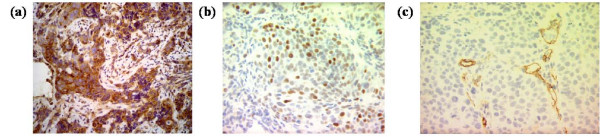
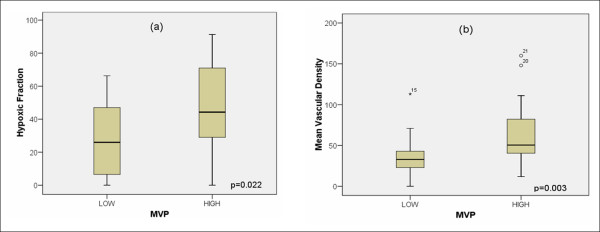
Oxygen molecule modulates tumour response to radiotherapy. Higher radiation doses are required under hypoxic conditions to induce cell death. Hypoxia may inhibit the non-homologous end-joining DNA repair through down regulating Ku70/80 expression. Hypoxia induces drug resistance in clinical tumours, although the mechanism is not clearly elucidated. Vaults are ribonucleoprotein particles with a hollow barrel-like structure composed of three proteins: major vault protein (MVP), vault poly(ADP-ribose) polymerase, and telomerase associated protein-1 and small untranslated RNA. Over-expression of MVP has been associated with chemotherapy resistance. Also, it has been related to poor outcome in patients treated with radiotherapy alone. The aim of the present study was to assess the relation of Major Vault Protein expression and tumor hypoxia in clinical cervical tumors. MVP, p53 and angiogenesis, together with tumor oxygenation, were determined in forty-three consecutive patients suffering from localized cervix carcinoma. High MVP expression was related to severe hypoxia compared to low MVP expressing tumors (p = 0.022). Tumors over-expressing MVP also showed increased angiogenesis (p = 0.003). Besides it, in this study we show for the first time that severe tumor hypoxia is associated with high MVP expression in clinical cervical tumors. Up-regulation of MVP by hypoxia is of critical relevance as chemotherapy is currently a standard treatment for those patients. From our results it could be suggested that hypoxia not only induces increased genetic instability, oncogenic properties and metastatization, but through the correlation observed with MVP expression, another pathway of chemo and radiation resistance could be developed.
氧分子调节肿瘤对放疗的反应。在缺氧条件下需要更高的辐射剂量来诱导细胞死亡。缺氧可能通过下调Ku70/80的表达来抑制非同源末端连接DNA修复。缺氧在临床肿瘤中诱导耐药性,尽管其机制尚未完全阐明。穹窿体是一种核糖核蛋白颗粒,具有由三种蛋白质组成的中空桶状结构:主要穹窿蛋白(MVP)、穹窿体聚(ADP-核糖)聚合酶、端粒酶相关蛋白-1和小非翻译RNA。MVP的过表达与化疗耐药有关。此外,它还与单纯接受放疗患者的不良预后有关。本研究的目的是评估临床宫颈癌中主要穹窿蛋白表达与肿瘤缺氧之间的关系。在43例连续的局限性宫颈癌患者中测定了MVP、p53和血管生成以及肿瘤氧合情况。与低MVP表达的肿瘤相比,高MVP表达与严重缺氧相关(p = 0.022)。过表达MVP的肿瘤也显示出血管生成增加(p = 0.003)。除此之外,在本研究中我们首次表明,临床宫颈癌中严重的肿瘤缺氧与高MVP表达相关。缺氧导致的MVP上调具有至关重要的意义,因为化疗目前是这些患者的标准治疗方法。从我们的结果可以推测,缺氧不仅会导致遗传不稳定性增加、致癌特性和转移,而且通过与MVP表达的相关性,可能会形成另一种化疗和放疗耐药途径。