Major Pierre P, Cook Richard J, Lipton Allan, Smith Matthew R, Terpos Evangelos, Coleman Robert E
McMaster University, Juravinski Cancer Centre, Hamilton, Ontario, Canada.
BMC Cancer. 2009 Aug 6;9:272. doi: 10.1186/1471-2407-9-272.
Bone metastases are a common cause of skeletal morbidity in patients with advanced cancer. The pattern of skeletal morbidity is complex, and the number of skeletal complications is influenced by the duration of survival. Because many patients with cancer die before trial completion, there is a need for survival-adjusted methods to accurately assess the effects of treatment on skeletal morbidity.
Recently, a survival-adjusted cumulative mean function model has been generated that can provide an intuitive graphic representation of skeletal morbidity throughout a study. This model was applied to the placebo-control arm of a pamidronate study in patients with malignant bone disease from breast cancer.
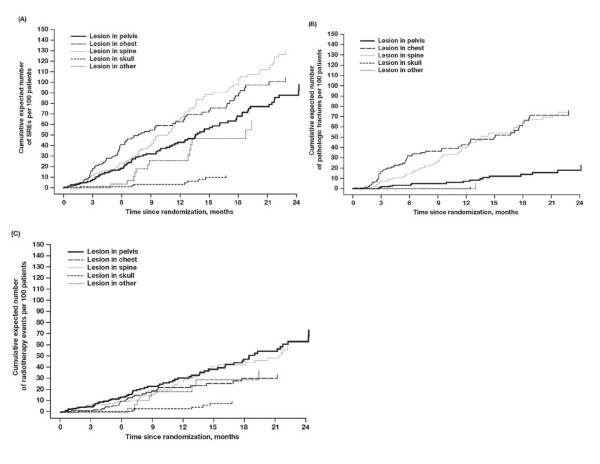
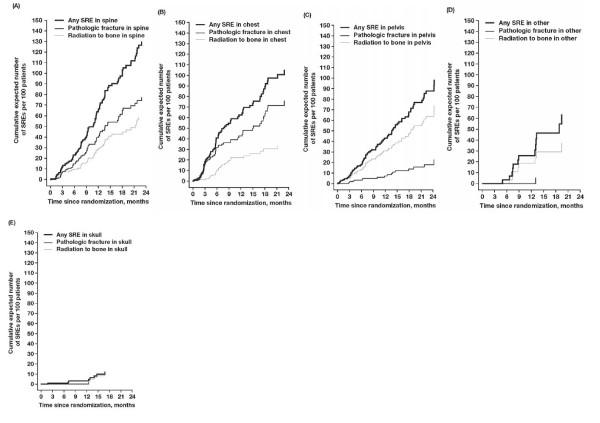
Analysis by bone lesion location showed that spinal metastases were associated with the highest cumulative mean incidence of skeletal-related events (SREs), followed by chest and pelvic metastases. Metastases located in the extremities were associated with an intermediate incidence of SREs, and those in the skull were associated with the lowest incidence of SREs.
Application of this model to data from the placebo arm of this trial revealed important insight into the natural history of skeletal morbidity in patients with bone metastases. Based on these observations, treatment for the prevention of SREs is warranted regardless of lesion location except for metastases on the skull.
骨转移是晚期癌症患者骨骼发病的常见原因。骨骼发病模式复杂,骨骼并发症的数量受生存时间的影响。由于许多癌症患者在试验完成前死亡,因此需要采用生存调整方法来准确评估治疗对骨骼发病的影响。
最近,生成了一种生存调整累积均值函数模型,该模型可以在整个研究过程中直观地呈现骨骼发病情况。该模型应用于一项针对乳腺癌恶性骨病患者的帕米膦酸研究的安慰剂对照组。
按骨病变部位分析显示,脊柱转移与骨骼相关事件(SREs)的累积平均发生率最高相关,其次是胸部和骨盆转移。位于四肢的转移与SREs的发生率中等相关,而颅骨转移与SREs的发生率最低相关。
将该模型应用于该试验安慰剂组的数据,揭示了对骨转移患者骨骼发病自然史的重要见解。基于这些观察结果,除颅骨转移外,无论病变部位如何,都有必要进行预防SREs的治疗。