Yoshida Naoto, Nakajima-Kambe Toshiaki, Matsuki Kaori, Shigeno Toshiya
Department of Biochemistry and Applied Biosciences, University of Miyazaki, Miyazaki-shi, 889-2192, Japan.
Anal Chem Insights. 2007 Feb 14;2:9-15.
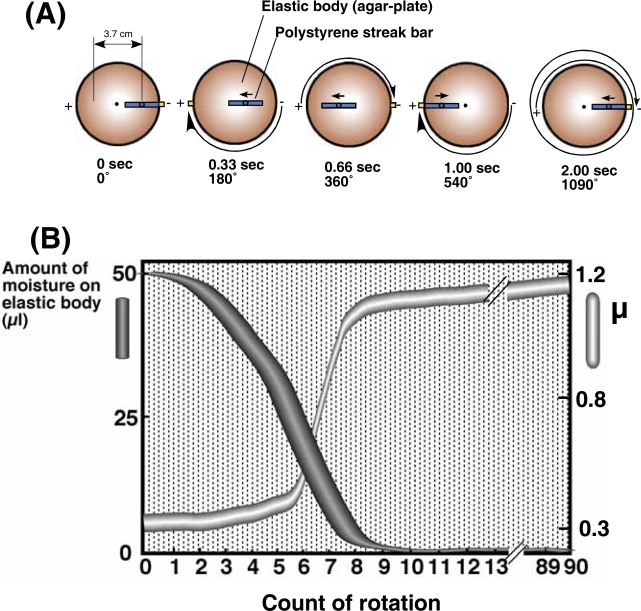
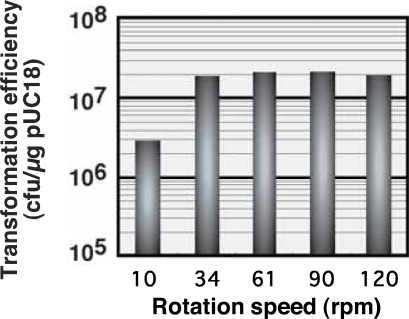
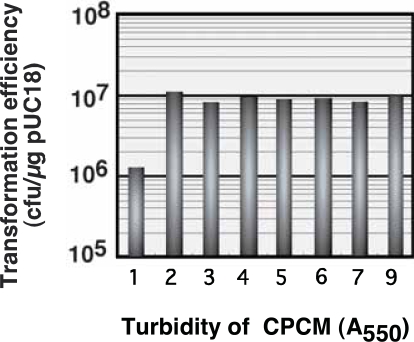
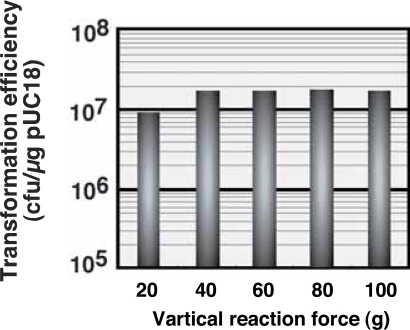
Escherichia coli as a plasmid recipient cell was dispersed in a chrysotile colloidal solution, containing chrysotile adsorbed to plasmid DNA (chrysotile-plasmid cell mixture). Following this, the chrysotile-plasmid cell mixture was dropped onto the surface of an elastic body, such as agarose, and treated physically by sliding a polystyrene streak bar over the elastic body to create friction. Plasmid DNA was easily incorporated into E. coli, and antibiotic resistance was conferred by transformation. The transformation efficiency of E. coli cultured in solid medium was greater than that of E. coli cultured in broth. To obtain greater transformation efficiency, we attempted to determine optimal transformation conditions. The following conditions resulted in the greatest transformation efficiency: the recipient cell concentration within the chrysotile-plasmid cell mixture had an optical density greater than or equal to 2 at 550 nm, the vertical reaction force applied to the streak bar was greater than or equal to 40 g, and the rotation speed of the elastic body was greater than or equal to 34 rpm. Under these conditions, we observed a transformation efficiency of 10(7) per microg plasmid DNA. The advantage of achieving bacterial transformation using the elastic body exposure method is that competent cell preparation of the recipient cell is not required. In addition to E. coli, other Gram negative bacteria are able to acquire plasmid DNA using the elastic body exposure method.
将作为质粒受体细胞的大肠杆菌分散在含有吸附了质粒 DNA 的温石棉的胶体溶液中(温石棉 - 质粒细胞混合物)。随后,将温石棉 - 质粒细胞混合物滴到弹性体表面,如琼脂糖,然后通过在弹性体上滑动聚苯乙烯划线棒以产生摩擦进行物理处理。质粒 DNA 很容易整合到大肠杆菌中,并通过转化赋予抗生素抗性。在固体培养基中培养的大肠杆菌的转化效率高于在肉汤中培养的大肠杆菌。为了获得更高的转化效率,我们试图确定最佳转化条件。以下条件可产生最大转化效率:温石棉 - 质粒细胞混合物中的受体细胞浓度在 550 nm 处的光密度大于或等于 2,施加到划线棒上的垂直反作用力大于或等于 40 g,弹性体的旋转速度大于或等于 34 rpm。在这些条件下,我们观察到每微克质粒 DNA 的转化效率为 10⁷。使用弹性体暴露法实现细菌转化的优点是不需要对受体细胞进行感受态细胞制备。除了大肠杆菌外,其他革兰氏阴性细菌也能够使用弹性体暴露法获得质粒 DNA。