Virginia Tech, Department of Biological Sciences, Blacksburg, VA, USA.
PLoS One. 2009 Aug 10;4(8):e6564. doi: 10.1371/journal.pone.0006564.
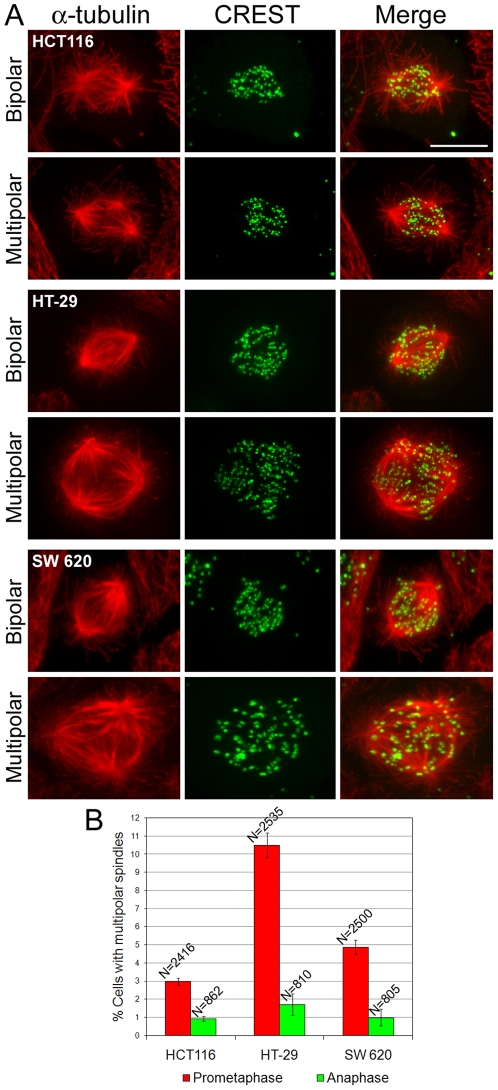
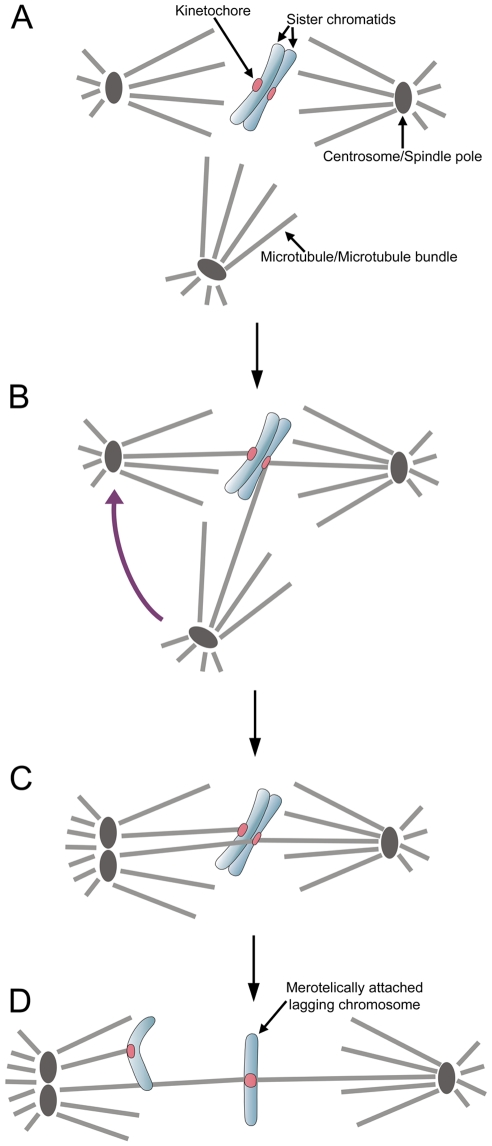
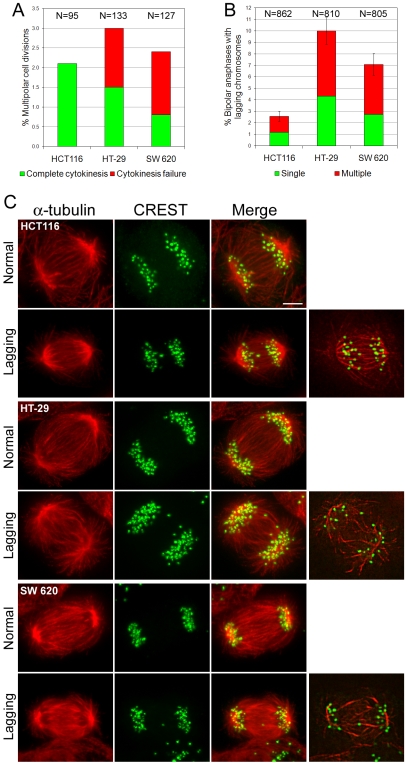
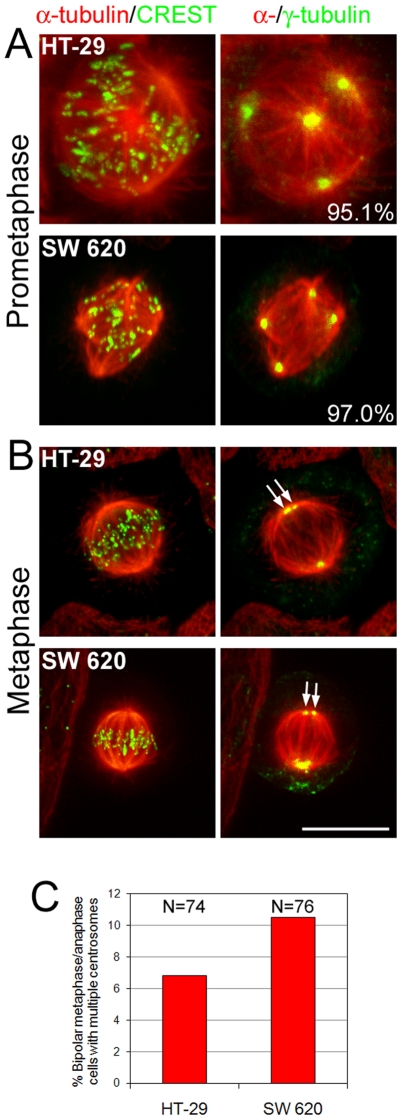
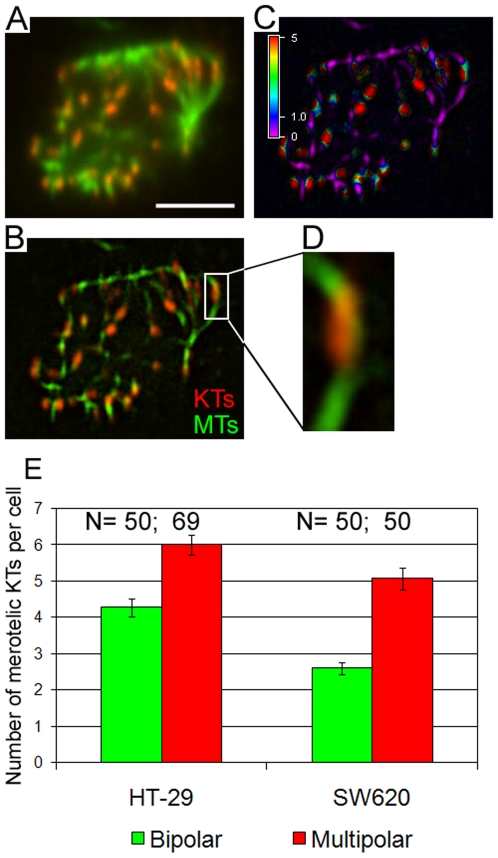
Many cancer cells display a CIN (Chromosome Instability) phenotype, by which they exhibit high rates of chromosome loss or gain at each cell cycle. Over the years, a number of different mechanisms, including mitotic spindle multipolarity, cytokinesis failure, and merotelic kinetochore orientation, have been proposed as causes of CIN. However, a comprehensive theory of how CIN is perpetuated is still lacking. We used CIN colorectal cancer cells as a model system to investigate the possible cellular mechanism(s) underlying CIN. We found that CIN cells frequently assembled multipolar spindles in early mitosis. However, multipolar anaphase cells were very rare, and live-cell experiments showed that almost all CIN cells divided in a bipolar fashion. Moreover, fixed-cell analysis showed high frequencies of merotelically attached lagging chromosomes in bipolar anaphase CIN cells, and higher frequencies of merotelic attachments in multipolar vs. bipolar prometaphases. Finally, we found that multipolar CIN prometaphases typically possessed gamma-tubulin at all spindle poles, and that a significant fraction of bipolar metaphase/early anaphase CIN cells possessed more than one centrosome at a single spindle pole. Taken together, our data suggest a model by which merotelic kinetochore attachments can easily be established in multipolar prometaphases. Most of these multipolar prometaphase cells would then bi-polarize before anaphase onset, and the residual merotelic attachments would produce chromosome mis-segregation due to anaphase lagging chromosomes. We propose this spindle pole coalescence mechanism as a major contributor to chromosome instability in cancer cells.
许多癌细胞表现出 CIN(染色体不稳定性)表型,即在每个细胞周期中表现出高比例的染色体丢失或获得。多年来,已经提出了许多不同的机制,包括有丝分裂纺锤体多极、胞质分裂失败和桥粒联会定向,作为 CIN 的原因。然而,CIN 如何持续存在的综合理论仍然缺乏。我们使用 CIN 结直肠癌细胞作为模型系统来研究 CIN 潜在的细胞机制。我们发现 CIN 细胞在早期有丝分裂中经常组装多极纺锤体。然而,多极后期细胞非常罕见,活细胞实验表明,几乎所有的 CIN 细胞都以二极方式分裂。此外,固定细胞分析显示,在二极后期的 CIN 细胞中,桥粒联会滞后染色体的频率较高,在多极前期与二极前期相比,桥粒联会的频率更高。最后,我们发现多极 CIN 前期通常在所有纺锤体极上都有γ微管蛋白,而在二极中期/早期后期的 CIN 细胞中,有相当一部分在单个纺锤体极上具有一个以上的中心体。总之,我们的数据表明了一个模型,其中桥粒联会可以在多极前期很容易地建立。这些多极前期细胞中的大多数在后期开始前将二极化,并且残留的桥粒联会由于后期滞后染色体而导致染色体错误分离。我们提出这种纺锤体极融合机制是癌细胞中染色体不稳定性的主要原因。