van de Port Ingrid G L, Wevers Lotte, Roelse Hanneke, van Kats Lenneke, Lindeman Eline, Kwakkel Gert
Centre of Excellence for Rehabilitation Medicine Utrecht, Rehabilitation Centre De Hoogstraat, Utrecht, The Netherlands.
BMC Neurol. 2009 Aug 13;9:43. doi: 10.1186/1471-2377-9-43.
Most patients who suffer a stroke experience reduced walking competency and health-related quality of life (HRQoL). A key factor in effective stroke rehabilitation is intensive, task-specific training. Recent studies suggest that intensive, patient-tailored training can be organized as a circuit with a series of task-oriented workstations. Primary aim of the FIT-Stroke trial is to evaluate the effects and cost-effectiveness of a structured, progressive task-oriented circuit class training (CCT) programme, compared to usual physiotherapeutic care during outpatient rehabilitation in a rehabilitation centre. The task-oriented CCT will be applied in groups of 4 to 6 patients. Outcome will be defined in terms of gait and gait-related ADLs after stroke. The trial will also investigate the generalizability of treatment effects of task-oriented CCT in terms of perceived fatigue, anxiety, depression and perceived HRQoL.
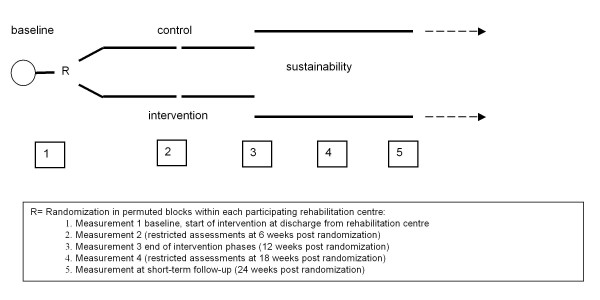
METHODS/DESIGN: The multicentre single-blinded randomized trial will include 220 stroke patients discharged to the community from inpatient rehabilitation, who are able to communicate and walk at least 10 m without physical, hands-on assistance. After discharge from inpatient rehabilitation, patients in the experimental group will receive task-oriented CCT two times a week for 12 weeks at the physiotherapy department of the rehabilitation centre. Control group patients will receive usual individual, face-to-face, physiotherapy. Costs will be evaluated by having each patient keep a cost diary for the first 24 weeks after randomisation. Primary outcomes are the mobility part of the Stroke Impact Scale (SIS-3.0) and the EuroQol. Secondary outcomes are the other domains of SIS-3.0, lower limb muscle strength, walking endurance, gait speed, balance, confidence not to fall, instrumental ADL, fatigue, anxiety, depression and HRQoL.
Based on assumptions about the effect of intensity of practice and specificity of treatment effects, FIT-Stroke will address two key aims. The first aim is to investigate the effects of task-oriented CCT on walking competency and HRQoL compared to usual face-to-face physiotherapy. The second aim is to reveal the cost-effectiveness of task-oriented CCT in the first 6 months post stroke. Both aims were recently recommended as priorities by the American Hearth Association and Stroke Council.
大多数中风患者的行走能力和健康相关生活质量(HRQoL)都会下降。有效的中风康复的一个关键因素是强化的、针对特定任务的训练。最近的研究表明,强化的、针对患者的训练可以组织成一个包含一系列面向任务的工作站的循环训练。FIT-Stroke试验的主要目的是评估一种结构化的、渐进的面向任务的循环训练(CCT)计划的效果和成本效益,并与康复中心门诊康复期间的常规物理治疗进行比较。面向任务的CCT将以4至6名患者为一组进行应用。结局将根据中风后的步态和与步态相关的日常生活活动来定义。该试验还将从感知疲劳、焦虑、抑郁和感知HRQoL方面研究面向任务的CCT治疗效果的普遍性。
方法/设计:这项多中心单盲随机试验将纳入220名从住院康复出院后回到社区的中风患者,这些患者能够在没有身体辅助的情况下进行交流并至少行走10米。从住院康复出院后,实验组的患者将在康复中心的理疗科每周接受两次面向任务的CCT,为期12周。对照组患者将接受常规的一对一面对面物理治疗。通过让每位患者在随机分组后的前24周记录成本日记来评估成本。主要结局是中风影响量表(SIS-3.0)的活动能力部分和欧洲五维度健康量表。次要结局是SIS-3.0的其他领域、下肢肌肉力量、步行耐力、步态速度、平衡、不跌倒的信心、工具性日常生活活动、疲劳、焦虑、抑郁和HRQoL。
基于对练习强度和治疗效果特异性的影响的假设,FIT-Stroke将解决两个关键目标。第一个目标是研究与常规面对面物理治疗相比,面向任务的CCT对行走能力和HRQoL的影响。第二个目标是揭示中风后前6个月面向任务的CCT的成本效益。这两个目标最近都被美国心脏协会和中风委员会推荐为优先事项。