Kraemer Anja, Hauser Stefan, Kim Young, Gorschlüter Marcus, Müller Stefan C, Brossart Peter, Schmidt-Wolf Ingo G H
Department of Internal Medicine III, University of Bonn, Bonn, Germany.
Ger Med Sci. 2009 Jun 10;7:Doc04. doi: 10.3205/000063.
The highly vascular nature of renal carcinoma cells suggests that inhibition of angiogenesis may be beneficial in this disease. Thalidomide has been described as inhibitor of the fibroblast growth factor (FGF) and the vascular endothelial growth factor (VEGF). Therefore and in consideration of the promising response rates of the combination of IL-2, IFN-alpha and 5-FU [1] in metastatic renal cancer, we found it reasonable to test the combination of 5-FU and thalidomide. Thus, we conducted a phase I trial to determine safety, side effects and responses to such a treatment.
Patients with metastasized renal cell cancer after nephrectomy and progress after IL-2 and interferon treatment, received oral 5-FU at a dose of 1250 mg/qm(2) twice a day for two weeks, then after pausing a week, the oral application was restarted. In addition, oral thalidomide was applied constantly at a maximum dose of 400 mg/d. The combined therapy was given for three months. The primary endpoint was duration until disease progression, the secondary endpoint the response to treatment. Response was determined by CT scans three months after the end of treatment.
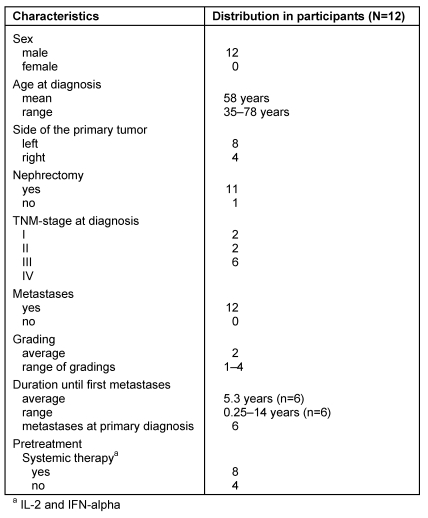
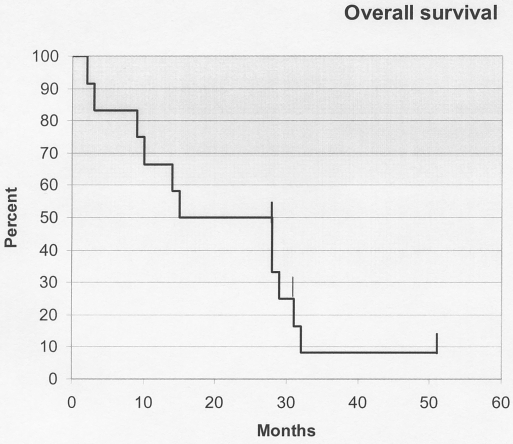
In total, 12 male patients participated in the trial and received the combined oral therapy. Concerning clinical response, one mixed response (8%), a stable disease in 4/12 patients (33%) and progression was seen in 7 patients (58%). The survival from the start of the therapy showed a median of 21 months with three patients being alive. At present, the longest survival after the therapy is 51 months.
The combination of oral 5-FU and thalidomide showed clinical response with tolerable side effects. Further studies will be required to assess the outcome of this treatment regimen.
肾癌细胞的高血管化特性表明,抑制血管生成可能对这种疾病有益。沙利度胺已被描述为成纤维细胞生长因子(FGF)和血管内皮生长因子(VEGF)的抑制剂。因此,考虑到白细胞介素-2、α-干扰素和5-氟尿嘧啶联合使用[1]在转移性肾癌中显示出有前景的缓解率,我们认为测试5-氟尿嘧啶和沙利度胺的联合使用是合理的。因此,我们进行了一项I期试验,以确定这种治疗的安全性、副作用和反应。
肾切除术后发生转移且在接受白细胞介素-2和干扰素治疗后病情进展的肾细胞癌患者,口服5-氟尿嘧啶,剂量为1250 mg/m²,每天两次,持续两周,然后停药一周,之后重新开始口服给药。此外,口服沙利度胺,最大剂量为400 mg/d,持续给药。联合治疗持续三个月。主要终点是疾病进展前的持续时间,次要终点是治疗反应。在治疗结束三个月后通过CT扫描确定反应情况。
共有12名男性患者参与试验并接受了联合口服治疗。关于临床反应,1例为混合反应(8%),4/12例患者病情稳定(33%),7例患者病情进展(58%)。从治疗开始计算的生存期显示,中位生存期为21个月,有3名患者存活。目前,治疗后最长生存期为51个月。
口服5-氟尿嘧啶和沙利度胺联合使用显示出临床反应,且副作用可耐受。需要进一步研究来评估这种治疗方案的效果。