Department of Biological Sciences, Northern Arizona University, USA.
Mol Biol Evol. 2009 Dec;26(12):2679-87. doi: 10.1093/molbev/msp183. Epub 2009 Aug 13.
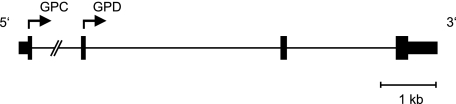
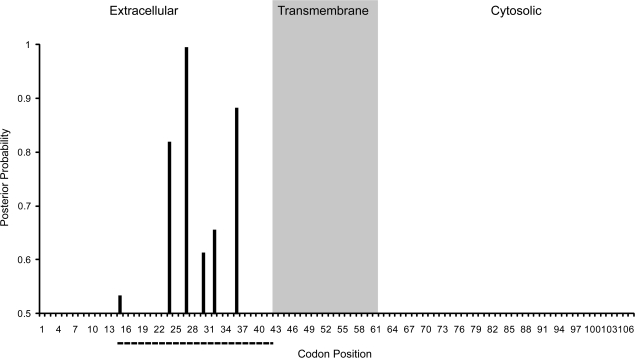
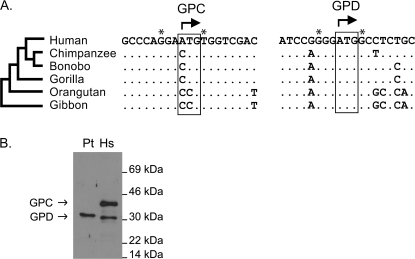
GYPC encodes two erythrocyte surface sialoglycoproteins in humans, glycophorin C and glycophorin D (GPC and GPD), via initiation of translation at two start codons on a single transcript. The malaria-causing parasite Plasmodium falciparum uses GPC as a means of invasion into the human red blood cell. Here, we examine the molecular evolution of GYPC among the Hominoidea (Greater and Lesser Apes) and also the pattern of polymorphism at the locus in a global human sample. We find an excess of nonsynonymous divergence among species that appears to be caused solely by accelerated evolution of GYPC in the human lineage. Moreover, we find that the ability of GYPC to encode both GPC and GPD is a uniquely human trait, caused by the evolution of the GPC start codon in the human lineage. The pattern of polymorphism among humans is consistent with a hitchhiking event at the locus, suggesting that positive natural selection affected GYPC in the relatively recent past. Because GPC is exploited by P. falciparum for invasion of the red blood cell, we hypothesize that selection for evasion of P. falciparum has caused accelerated evolution of GYPC in humans (relative to other primates) and that this positive selection has continued to act in the recent evolution of our species. These data suggest that malaria has played a powerful role in shaping molecules on the surface of the human red blood cell. In addition, our examination of GYPC reveals a novel mechanism of protein evolution: co-option of untranslated region (UTR) sequence following the formation of a new start codon. In the case of human GYPC, the ancestral protein (GPD) continues to be produced through leaky translation. Because leaky translation is a widespread phenomenon among genes and organisms, we suggest that co-option of UTR sequence may be an important source of protein innovation.
GYPC 通过在单个转录本上的两个起始密码子起始翻译,编码人类红细胞表面的两种唾液糖蛋白,即糖蛋白 C 和糖蛋白 D(GPC 和 GPD)。引起疟疾的寄生虫恶性疟原虫利用 GPC 作为入侵人类红细胞的一种手段。在这里,我们研究了 Hominoidea(大猿和小猿)中 GYPC 的分子进化,以及在全球人类样本中该基因座的多态性模式。我们发现物种之间存在过多的非同义分歧,这似乎完全是由于人类谱系中 GYPC 的加速进化所致。此外,我们发现 GYPC 编码 GPC 和 GPD 的能力是人类特有的,这是由于人类谱系中 GPC 起始密码子的进化所致。人类之间的多态性模式与该基因座的 hitchhiking 事件一致,表明在相对较近的过去,正自然选择影响了 GYPC。由于 GPC 被恶性疟原虫用于入侵红细胞,我们假设逃避恶性疟原虫的选择导致了 GYPC 在人类(相对于其他灵长类动物)中的加速进化,并且这种正选择在我们物种的最近进化中仍在继续发挥作用。这些数据表明,疟疾在塑造人类红细胞表面分子方面发挥了强大的作用。此外,我们对 GYPC 的研究揭示了一种新的蛋白质进化机制:在形成新的起始密码子后,非翻译区(UTR)序列的选择。在人类 GYPC 的情况下,原始蛋白(GPD)通过渗漏翻译继续产生。由于渗漏翻译是基因和生物体中广泛存在的现象,我们认为 UTR 序列的选择可能是蛋白质创新的重要来源。