Windecker Hanna, Langegger Maria, Heinrich Stephanie, Hauf Silke
Friedrich Miescher Laboratory of the Max Planck Society, Spemannstrasse 39, 72076 Tuebingen, Germany.
EMBO Rep. 2009 Sep;10(9):1022-8. doi: 10.1038/embor.2009.183. Epub 2009 Aug 14.
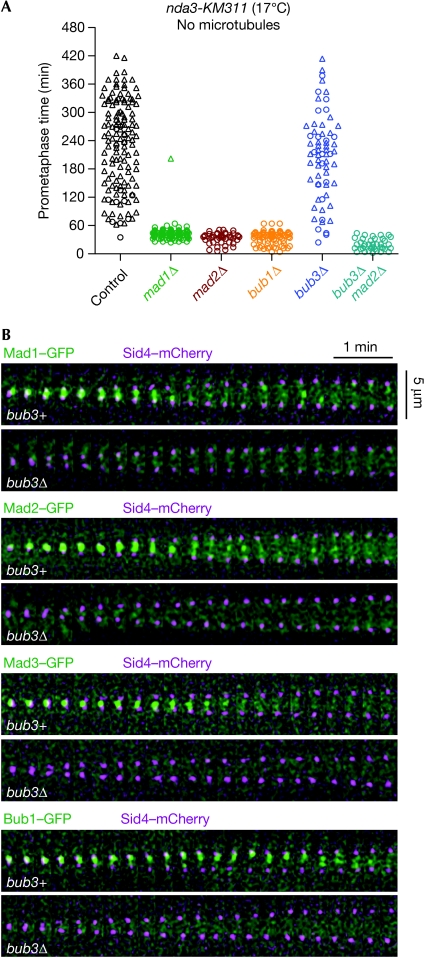
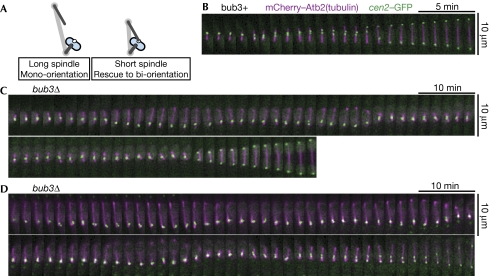
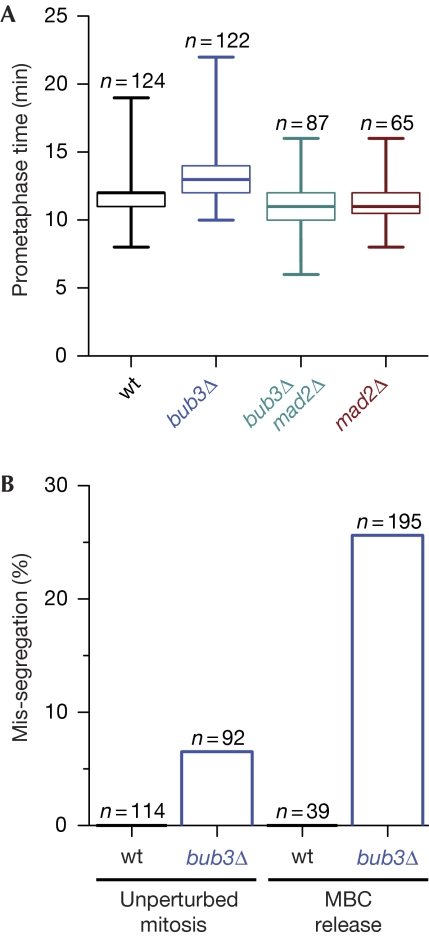
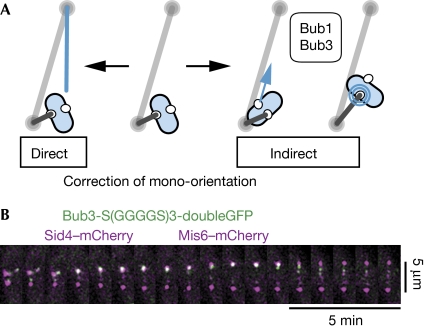
The eukaryotic spindle assembly checkpoint (SAC) delays anaphase in the presence of chromosome attachment errors. Bub3 has been reported to be required for SAC activity in all eukaryotes examined so far. We find that Bub3, unlike its binding partner Bub1, is not essential for the SAC in fission yeast. As Bub3 is needed for the efficient kinetochore localization of Bub1, and of Mad1, Mad2 and Mad3, this implies that most SAC proteins do not need to be enriched at the kinetochores for the SAC to function. We find that Bub3 is also dispensable for shugoshin localization to the centromeres, which is the second known function of Bub1. Instead, Bub3, together with Bub1, has a specific function in promoting the conversion from chromosome mono-orientation to bi-orientation.
真核生物纺锤体组装检查点(SAC)在存在染色体附着错误的情况下会延迟后期。据报道,到目前为止,在所有已检测的真核生物中,Bub3是SAC活性所必需的。我们发现,与它的结合伴侣Bub1不同,Bub3在裂殖酵母的SAC中并非必不可少。由于Bub3是Bub1以及Mad1、Mad2和Mad3在动粒上高效定位所必需的,这意味着大多数SAC蛋白不需要在动粒上富集SAC就能发挥作用。我们发现,Bub3对于守护蛋白定位到着丝粒也是可有可无的,这是Bub1的第二个已知功能。相反,Bub3与Bub1一起在促进染色体从单极取向转变为双极取向方面具有特定功能。