Mondol Samrat, Karanth K Ullas, Ramakrishnan Uma
National Centre for Biological Sciences, Tata Institute of Fundamental Research, Bangalore, India.
PLoS Genet. 2009 Aug;5(8):e1000585. doi: 10.1371/journal.pgen.1000585. Epub 2009 Aug 14.
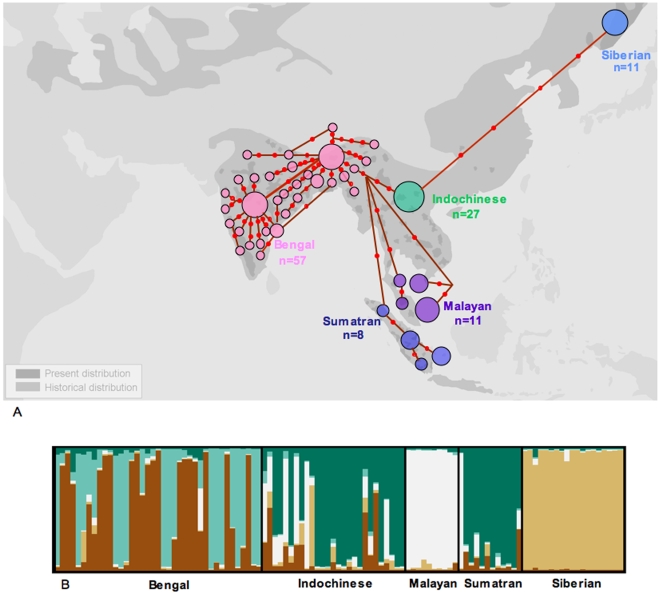
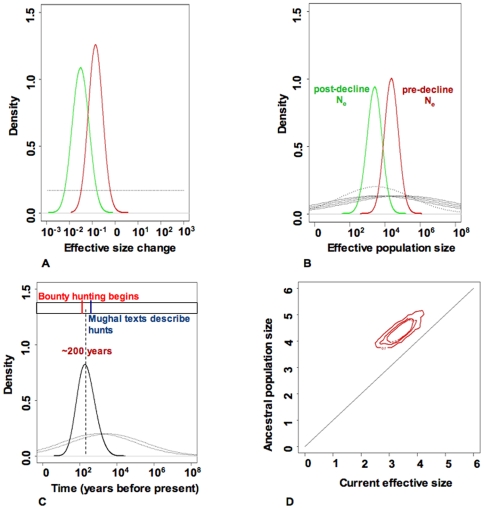
With only approximately 3,000 wild individuals surviving restricted to just 7% of their historical range, tigers are now a globally threatened species. Therefore, conservation efforts must prioritize regions that harbor more tigers, as well try to capture most of the remaining genetic variation and habitat diversity. Only such prioritization based on demographic, genetic, and ecological considerations can ensure species recovery and retention of evolutionary flexibility in the face of ongoing global changes. Although scientific understanding of ecological and demographic aspects of extant wild tiger populations has improved recently, little is known about their genetic composition and variability. We sampled 73 individual tigers from 28 reserves spread across a diversity of habitats in the Indian subcontinent to obtain 1,263 bp of mitochondrial DNA and 10 microsatellite loci. Our analyses reveals that Indian tigers retain more than half of the extant genetic diversity in the species. Coalescent simulations attribute this high genetic diversity to a historically large population size of about 58,200 tigers for peninsular India south of the Gangetic plains. Furthermore, our analyses indicate a precipitous, possibly human-induced population crash approximately 200 years ago in India, which is in concordance with historical records. Our results suggest that only 1.7% (with an upper limit of 13% and a lower limit of 0.2%) of tiger numbers in historical times remain now. In the global conservation context our results suggest that, based on genetic, demographic, and ecological considerations, the Indian subcontinent holds the key to global survival and recovery of wild tigers.
野生老虎仅存约3000只,其活动范围局限于历史分布区域的7%,如今已成为全球受威胁物种。因此,保护工作必须优先考虑老虎数量较多的地区,同时努力保存大部分剩余的遗传变异和栖息地多样性。只有基于种群统计学、遗传学和生态学考量进行这样的优先排序,才能确保在全球持续变化的情况下物种得以恢复,并保留进化灵活性。尽管最近对现存野生老虎种群的生态和种群统计学方面的科学认识有所提高,但对它们的遗传组成和变异性却知之甚少。我们从印度次大陆分布在各种栖息地的28个保护区中采集了73只老虎个体的样本,以获取1263个碱基对的线粒体DNA和10个微卫星位点。我们的分析表明,印度老虎保留了该物种现存遗传多样性的一半以上。溯祖模拟将这种高遗传多样性归因于恒河平原以南印度半岛历史上约58200只老虎的庞大种群数量。此外,我们的分析表明,大约200年前印度的老虎种群数量急剧下降,可能是人为导致的,这与历史记录相符。我们的结果表明,如今仅存历史时期老虎数量的1.7%(上限为13%,下限为0.2%)。在全球保护背景下,我们的结果表明,基于遗传学、种群统计学和生态学考量,印度次大陆是野生老虎全球生存和恢复的关键所在。