Alyamkina Ekaterina A, Dolgova Evgenia V, Likhacheva Anastasia S, Rogachev Vladimir A, Sebeleva Tamara E, Nikolin Valeriy P, Popova Nelly A, Orishchenko Konstantin E, Strunkin Dmitriy N, Chernykh Elena R, Zagrebelniy Stanislav N, Bogachev Sergei S, Shurdov Mikhail A
Novosibirsk State University, Novosibirsk, Russia.
Genet Vaccines Ther. 2009 Aug 14;7:12. doi: 10.1186/1479-0556-7-12.
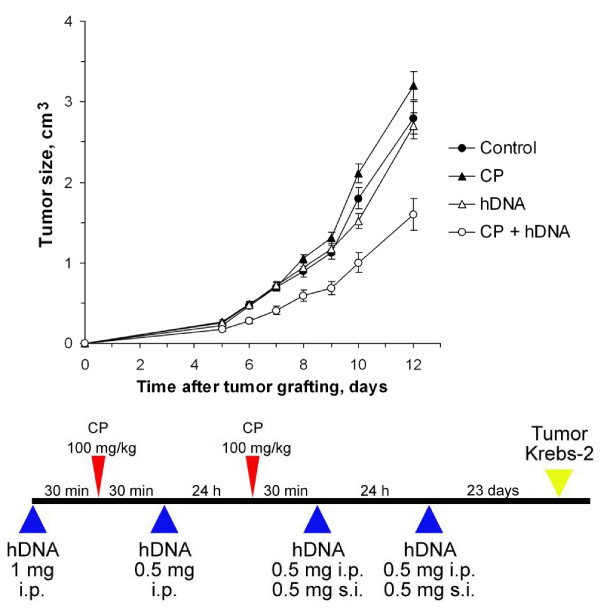
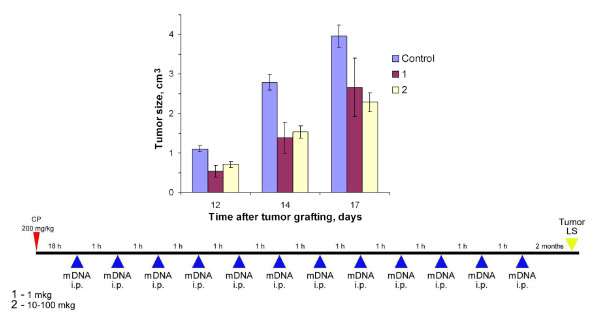
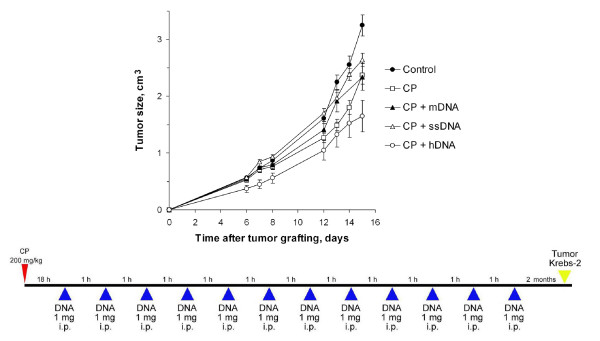
When cyclophosphamide and preparations of fragmented exogenous genomic double stranded DNA were administered in sequence, the regressive effect on the tumor was synergic: this combined treatment had a more pronounced effect than cyclophosphamide alone. Our further studies demonstrated that exogenous DNA stimulated the maturation and specific activities of dendritic cells. This suggests that cyclophosphamide, combined with DNA, leads to an immune response to the tumors that were grafted into the subjects post treatment.
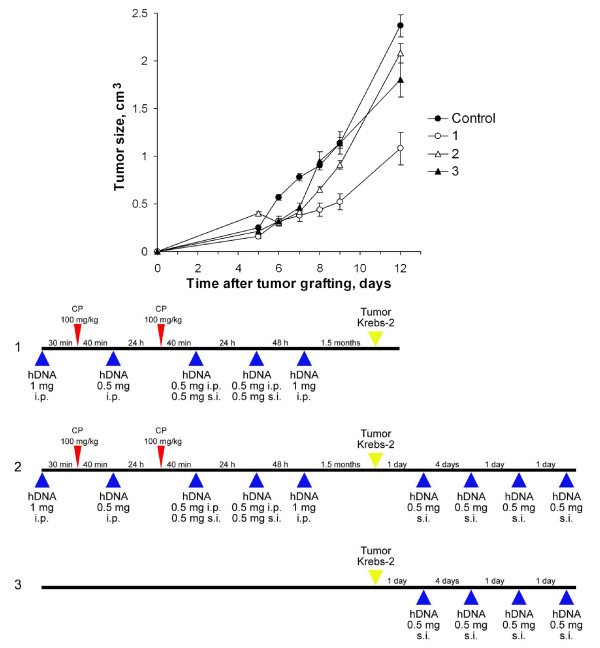
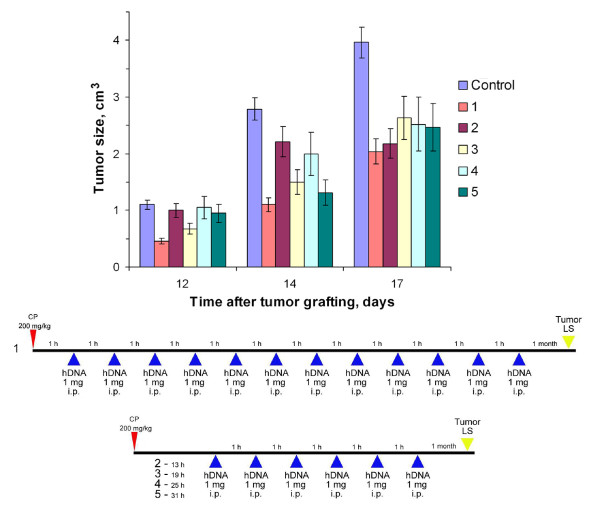
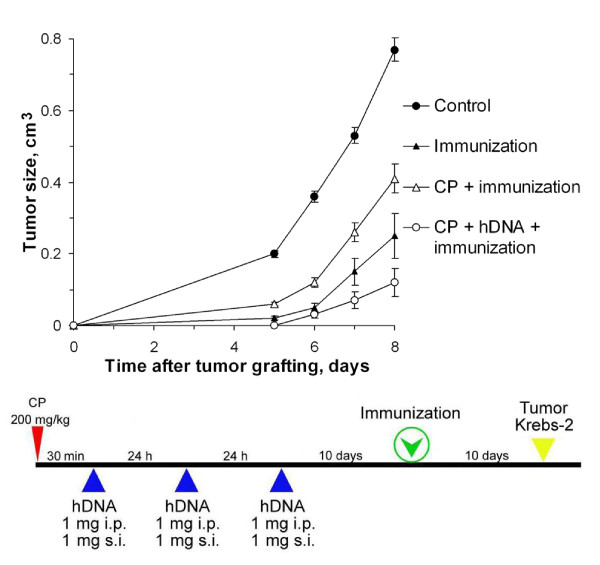
Three-month old CBA/Lac mice were used in the experiments. The mice were injected with cyclosphamide (200 mkg per 1 kg body weight) and genomic DNA (of human, mouse or salmon sperm origin). The DNA was administered intraperitoneally or subcutaneously. After 23 to 60 days, one million tumor cells were intramuscularly grafted into the mice. In the final experiment, the mice were pre-immunized by subcutaneous injections of 20 million repeatedly thawed and frozen tumor cells. Changes in tumor growth were determined by multiplying the three perpendicular diameters (measured by caliper). Students' t-tests were used to determine the difference between tumor growth and average survival rate between the mouse groups and the controls.
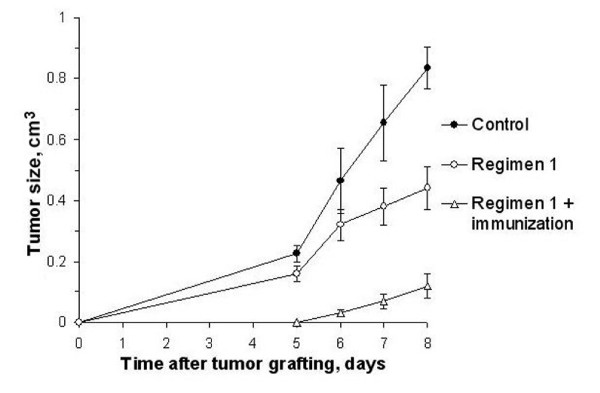
An analysis of varying treatments with cyclophosphamide and exogenous DNA, followed by tumor grafting, provided evidence that this combined treatment had an immunizing effect. This inhibitory effect in mice was analyzed in an experiment with the classical immunization of a tumor homogenate. The strongest inhibitory action on a transplanted graft was created through the following steps: cyclophosphamide at 200 mg/kg of body weight administered as a pretreatment; 6 mg fragmented exogenous DNA administered over the course of 3 days; tumor homogenate grafted 10 days following the final DNA injection.
Fragmented exogenous DNA injected with cyclophosphamide inhibits the growth of tumors that are grafted to mice after this combined treatment.
当依次给予环磷酰胺和片段化的外源性基因组双链DNA制剂时,对肿瘤的消退作用具有协同性:这种联合治疗比单独使用环磷酰胺具有更显著的效果。我们进一步的研究表明,外源性DNA刺激树突状细胞的成熟和特异性活性。这表明环磷酰胺与DNA联合使用会引发对治疗后移植到受试者体内肿瘤的免疫反应。
实验使用3个月大的CBA/Lac小鼠。给小鼠注射环磷酰胺(每1千克体重200微克)和基因组DNA(人、小鼠或鲑鱼精子来源)。DNA通过腹腔内或皮下注射给药。23至60天后,将100万个肿瘤细胞肌肉内移植到小鼠体内。在最终实验中,通过皮下注射2000万个反复冻融的肿瘤细胞对小鼠进行预免疫。通过将三个垂直直径(用卡尺测量)相乘来确定肿瘤生长的变化。使用学生t检验来确定小鼠组与对照组之间肿瘤生长和平均存活率的差异。
对环磷酰胺和外源性DNA进行不同处理后再进行肿瘤移植的分析提供了证据,表明这种联合治疗具有免疫作用。在一项使用肿瘤匀浆经典免疫的实验中分析了这种对小鼠的抑制作用。对移植瘤产生最强抑制作用的步骤如下:作为预处理给予200毫克/千克体重的环磷酰胺;在3天内给予6毫克片段化外源性DNA;在最后一次DNA注射后10天移植肿瘤匀浆。
与环磷酰胺一起注射的片段化外源性DNA在这种联合治疗后可抑制移植到小鼠体内肿瘤的生长。