Cardani R, Mancinelli E, Giagnacovo M, Sansone V, Meola G
Department of Molecular Biology and Biotechnologies, University of Milan, Italy.
Eur J Histochem. 2009 Apr-Jun;53(2):e13. doi: 10.4081/ejh.2009.e13.
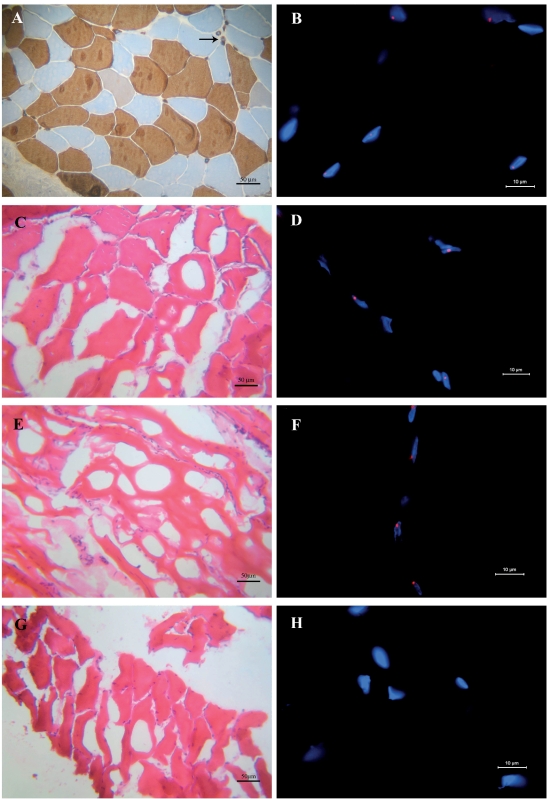
Myotonic dystrophy type 2 (DM2) is a dominantly inherited disorder caused by a CCTG repeat expansion in intron 1 of ZNF9 gene. The size and the somatic instability of DM2 expansion complicate the molecular diagnosis of DM2. In situ hybridization represents a rapid and sensitive method to obtain a definitive diagnosis in few hours, since it allows the direct visualization of the mutant mRNA foci on skeletal muscle sections. This approach makes the muscle biopsy an important tool for definitive diagnosis of DM2. Consequently, a rapid freezing at ultra cold temperature and a good storage of muscle specimens are essential to avoid morphologic alterations and nucleic acids degradation. However incorrect freezing or thawing may accidentally occur. In this work we report that fluorescence in situ hybridization may be applied on improperly frozen or inappropriately stored muscle biopsies since foci of mutant mRNA are well preserved and can still be detected in muscle sections no more useful for histopathological evaluation.
2型强直性肌营养不良症(DM2)是一种由ZNF9基因内含子1中CCTG重复序列扩增引起的常染色体显性遗传病。DM2扩增的大小和体细胞不稳定性使DM2的分子诊断变得复杂。原位杂交是一种快速且灵敏的方法,能在数小时内做出明确诊断,因为它能直接观察骨骼肌切片上的突变mRNA病灶。这种方法使肌肉活检成为确诊DM2的重要工具。因此,在超低温下快速冷冻并妥善保存肌肉标本对于避免形态学改变和核酸降解至关重要。然而,可能会意外出现冷冻或解冻不当的情况。在本研究中,我们报告荧光原位杂交可应用于冷冻不当或保存不当的肌肉活检标本,因为突变mRNA病灶保存良好,在对组织病理学评估不再有用的肌肉切片中仍可检测到。