Department of Neurology, University of Massachusetts Medical School, Worcester, MA 01655, USA.
Cells. 2021 Jan 28;10(2):249. doi: 10.3390/cells10020249.
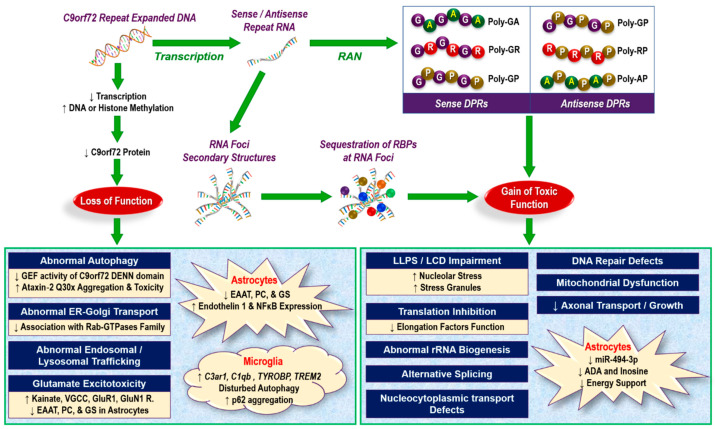
Since the discovery of the chromosome 9 open reading frame 72 () repeat expansion mutation in 2011 as the most common genetic abnormality in amyotrophic lateral sclerosis (ALS, also known as Lou Gehrig's disease) and frontotemporal dementia (FTD), progress in understanding the signaling pathways related to this mutation can only be described as intriguing. Two major theories have been suggested-(i) loss of function or haploinsufficiency and (ii) toxic gain of function from either repeat RNA or dipeptide repeat proteins (DPRs) generated from repeat-associated non-ATG (RAN) translation. Each theory has provided various signaling pathways that potentially participate in the disease progression. Dysregulation of the immune system, particularly glial cell dysfunction (mainly microglia and astrocytes), is demonstrated to play a pivotal role in both loss and gain of function theories of pathogenesis. In this review, we discuss the pathogenic roles of glial cells in ALS/FTD as evidenced by pre-clinical and clinical studies showing the presence of gliosis in ALS/FTD, pathologic hallmarks in glial cells, including TAR DNA-binding protein 43 (TDP-43) and p62 aggregates, and toxicity of glial cells. A better understanding of these pathways can provide new insights into the development of therapies targeting glial cell abnormalities in ALS/FTD.
自 2011 年发现染色体 9 开放阅读框 72()重复扩展突变是肌萎缩侧索硬化症(ALS,也称为卢伽雷氏病)和额颞叶痴呆(FTD)中最常见的遗传异常以来,人们对与该突变相关的信号通路的理解进展只能用“引人入胜”来形容。已经提出了两种主要理论-(i) 功能丧失或单倍不足和 (ii) 来自重复相关非 ATG(RAN)翻译的重复 RNA 或二肽重复蛋白 (DPR) 的毒性获得功能。每个理论都提供了各种可能参与疾病进展的信号通路。免疫系统失调,特别是神经胶质细胞功能障碍(主要是小胶质细胞和星形胶质细胞),被证明在 发病机制的功能丧失和获得功能理论中都发挥着关键作用。在这篇综述中,我们讨论了神经胶质细胞在 ALS/FTD 中的致病作用,临床前和临床研究表明 ALS/FTD 中存在神经胶质增生、神经胶质细胞中的病理特征,包括 TAR DNA 结合蛋白 43 (TDP-43) 和 p62 聚集体,以及神经胶质细胞的毒性。更好地了解这些途径可以为针对 ALS/FTD 中神经胶质细胞异常的治疗方法的开发提供新的见解。