INMED, INSERM U901, Université de La Méditerranée, Parc scientifique de Luminy, BP 13, 13273, Marseille Cedex 09, France.
Cereb Cortex. 2010 Apr;20(4):898-911. doi: 10.1093/cercor/bhp156. Epub 2009 Aug 14.
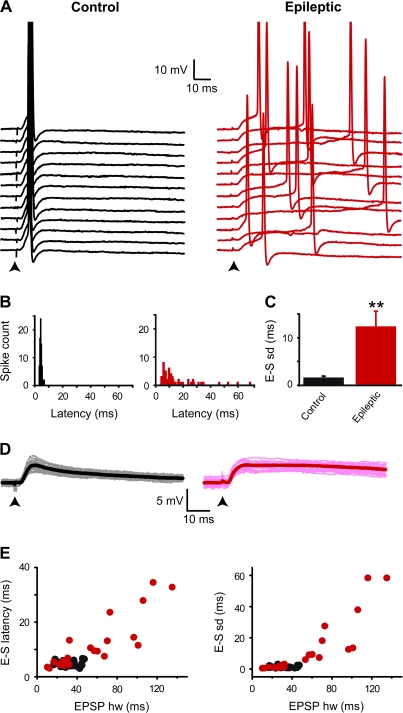
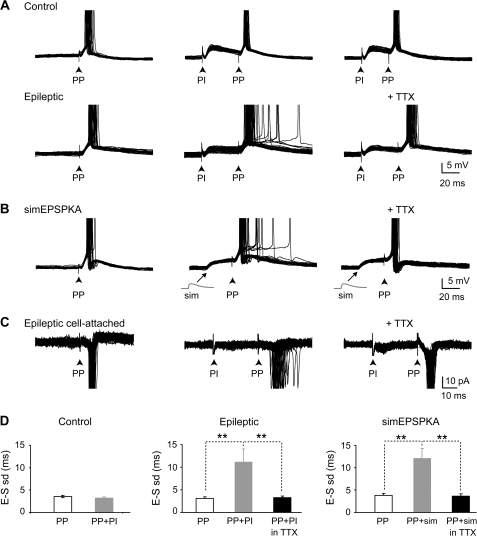
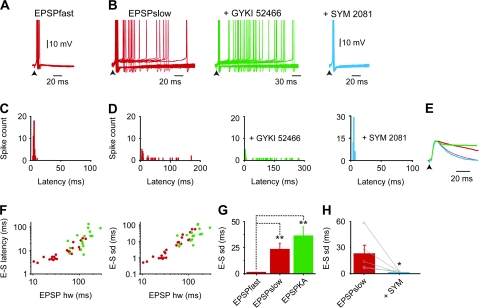
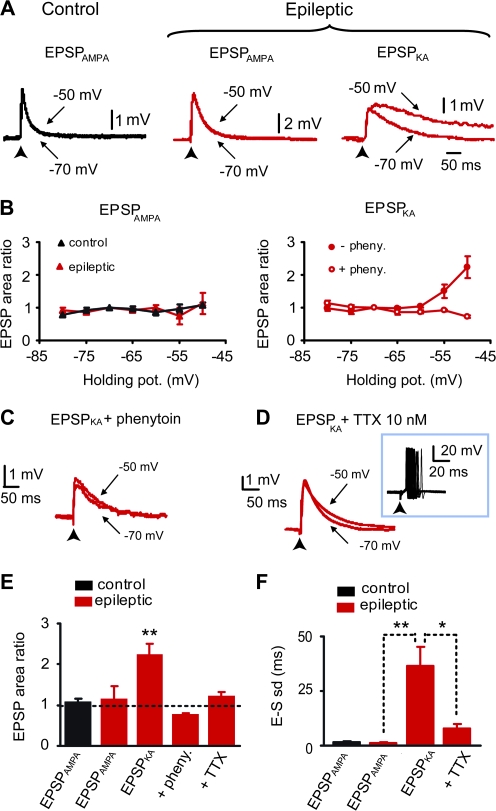
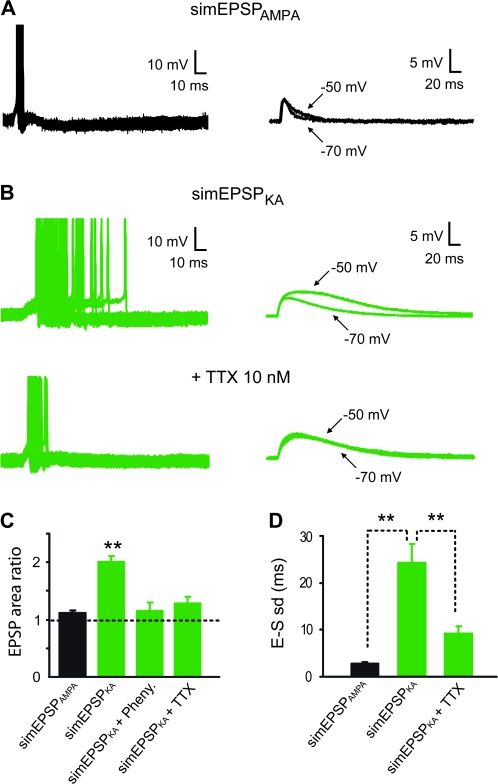
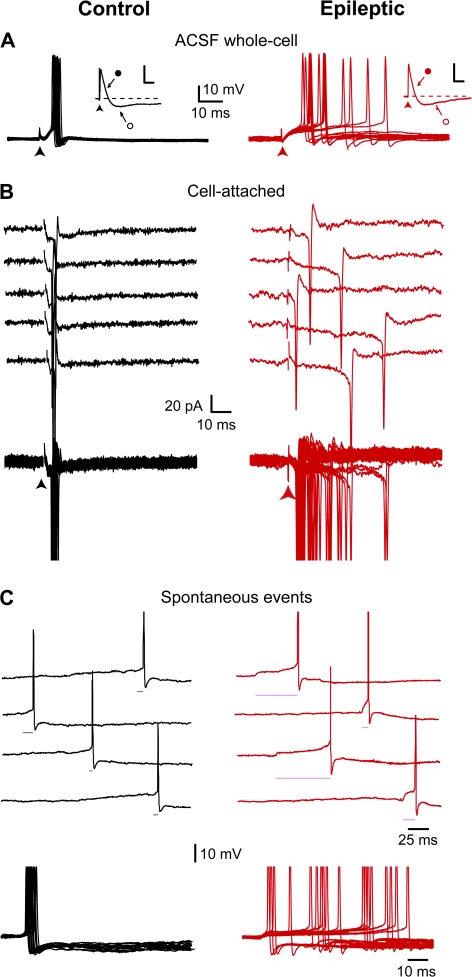
Spike timing precision is a fundamental aspect of neuronal information processing in the brain. Here we examined the temporal precision of input-output operation of dentate granule cells (DGCs) in an animal model of temporal lobe epilepsy (TLE). In TLE, mossy fibers sprout and establish recurrent synapses on DGCs that generate aberrant slow kainate receptor-mediated excitatory postsynaptic potentials (EPSP(KA)) not observed in controls. We report that, in contrast to time-locked spikes generated by EPSP(AMPA) in control DGCs, aberrant EPSP(KA) are associated with long-lasting plateaus and jittered spikes during single-spike mode firing. This is mediated by a selective voltage-dependent amplification of EPSP(KA) through persistent sodium current (I(NaP)) activation. In control DGCs, a current injection of a waveform mimicking the slow shape of EPSP(KA) activates I(NaP) and generates jittered spikes. Conversely in epileptic rats, blockade of EPSP(KA) or I(NaP) restores the temporal precision of EPSP-spike coupling. Importantly, EPSP(KA) not only decrease spike timing precision at recurrent mossy fiber synapses but also at perforant path synapses during synaptic integration through I(NaP) activation. We conclude that a selective interplay between aberrant EPSP(KA) and I(NaP) severely alters the temporal precision of EPSP-spike coupling in DGCs of chronic epileptic rats.
尖峰时间精度是大脑中神经元信息处理的一个基本方面。在这里,我们在颞叶癫痫(TLE)动物模型中检查了齿状回颗粒细胞(DGC)输入-输出操作的时间精度。在 TLE 中,苔藓纤维发芽并在 DGC 上建立反复的突触,产生在对照中未观察到的异常慢 K+型谷氨酸受体介导的兴奋性突触后电位(EPSP(KA))。我们报告说,与对照 DGC 中由 EPSP(AMPA)产生的定时尖峰相反,异常 EPSP(KA)与单尖峰模式发射期间的长时间平台和抖动尖峰相关。这是通过持久钠电流(I(NaP))激活对 EPSP(KA)的选择性电压依赖性放大介导的。在对照 DGC 中,模拟 EPSP(KA)慢形状的电流注入会激活 I(NaP)并产生抖动尖峰。相反,在癫痫大鼠中,阻断 EPSP(KA)或 I(NaP)会恢复 EPSP-尖峰耦合的时间精度。重要的是,EPSP(KA)不仅通过 I(NaP)激活降低了反复苔藓纤维突触处的尖峰时间精度,而且降低了在突触整合过程中在穿通路径突触处的尖峰时间精度。我们得出结论,异常 EPSP(KA)和 I(NaP)之间的选择性相互作用严重改变了慢性癫痫大鼠 DGC 中 EPSP-尖峰耦合的时间精度。