Banach-Orlowska Magdalena, Pilecka Iwona, Torun Anna, Pyrzynska Beata, Miaczynska Marta
International Institute of Molecular and Cell Biology, Laboratory of Cell Biology, Ks. Trojdena 4, 02-109 Warsaw, Poland.
Biochem J. 2009 Oct 12;423(3):389-400. doi: 10.1042/BJ20090086.
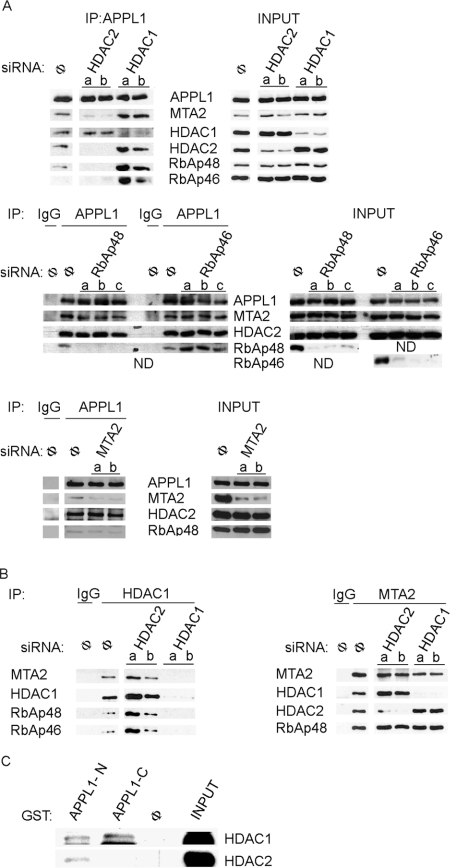
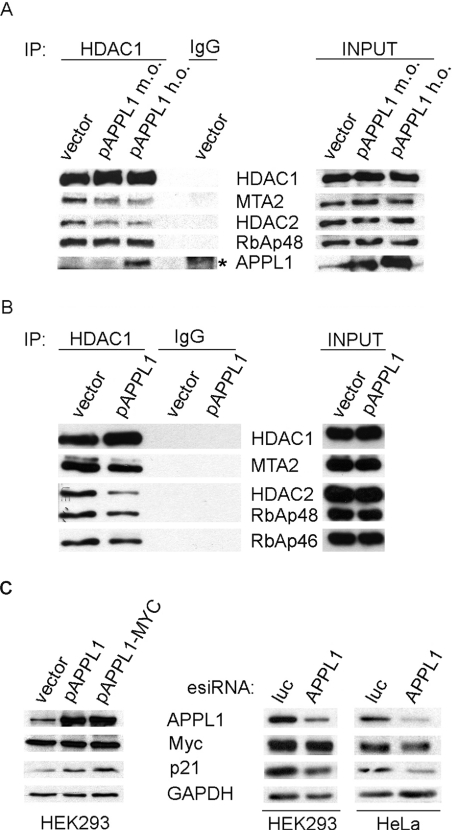
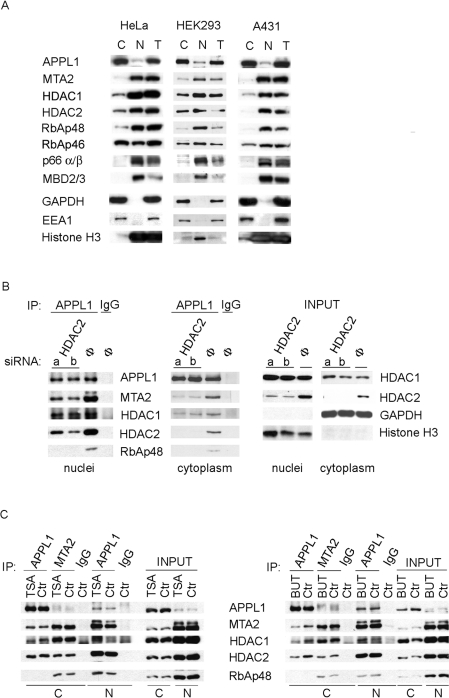
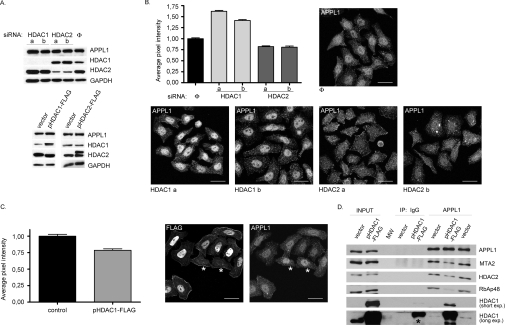
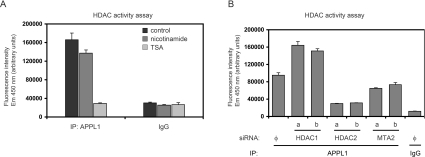
Multifunctional adaptor protein APPL1 [adaptor protein containing PH (pleckstrin homology) domain, PTB (phosphotyrosine binding) domain and leucine zipper motif] belongs to a growing group of endocytic proteins which actively participate in various stages of signalling pathways. Owing to its interaction with the small GTPase Rab5, APPL1 localizes predominantly to a subpopulation of early endosomes but is also capable of nucleocytoplasmic shuttling. Among its various binding partners, APPL1 was reported to associate with the nuclear co-repressor complex NuRD (nucleosome remodelling and deacetylase), containing both nucleosome remodelling and HDAC (histone deacetylase) activities, but the biochemical basis or functional relevance of this interaction remained unknown. Here we characterized the binding between APPL1 and NuRD in more detail, identifying HDAC2 as the key NuRD subunit responsible for this association. APPL1 interacts with the NuRD complex containing enzymatically active HDAC2 but not HDAC1 as the only deacetylase. However, the cellular levels of HDAC1 can regulate the extent of APPL1-NuRD interactions, which in turn modulates the nucleocytoplasmic distribution of APPL1. Increased binding of APPL1 to NuRD upon silencing of HDAC1 promotes the nuclear localization of APPL1, whereas HDAC1 overexpression exerts an opposite effect. Moreover, we also uncovered a NuRD-independent interaction of APPL1 with HDAC1. APPL1 overexpression affects the composition of the HDAC1-containing NuRD complex and the expression of HDAC1 target p21WAF1/CIP1. Cumulatively, these data reveal a surprising complexity of APPL1 interactions with HDACs, with functional consequences for the modulation of gene expression. In a broader sense, these results contribute to an emerging theme of endocytic proteins playing alternative roles in the cell nucleus.
多功能衔接蛋白APPL1[含PH(普列克底物蛋白同源)结构域、PTB(磷酸酪氨酸结合)结构域和亮氨酸拉链基序的衔接蛋白]属于一类不断增多的内吞蛋白,它们积极参与信号通路的各个阶段。由于其与小GTP酶Rab5相互作用,APPL1主要定位于早期内体的一个亚群,但也能够进行核质穿梭。在其各种结合伴侣中,据报道APPL1与核共抑制复合物NuRD(核小体重塑和去乙酰化酶)相关联,该复合物同时具有核小体重塑和HDAC(组蛋白去乙酰化酶)活性,但这种相互作用的生化基础或功能相关性尚不清楚。在这里,我们更详细地描述了APPL1与NuRD之间的结合,确定HDAC2是负责这种关联的关键NuRD亚基。APPL1与含有具有酶活性的HDAC2的NuRD复合物相互作用,但不与作为唯一去乙酰化酶的HDAC1相互作用。然而,HDAC1的细胞水平可以调节APPL1-NuRD相互作用的程度,进而调节APPL1的核质分布。HDAC1沉默后APPL1与NuRD的结合增加促进了APPL1的核定位,而HDAC1过表达则产生相反的效果。此外,我们还发现了APPL1与HDAC1的不依赖于NuRD的相互作用。APPL1过表达影响含HDAC1的NuRD复合物的组成以及HDAC1靶标p21WAF1/CIP1的表达。累积起来,这些数据揭示了APPL1与HDACs相互作用的惊人复杂性,对基因表达的调节具有功能影响。从更广泛的意义上讲,这些结果有助于形成内吞蛋白在细胞核中发挥替代作用这一新兴主题。